
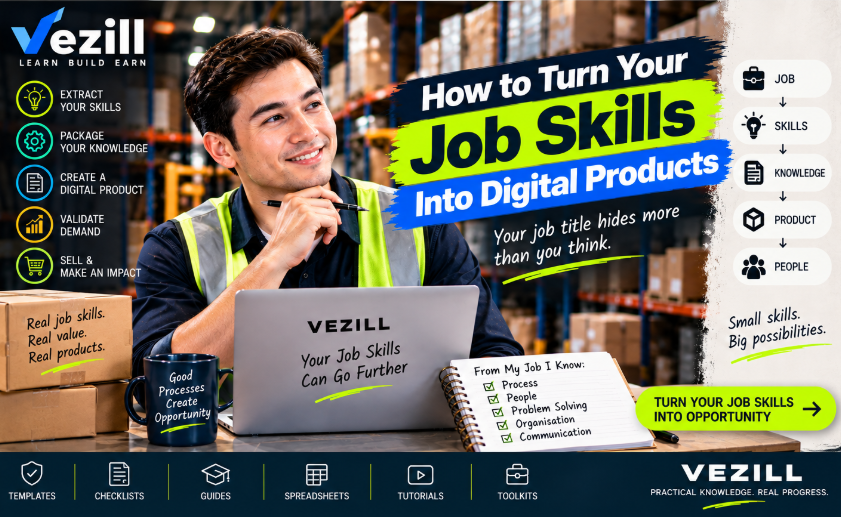
A practical framework for finding transferable knowledge inside your job, packaging it responsibly, and testing whether it can become a useful digital product.
A delivery truck backs toward the warehouse bay while cartons move into the receiving area. A junior employee watches David compare the delivery information, inspect what arrived and organize what needs attention.
“David, how do you know what to check first?” the junior employee asks. David answers almost automatically. Some checks happen before anything is put away. Some discrepancies need documenting immediately. Some issues can wait. Some details a beginner forgets because nobody has yet taught them what matters.
David has worked around warehouse and inventory operations for about eight years. Ask what digital knowledge he could package and he might say: “I don’t create anything. I just work in a warehouse.”
YOUR JOB TITLE HIDES THE SKILLS INSIDE YOUR JOB. QUICK ANSWER: Break your job into tasks, processes, decisions, tools, recurring problems and lessons. Identify which knowledge is transferable, original and safe to share. Match one skill to a specific problem, choose the format that makes the solution easiest to apply, and validate demand before investing heavily.A job title is an organizational label. The work itself contains actions, decisions, communication patterns, tools and repeated problem-solving. For David, “warehouse coordinator” contains inventory organization, receiving procedures, documentation, prioritization, staff coordination, stock checking, handover communication, problem detection, spreadsheet use, dispatch preparation, training and record keeping.
YOUR JOB TITLE IS THE CONTAINER. YOUR SKILLS ARE INSIDE IT.VEZILL’s guide to identifying valuable knowledge similarly looks for repeated problems, questions, mistakes and improved processes. Research on tacit knowledge and practical intelligence helps explain why practiced know-how can become partly automatic until someone makes it explicit.
 Your Job Is a Bundle of Skills
Tasks: What do you repeatedly do? Decisions: What do you regularly decide? Problems: What are you expected to solve? Tools: What software or equipment can you use competently? Documents: What do you prepare? Communication: Which conversations have you learned to handle? Mistakes: What errors can you spot quickly? Training: What do you teach new people? Improvements: Which legitimate efficiencies have you learned? Context: What does experience help you notice?
IF YOU HAVE EVER TRAINED A NEW EMPLOYEE, YOU HAVE PROBABLY ALREADY DISCOVERED KNOWLEDGE THAT IS NOT OBVIOUS TO A BEGINNER. The VEZILL Job Skill Extraction Map
Imagine a completely new person starts your role tomorrow. What must they know before they start, on day one, in week one, after their first mistake, when using tools, when communicating, when solving problems and when checking quality? This reveals knowledge that experienced workers often compress into habit.
But not everything taught internally belongs to the employee. A useful skill can be transferable while a particular employer document, dataset, manual, template or proprietary process remains restricted.
These are starting hypotheses, not promises of demand. Each connects a real work capability to a user problem and possible format.
Skill: organizing recurring office tasks.
Who may need it: small teams.
Problem: routine duties are forgotten.
Possible product: Weekly Office Operations Checklist.
Format: checklist.
Skill: preparing meetings.
Who may need it: new assistants.
Problem: meetings begin without the right information.
Possible product: Meeting Preparation Pack.
Format: template + checklist.
Skill: handling recurring visitor questions.
Who may need it: small offices.
Problem: front-desk responses vary.
Possible product: Visitor Reception Script Pack.
Format: scripts.
Skill: organizing document filing.
Who may need it: small organizations.
Problem: documents are difficult to retrieve.
Possible product: Digital Filing Structure Guide.
Format: guide.
Skill: categorizing common enquiries.
Who may need it: small online sellers.
Problem: the same questions consume time.
Possible product: Customer Enquiry Response Library.
Format: script pack.
Skill: handover communication.
Who may need it: small support teams.
Problem: open cases lose context.
Possible product: Support Shift Handover Template.
Format: template.
Skill: preparing for difficult conversations.
Who may need it: new service staff.
Problem: tense calls lack structure.
Possible product: Difficult Conversation Worksheet.
Format: worksheet.
Skill: qualifying leads.
Who may need it: new salespeople.
Problem: time is spent on poorly matched prospects.
Possible product: Lead Qualification Sheet.
Format: worksheet.
Skill: preparing client check-ins.
Who may need it: junior account managers.
Problem: meetings lack structure.
Possible product: Client Check-In Planner.
Format: planner.
Skill: explaining product choices.
Who may need it: new retail staff.
Problem: customers receive inconsistent explanations.
Possible product: Product Comparison Framework.
Format: framework.
Skill: preparing shift handovers.
Who may need it: small hotels and beginner receptionists.
Problem: guest information gets lost between shifts.
Possible product: Front Desk Shift Handover Template.
Format: template + checklist.
Skill: opening a service shift.
Who may need it: new supervisors.
Problem: opening duties are handled from memory.
Possible product: Restaurant Shift-Opening Checklist.
Format: checklist.
Skill: organizing room-turnover checks.
Who may need it: small hospitality teams.
Problem: quality checks vary.
Possible product: Room Turnover Quality Checklist.
Format: checklist.
Skill: collecting event requirements.
Who may need it: first-time coordinators.
Problem: important client details are missed.
Possible product: Event Requirements Questionnaire.
Format: questionnaire.
Skill: receiving stock.
Who may need it: small retail and warehouse teams.
Problem: deliveries lack a consistent check.
Possible product: Goods Receiving Checklist.
Format: checklist.
Skill: preparing stock counts.
Who may need it: small retailers.
Problem: counts begin without preparation.
Possible product: Stock Count Preparation Checklist.
Format: checklist.
Skill: preparing outgoing orders.
Who may need it: small fulfillment teams.
Problem: dispatch details are missed.
Possible product: Dispatch Readiness Checklist.
Format: checklist.
Skill: shift handovers.
Who may need it: small warehouse teams.
Problem: pending tasks lose context.
Possible product: Warehouse Shift Handover Template.
Format: template.
Skill: opening and closing a store.
Who may need it: new shop supervisors.
Problem: routine controls are inconsistent.
Possible product: Retail Opening & Closing Checklist.
Format: checklist.
Skill: tracking reorder points.
Who may need it: micro-retailers.
Problem: stock-outs are noticed too late.
Possible product: Simple Reorder Tracker.
Format: spreadsheet.
Skill: organizing till handover.
Who may need it: small retailers.
Problem: cash-desk handovers lack structure.
Possible product: Till Handover Worksheet.
Format: worksheet.
Skill: collecting content information from clients.
Who may need it: new freelancers.
Problem: clients provide vague material.
Possible product: Client Content Questionnaire.
Format: template.
Skill: preparing campaign briefs.
Who may need it: small marketing teams.
Problem: objectives and assets are unclear.
Possible product: Campaign Brief Builder.
Format: worksheet.
Skill: turning business stories into content angles.
Who may need it: small-business marketers.
Problem: content becomes generic.
Possible product: Story-to-Content Framework.
Format: workbook.
Skill: planning campaign QA.
Who may need it: junior marketers.
Problem: links and segments are missed.
Possible product: Email Pre-Send Checklist.
Format: checklist.
Skill: collecting design requirements.
Who may need it: new designers.
Problem: projects start from vague requests.
Possible product: Design Brief Questionnaire.
Format: template.
Skill: preparing clients for a shoot.
Who may need it: new photographers.
Problem: clients arrive unprepared.
Possible product: Photo Session Preparation Guide.
Format: guide.
Skill: organizing revision feedback.
Who may need it: freelance editors.
Problem: feedback is scattered.
Possible product: Video Revision Tracker.
Format: tracker.
Skill: collecting website content.
Who may need it: new freelancers.
Problem: projects stall waiting for material.
Possible product: Website Content Collection Kit.
Format: toolkit.
Skill: running pre-release checks.
Who may need it: junior software teams.
Problem: basic defects escape ad hoc checks.
Possible product: Release QA Checklist.
Format: checklist.
Skill: collecting diagnostic context.
Who may need it: junior help-desk staff.
Problem: tickets lack useful details.
Possible product: IT Issue Intake Questionnaire.
Format: questionnaire.
Skill: preparing recurring reports.
Who may need it: junior analysts.
Problem: reports lack decision context.
Possible product: Analytics Reporting Template.
Format: template.
Skill: organizing monthly business documents.
Who may need it: small-business owners.
Problem: records are disorganized before bookkeeping.
Possible product: Monthly Bookkeeping Preparation Checklist.
Format: checklist.
Skill: tracking invoice follow-up.
Who may need it: small service businesses.
Problem: unpaid invoices are followed inconsistently.
Possible product: Invoice Follow-Up Tracker.
Format: spreadsheet.
Skill: organizing expense evidence.
Who may need it: microbusiness owners.
Problem: expense records lack support.
Possible product: Expense Documentation Checklist.
Format: checklist.
Skill: planning a lesson sequence.
Who may need it: new teachers.
Problem: lessons lack clear progression.
Possible product: Lesson Planning Worksheet.
Format: worksheet.
Skill: diagnosing learner gaps.
Who may need it: new tutors.
Problem: sessions start without identifying weak areas.
Possible product: Learner Gap Interview Sheet.
Format: questionnaire.
Skill: coordinating term-opening tasks.
Who may need it: small schools.
Problem: opening tasks are scattered.
Possible product: Term-Opening Admin Checklist.
Format: checklist.
Skill: preparing candidates for interviews.
Who may need it: job seekers.
Problem: preparation is random.
Possible product: Interview Preparation Workbook.
Format: workbook.
Skill: collecting onboarding information.
Who may need it: small employers.
Problem: new-hire administration varies.
Possible product: New Hire Admin Checklist.
Format: checklist.
Skill: structuring role requirements.
Who may need it: small-business owners.
Problem: job descriptions are vague.
Possible product: Role Requirements Worksheet.
Format: worksheet.
Skill: documenting repeatable workflows.
Who may need it: small teams.
Problem: process knowledge lives in heads.
Possible product: Simple SOP Builder.
Format: template.
Skill: organizing routine inspections.
Who may need it: small offices.
Problem: maintenance checks are reactive.
Possible product: Facilities Inspection Checklist.
Format: checklist.
Skill: tracking dependencies.
Who may need it: small project teams.
Problem: blocked tasks are discovered late.
Possible product: Project Dependency Tracker.
Format: tracker.
Skill: collecting a client brief.
Who may need it: new writers.
Problem: projects start with unclear expectations.
Possible product: Writing Client Brief Template.
Format: template.
Skill: defining project scope.
Who may need it: new consultants.
Problem: scope expands after agreement.
Possible product: Scope Definition Worksheet.
Format: worksheet.
Skill: organizing client onboarding.
Who may need it: new VAs.
Problem: access and priorities are unclear.
Possible product: VA Client Onboarding Kit.
Format: toolkit.
Skill: organizing non-hazardous job preparation and documentation.
Who may need it: apprentices and trade-business owners.
Problem: tools and paperwork are not organized.
Possible product: Job Preparation & Documentation Checklist.
Format: checklist.
Skill: planning material lists.
Who may need it: beginner woodworkers.
Problem: materials are estimated informally.
Possible product: Project Materials Planning Worksheet.
Format: worksheet.
Skill: collecting garment-order requirements.
Who may need it: new tailoring businesses.
Problem: measurements and deadlines are poorly documented.
Possible product: Garment Order Intake Form.
Format: template.
Ask ten questions: Did I genuinely learn this? Have I done it repeatedly? Can I explain it without confidential information? Does it exist beyond my employer? Would a beginner or small business find it useful? Can it solve a specific problem? Can I package it without overstating qualifications? Can I create original material? Can I explain the limits? Is there evidence people need it?
JOB-SPECIFIC + CONFIDENTIAL → DO NOT PACKAGEYou may know how to structure a shift handover; do not simply copy your employer’s confidential handover document. You may understand inventory-count principles; do not sell internal stock records. You may understand customer-service organization; do not export private customer conversations. You may know onboarding principles; do not copy proprietary training manuals.
PACKAGE THE LESSON. DO NOT STEAL THE DOCUMENT.Ownership depends on jurisdiction, contracts and facts. As one authoritative example, the U.S. Copyright Office explains that qualifying work created by an employee within the scope of employment can be treated as work made for hire under U.S. law. The USPTO separately provides trade-secret policy resources. These are boundaries to investigate, not universal legal advice.
 Employer Knowledge vs Transferable Knowledge
This is a decision framework, not a guarantee. Distribution, price, competition, trust and execution still matter.
 The Job-Skill-to-Product Engine
Repeated steps → Checklist. Repeated document → Template. Tracking → Spreadsheet. Training beginners → Guide or micro-course. Repeated questions → Script pack or guide. Decisions → Framework. Planning → Workbook. Standard process → SOP starter. Software → Tutorial. Repeated AI workflow → Prompt workflow. Several resources → Toolkit.
DO NOT CREATE AN EBOOK JUST BECAUSE “EBOOK” SOUNDS LIKE A DIGITAL PRODUCT.VEZILL’s current About page makes the same distinction: the format is secondary to the useful knowledge inside it.
Extract ten knowledge assets before naming products. Product design comes after knowledge extraction.
Act as a structured job-skill extraction interviewer. Do not generate product ideas yet.

Interview me ONE question at a time about my job title, responsibilities, daily and weekly tasks, tools, documents, repeated decisions, repeated problems, customer interactions, training others, common mistakes, troubleshooting, improvements and lessons from experience.

PHASE 1 — Extract only what I actually tell you into skills, processes, decisions, lessons and tools.
PHASE 2 — Suggest narrow audiences and problems. Label them hypotheses.
PHASE 3 — Match strong skills to useful formats such as checklists, templates, spreadsheets, guides, workbooks, tutorials, prompt workflows or toolkits.
PHASE 4 — State what evidence is still needed before assuming demand.
PHASE 5 — Flag employer-owned documents, confidential information, customer data, trade secrets, IP, privacy, unsafe instructions or regulated advice.

Never invent my experience, qualifications, customers, results or demand. Do not ask me to upload confidential employer documents.
Do not paste confidential employer files, customer records, passwords or trade secrets into AI systems. For ChatGPT specifically, current OpenAI Data Controls guidance says users can turn off “Improve the model for everyone”; privacy settings still do not give you permission to upload information you do not have the right to share.
Warehouse coordinator → Goods Receiving Checklist. Extract the general preparation, checks, discrepancy documentation and handoff David genuinely understands. Do not copy his employer’s SOP, supplier list or inventory records. Validate whether small retail or warehouse teams experience the problem and whether a checklist is sufficient.
Hotel receptionist → Front Desk Handover Template. Extract general continuity categories and workflow. Do not copy guest records or proprietary hotel forms. Validate with the intended hospitality users.
Social media manager → Client Content Questionnaire. Extract the questions that reveal offers, stories, objections and usable content. Do not expose private client strategy. Test whether the questionnaire actually reduces back-and-forth.
Recruiter → Interview Preparation Workbook. Extract general preparation methods, not confidential candidate data, internal scoring systems or employer-specific selection criteria. Validate with a narrow job-seeker segment.
Bookkeeper → Monthly Records Preparation Checklist. Extract document-organization know-how, not individualized tax advice outside competence. Validate whether the checklist saves small-business users meaningful time or confusion.
For broader workflows, see turning what you know into a digital product and turning work experience into a digital product.
Research repeated search questions, communities, existing products, reviews, complaints and conversations with intended users. Test a small prototype. Distinguish interest from purchase intent and purchase intent from actual purchase.
VEZILL’s skill-monetization guide similarly emphasizes problem, buyer, offer and proof rather than assuming capability alone creates a market.
Do not productize passwords, security credentials, customer databases, private employee information, internal financial information, confidential strategy, proprietary formulas, trade secrets, employer-owned manuals, copyrighted documents you do not control, fraudulent methods, security-bypass instructions, confidential government information or regulated advice outside your competence.
YOUR CAREER CAN GIVE YOU KNOWLEDGE WITHOUT GIVING YOU OWNERSHIP OF EVERYTHING YOU TOUCHED AT WORK.In Kenya, the Office of the Data Protection Commissioner defines personal data broadly, while the Data Protection Act framework governs processing and data-subject rights. Customer lists, employee details and identifiable records should not be treated as product raw material.
Local professional experience can contain useful context around M-PESA business routines, retail, hospitality, church administration, events, logistics, job seeking, customer service, digital marketing, chama administration, property operations and informal-business workflows. Context can make a resource more relevant when generic global advice misses local realities.
LOCAL CONTEXT CAN BE PART OF THE PRODUCT’S VALUE.When the product touches tax, employment, data protection, regulated finance or another changing legal area, verify current official sources and use qualified advice where required.
David can now see a goods-receiving checklist, stock-count preparation sheet, shift-handover template, new-assistant guide, dispatch checklist, discrepancy form, daily task planner, inventory workbook, damaged-goods log, stock-location planner, supplier-delivery preparation sheet and training checklist.
He does not build all twelve. He scores them for competence, problem clarity, ability to explain without employer material, usefulness, safety, ease of testing and evidence of need. One hypothesis survives: Goods Receiving Checklist for Small Retail and Warehouse Teams. It is narrow, the checklist format fits the task, and he can create an original version from general knowledge. He still needs validation.
“I JUST WORK IN A WAREHOUSE.” → 8 YEARS OF EXPERIENCE → REPEATED TASKS → TRANSFERABLE SKILLS → USEFUL KNOWLEDGE → PRODUCT HYPOTHESISVEZILL describes itself as a digital knowledge marketplace connecting people who know how with people who need to know how.
YOUR JOB → SKILLS → KNOWLEDGE → PACKAGE → DIGITAL PRODUCT → VEZILL → ACCESS → LEARN → APPLY YOUR KNOWLEDGE IS THE VALUE.Explore the VEZILL homepage and VEZILL Products. Continue with How to Sell Your Knowledge Online, What Can I Create and Sell Online Using AI?, How to Use ChatGPT to Turn Your Knowledge Into an Ebook and Why Human Experience Still Matters in the Age of AI.
Potentially. Extract a transferable skill, match it to a specific problem, create original material and validate demand while respecting employment and IP boundaries.
Repeated processes, planning systems, training methods, communication frameworks, checklists, tracking systems, software workflows and beginner explanations are common starting points.
General know-how may sometimes be reusable, but contracts, confidentiality, trade secrets, copyright and local law can restrict what you share.
Do not assume so. Employer documents may be copyrighted, confidential, proprietary or contractually restricted.
Find a specific person with a recurring problem your skill can help solve, then gather evidence through research and real user behavior.
Checklists, templates, spreadsheets, trackers, workbooks, guides, tutorials, SOP starters, scripts, frameworks, prompt workflows and toolkits.
No, but review your employment contract, conflict-of-interest rules, confidentiality duties and applicable law.
Yes, when the scope matches what they genuinely know and they describe their competence honestly.
Yes. AI can interview you, organize knowledge and expose gaps, but should not invent experience or receive confidential workplace information.
Research repeated questions and alternatives, interview intended users, test a small prototype and look for meaningful behavior.
Passwords, customer or employee personal data, trade secrets, confidential strategy, proprietary records, restricted documents and information you lack rights to share.
You can use your own distribution channel or an appropriate marketplace. VEZILL is built around practical knowledge products.
At the beginning, David could answer a junior employee’s receiving question almost without thinking. Repetition had turned parts of his knowledge into habit. Breaking the job apart made those skills visible.
He did not copy an employer SOP. He did not export inventory data. He did not ask AI to fabricate expertise. He extracted one general process he understood, matched it to a narrow problem, chose a format that fit the task and treated the result as a hypothesis that still needed testing.
DAVID DID NOT NEED TO INVENT A NEW CAREER.Start with one job. Break it into tasks. Find one skill. Identify one problem. Package only what you legitimately know and can responsibly share. Then let market evidence decide what deserves to become a product.
VEZILLDiscover practical guides, templates and tools—or start extracting useful knowledge from the work you already know how to do.
EXPLORE VEZILL →Discover more articles you might be interested in

how to create your first knowledge product in one weekend
By Davie

how to build multiple digital products from one skill
By Davie

how to find problems people will pay you to solve
By Davie

How to turn a hobby into a digital product
By Davie
Get the updates, on newly released, popular & fast-moving MRR digital products
Up to Top