
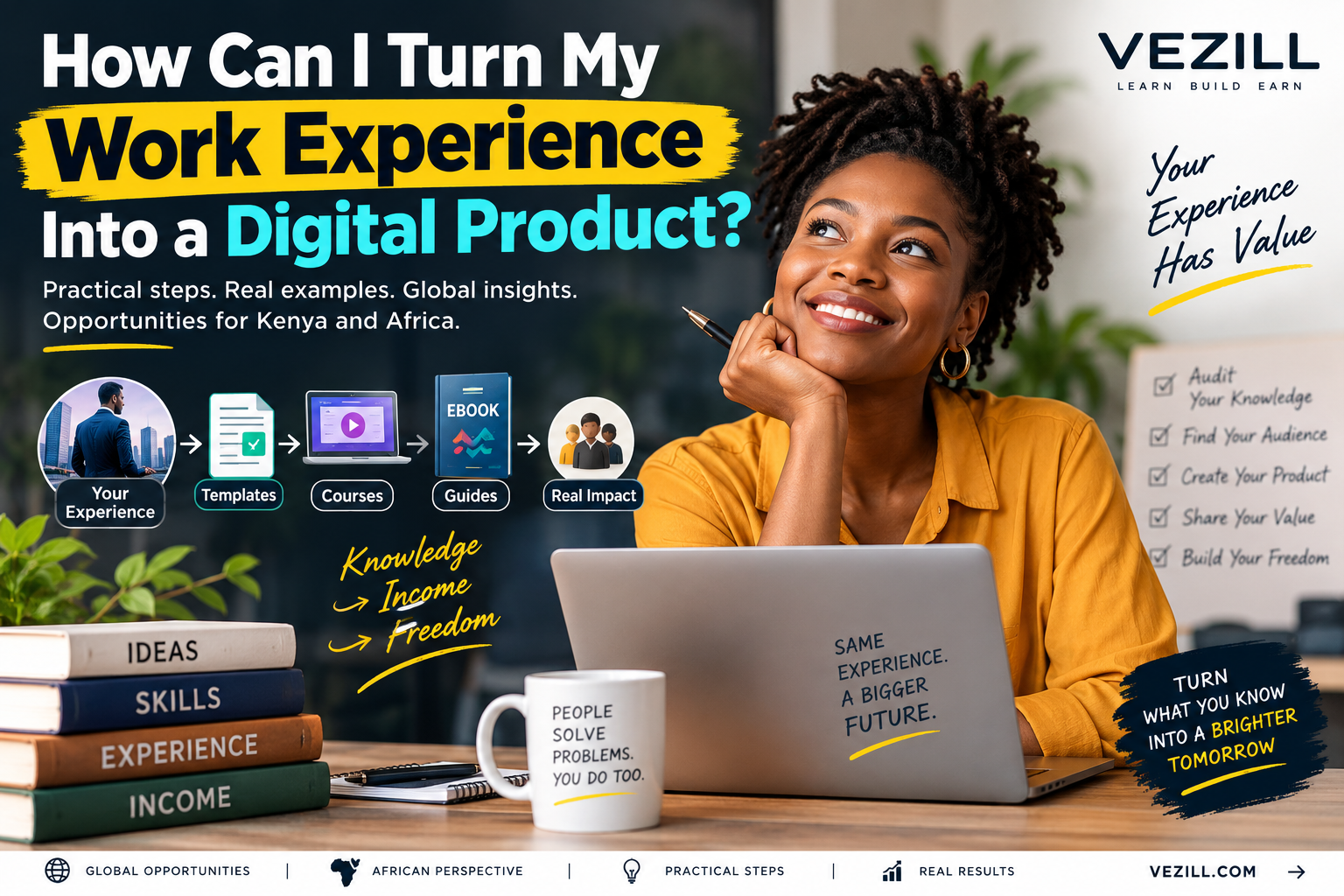
Your career may already contain the raw material for a useful digital product. The challenge is not simply to “write an ebook about what you know.” It is to identify one repeatable problem you understand, extract a method that belongs to you, remove employer or client information, choose a specific buyer, and package the solution in the format that makes the task easier.
Quick AnswerTo turn work experience into a digital product, identify a problem you repeatedly solved, choose a specific person who needs that solution, extract your method without using confidential or employer-owned material, convert it into a suitable format, validate demand, create a useful minimum version, price it according to the problem and buyer, publish it and improve it using customer feedback.
EXPERIENCE → REPEATED PROBLEM → PERSONAL METHOD → TARGET USER → USEFUL OUTCOME → PRODUCT FORMAT → VALIDATION → CREATION → SALE → IMPROVEMENTWork experience does not automatically become a valuable product. Demand, purchasing power, usefulness, accuracy, differentiation, pricing, trust, distribution, competition, support and execution all matter. The goal is not to sell “years of experience.” The goal is to convert selected experience into a shortcut, system, tool or explanation that another person can use.
It means transforming knowledge gained through real work into a repeatable digital resource that can help more than one buyer solve a defined problem without requiring you to redo the entire job from scratch each time.
Raw experience is personal. A sellable product is organized for somebody else. If you managed restaurant inventory for five years, “I know restaurant inventory” is experience. “A stock-count spreadsheet, weekly reconciliation checklist and setup guide for small restaurant owners” is a possible product. If you want the broader idea-to-product workflow, VEZILL’s guide to creating a digital product with AI is a useful companion, but your own judgement and original method still have to be central.
| Model | Personalization | Customer involvement | Repeatability | Support | Best use |
|---|---|---|---|---|---|
| Raw experience | Personal | None | Low | None | Your accumulated know-how |
| General advice | Low | Low | High | Low | Education and awareness |
| Freelance service | High | High | Low | High | Client-specific execution |
| Consulting | High | High | Medium | High | Judgement and recommendations |
| Productized service | Medium | Medium | Medium-high | Medium | Repeated client problem with a defined process |
| Digital product | Low | Low | High | Low-medium | Reusable solution, tool or resource |
| Online course | Low-medium | Low-medium | High | Medium | Structured skill development |
| Membership/support | Medium | Ongoing | Medium | High | Continuing updates or guidance |
A digital product is also not automatically passive income. You may still need updates, customer support, marketing, refunds, file maintenance, licensing administration and quality control.
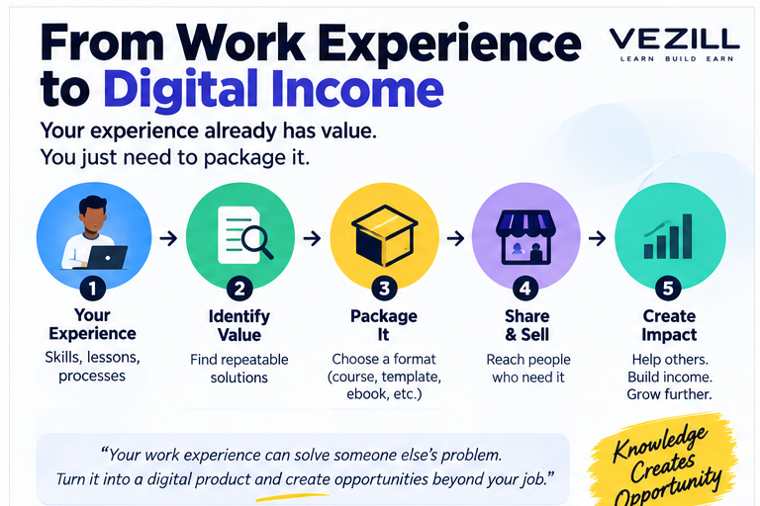 Experience becomes commercially useful when a repeated problem is converted into a usable, validated solution.
The best raw material is usually not the most impressive project on your CV. It is the repeated work that beginners, customers or colleagues find difficult: questions you answer often, mistakes you keep correcting, decisions you make from experience, files you recreate, checklists you mentally follow, or manual tasks that can be simplified.
| Work activity | Repeated problem | Existing method | Potential buyer | Possible product |
|---|---|---|---|---|
| Teacher prepares revision lessons | Learners revise without structure | Topic-priority and practice routine | Students or tutors | Revision planner + practice checklist |
| HR officer screens candidates | Small firms interview inconsistently | Role scorecard and question sequence | Small-business managers | Interview toolkit |
| Bookkeeper closes monthly records | Owners submit incomplete records | Document request and reconciliation process | Small businesses | Monthly records checklist + tracker |
| Digital marketer plans campaigns | Businesses post without objectives | Brief → audience → message → calendar | Solo business owners | Campaign planning workbook |
| VA organizes inboxes | Consultants lose follow-ups | Labels, response rules, follow-up tracker | Independent consultants | Inbox organization toolkit |
| Data analyst prepares reports | Teams struggle to turn raw exports into summaries | Clean → check → calculate → visualize | Operations teams | Reporting spreadsheet + guide |
| Farmer records crop activity | New farmers cannot compare costs and field activities | Field log and input tracking routine | Smallholder farmers | Farm record workbook |
Other roles can generate similar ideas: sales professionals can turn objection-handling patterns into a script library; hospitality workers can create shift handover or stock checklists; project managers can build planning templates; graphic designers can create original briefing systems; developers can create starter kits or code they personally own; church and nonprofit administrators can build event-planning templates using fictional data; consultants can convert repeated diagnostic questions into assessment tools.
If you work in technology, VEZILL’s article on building digital assets alongside a career gives useful context for why reusable resources, software and templates can create options beyond a CV.
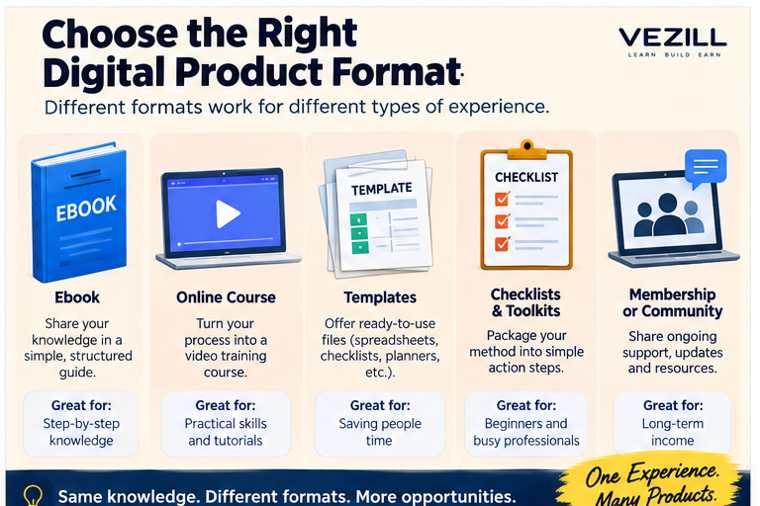 Audit what you repeatedly solved, explained, followed and created before deciding what to sell.
Experience becomes commercially useful when it helps a defined person save time, avoid a mistake, understand a process, make a better decision, complete a task, organize information, improve consistency or learn a practical skill.
Use this test before building anything: Who has the problem? How often does it happen? What happens if it remains unsolved? What do people use now? Are they already spending money or serious time on the problem? Can your method create a clear improvement? Can it be delivered digitally? Can you create it legally and ethically? Can the buyer understand the value quickly? Can you actually reach that buyer?
Validation matters because being experienced is different from being useful to a buyer. VEZILL’s digital-product validation guide is worth reviewing before you invest heavily in design or production.
Turn tacit knowledge—the things you “just know” after doing a job repeatedly—into a system a beginner can follow. Start with one supported result, describe the starting situation, list the decisions you normally make, record the steps in their real order, identify inputs, common mistakes, quality checks, exceptions and limitations, then test whether a beginner can use the method without you filling in missing steps.
“I know how to do this” → INPUT → DECISION → ACTION → CHECK → OUTPUTHypothetical Kenyan workplace example: an office administrator in Nairobi organizes supplier quotations every month. Their real expertise may be the decision process: required request details → supplier response log → comparison fields → missing-document check → approval pack. They could independently create a blank quotation-comparison spreadsheet and instructions for small organizations, provided they do not copy the employer’s file, suppliers, prices, branding, internal approval rules or private communications.
The product should be designed for a specific person in a specific situation, not “everyone who wants success.” A beginner entering your profession, a small-business owner doing a task alone, a junior employee, freelancer, job seeker, student, manager training a team, nonprofit administrator or someone moving from manual to digital work may all need different versions.
Positioning sentence: This product is for [specific person] who needs to [complete action or solve problem] without [important obstacle].For example: “This toolkit is for independent Kenyan consultants who need to track enquiries and follow-ups without buying a full CRM.” That is more useful than “productivity toolkit for professionals.”
Choose the format that best delivers the solution. A reader who needs to calculate does not primarily need an ebook. A manager who needs a reusable document may value a template more than a two-hour course.
| Format | Best problem type | Creation difficulty | Updates/support | Do not use when… |
|---|---|---|---|---|
| Ebook / short guide | Understanding a process | Low-medium | Update facts periodically | The buyer mainly needs a tool |
| Checklist / SOP | Repeatable execution | Low | Low | Judgement is highly situational |
| Template | Creating a document | Low-medium | Low-medium | Users cannot adapt it safely |
| Spreadsheet / calculator | Tracking, comparing, calculating | Medium | Version compatibility matters | Formula errors could create serious harm |
| Workbook | Guided reflection or planning | Medium | Low | The task needs live feedback |
| Swipe file / script library | Adaptable wording | Low-medium | Examples need refreshing | Copy-paste use could mislead or violate policy |
| SOP pack / toolkit | Connected operational tasks | Medium-high | Medium | The buyer only needs one narrow resource |
| Notion workspace | Organizing connected information | Medium | Platform changes may require updates | Users do not use Notion |
| Canva / presentation template | Repeated visual communication | Medium | Asset licensing matters | You do not own the design elements |
| Prompt library | Structured AI-assisted tasks | Low-medium | High; models change | Prompts replace necessary professional judgement |
| Video tutorial / mini-course | Demonstration and skill practice | Medium-high | Higher support/update load | The task can be solved with a one-page tool |
| Resource directory | Finding vetted options | Medium | High | Links cannot be maintained |
| Assessment / decision framework | Choosing among options | Medium-high | Needs careful boundaries | The decision requires licensed professional advice |
If product creation itself is the missing skill, Inceptor currently has a Digital Product Trading Masterclass with AI. Review the provider page directly for current details before relying on fees, schedules, certification or availability.
 Format follows the job the buyer needs to complete—not the format you personally enjoy making.
You can often use your general skills, personal lessons, public information and independently recreated methods. You should not assume that documents, code, templates, databases, reports, client information, internal training materials, unpublished strategies, private financial information, licensed assets or other work created in employment belongs to you personally.
In Kenya, copyright law states that work made in the course of employment can be deemed transferred to the employer, subject to the agreement between the parties. This is one reason to review your employment agreement, freelance contract, confidentiality terms, intellectual-property clauses and workplace policies before selling anything based on work materials. This article is general educational information, not legal advice.
A safe approach is to ask: “Could I recreate this from my own general knowledge, from a blank page, without copying the company’s expression, data, branding, code or confidential process?” Even then, your contract may impose additional duties. Where ownership or confidentiality is uncertain, obtain qualified legal advice.
 General know-how is not the same thing as permission to reuse employer or client materials.
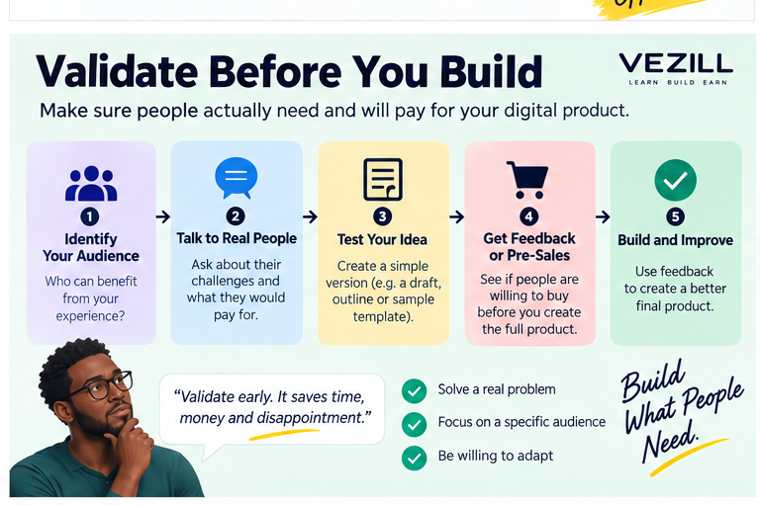
Validation tests the problem, buyer, promise, format and willingness to act. It is stronger than asking friends whether the idea “sounds good.” Interview target users, study repeated questions, examine competing products, publish a useful tutorial, offer a free checklist, create a waitlist, share the outline, run a workshop, offer a paid pilot or responsibly pre-sell a clearly described product.
Collect evidence such as specific questions, email sign-ups, downloads, replies, requests for examples, deposits, paid pilots, pre-orders, repeated objections and actual use of a sample. Likes and compliments are weak signals unless they lead to meaningful action. If you need a broader market view, VEZILL also covers digital-product demand in Kenya; treat broad market lists as idea sources, not proof that your exact product will sell.
Build the smallest complete version that solves one narrow problem. “Minimum” should reduce scope, not quality.
ONE CUSTOMER + ONE PROBLEM + ONE USEFUL OUTCOME + ONE COMPLETE SOLUTIONInclude clear instructions, necessary examples, usable tools, limitations, required inputs, quality checks, file instructions, licensing terms, version information and support details where relevant. Test it with a few target users before adding bonuses or expanding into a large course.
VEZILL’s Sell Your First Digital Product is one example of a beginner-focused resource that currently describes idea validation, creation, pricing, listing and launch. Check the product page and licence before assuming any resale or reuse rights.
AI is useful as an interviewer, organizer and editor. It can ask you structured questions about your method, group notes, expose missing steps, produce an outline, simplify explanations, draft fictional practice scenarios, create FAQ drafts, check consistency and repurpose finished material into marketing drafts.
AI should not invent your career experience, fabricate case studies or testimonials, expose employer data, reproduce confidential documents, copy protected materials, manufacture qualifications or replace required professional review. The strongest AI-assisted product still depends on your judgement, examples, method and quality control. For a broader business context, see VEZILL’s article on how AI can support small businesses and digital products.
If your main gap is visual presentation rather than subject knowledge, Inceptor currently lists a Graphic Design with AI course. Verify current course details directly before enrolling.
Build proof from material you are allowed to show: a fictional example clearly labelled as fictional, an independently created demonstration, a personal project, invented data, public information, a process walkthrough, sample pages, an anonymized case study with written permission, a paid pilot, a quality checklist or relevant qualifications.
Never fabricate results, invent customers, use unauthorized screenshots, display employer logos without permission, steal templates or reveal private analytics. If your product is data-related and your skills need strengthening, Inceptor currently lists a Data Analytics course; verify the provider’s current curriculum, fees and availability on the page.
Price should reflect the buyer, problem, specificity, product quality, time saved, alternatives, included tools, support, updates, licensing rights and your credibility—not page count alone. Use cost-informed, competitor-informed and value-informed pricing together rather than picking a number from a viral post.
Hypothetical Kenya examples only—not standard VEZILL or Kenyan market prices: a narrow checklist might be tested at KSh 400–900; a specialized spreadsheet and instruction pack at KSh 1,200–3,500; a deeper toolkit with templates and video walkthrough at KSh 3,000–8,000. These are illustrations to show pricing logic, not market benchmarks. A business-use licence may reasonably cost more than personal use because the permitted scope is broader.
Before setting a final price, compare real alternatives, speak to the intended buyer and test willingness to pay. A 12-page tool that prevents hours of repeated work can be more valuable than a 100-page ebook.
A good product description removes uncertainty. State who it is for, the problem, useful outcome, what is included, how to use it, required tools or knowledge, exclusions, file format, access, updates, support, licensing, price and one next action.
Before: “Ultimate business toolkit that will transform your productivity.”Avoid “guaranteed success,” “effortless passive income,” “secret formula,” “works for everyone” or guaranteed client and sales claims.
You need distribution, not fame. Search-optimized articles, useful LinkedIn posts, YouTube tutorials, WhatsApp communities, professional associations, newsletters, partnerships, relevant communities, workshops, referrals, direct outreach and marketplaces can all create discovery.
Think in six channels: owned audience, borrowed audience, search discovery, partnerships, direct outreach and marketplace discovery. VEZILL’s guide to marketing digital products provides additional channel ideas, while its article on digital entrepreneurship with AI is useful if you want to connect a knowledge product to a broader business model.
Trust and relevance matter more than spam. Teach something useful, demonstrate the product, answer objections honestly and give buyers enough information to decide whether it fits them.
Client work is one of the best places to observe repeated problems because you see what people repeatedly ask, misunderstand, need delivered or need explained.
CLIENT WORK → REPEATED PROBLEM → REPEATABLE PROCESS → DOCUMENTED METHOD → TEMPLATE OR GUIDE → VALIDATED DIGITAL PRODUCTA social-media service can produce an original content-planning template; virtual-assistant work can reveal an inbox organization toolkit; web-design work can lead to a website-content checklist; bookkeeping can lead to a records-preparation spreadsheet; recruitment can reveal an interview toolkit; data-analysis work can lead to a reporting template; training can become a mini-course.
If you are still standardizing the service itself, first package your freelance service. A clear, repeated service process makes it easier to see which elements could later become a reusable product.
The following examples are hypothetical. They are not verified customers, standard prices or guaranteed opportunities.
Experience: preparing revision lessons. Repeated problem: learners revise randomly. Target customer: secondary-school learners or private tutors. Original insight: prioritization by syllabus area, confidence and practice frequency. Format: revision planner + checklist. Contents: weekly plan, topic tracker, practice log and reflection prompts. Outcome: more structured revision. Validation: test with learners and tutors. Proof: sample week and fictional completed planner. Exclude: copyrighted exam materials, student data and employer worksheets. Pricing: compare student purchasing power and alternatives. Distribution: tutor networks, search, education communities. Next version: subject-specific planner.
Experience: candidate screening and interviews. Problem: small firms interview inconsistently. Customer: small-business managers. Method: role criteria → structured questions → scorecard → decision notes. Format: interview toolkit. Contents: blank scorecard, question-building guide, candidate communication templates. Outcome: more consistent process. Validation: interview managers. Proof: fictional role demonstration. Exclude: real candidate data, employer forms, confidential policies and discriminatory criteria. Pricing: business-use licence. Distribution: LinkedIn, HR communities, workshops. Next: onboarding toolkit.
Experience: planning campaigns. Problem: business owners post without a plan. Customer: small local businesses. Method: objective → audience → offer → content themes → calendar → review. Format: campaign-planning workbook. Contents: brief, content calendar, KPI selection guide and review template. Outcome: clearer campaign planning. Validation: run a paid planning workshop. Proof: fictional salon campaign. Exclude: client analytics, ad accounts, creative assets and private strategy. Pricing: compare templates and consulting alternatives. Distribution: search, workshops, marketer communities. Next: industry-specific editions.
Experience: scheduling, inbox and document coordination. Problem: solo consultants lose follow-ups. Customer: independent consultants. Method: categorize → prioritize → respond → schedule → track. Format: inbox toolkit. Contents: response library, follow-up tracker and daily checklist. Outcome: more consistent enquiry handling. Validation: pilot with two consultants. Proof: invented inbox example. Exclude: real emails, contacts or client systems. Pricing: personal vs business-use licence. Distribution: LinkedIn and referrals. Next: CRM-lite workspace.
Experience: monthly reporting. Problem: operations teams struggle with raw exports. Customer: small organizations using spreadsheets. Method: import → clean → validate → summarize → visualize → check. Format: spreadsheet template + video. Contents: blank workbook, data dictionary, quality checks and walkthrough. Outcome: repeatable basic reporting. Validation: test with sample public or invented data. Proof: demonstration dashboard. Exclude: employer formulas, real databases, private KPIs and personal data. Pricing: based on complexity and support. Distribution: search and professional communities. Next: sector-specific dashboard.
Experience: handovers and stock checks. Problem: small outlets miss tasks between shifts. Customer: owner-managed shops or cafes. Method: opening checks → service checks → exception log → closing handover. Format: shift checklist pack. Contents: opening, closing, stock and incident forms. Outcome: more consistent handovers. Validation: observe owner workflows and run a sample week. Proof: fictional cafe example. Exclude: employer safety manuals, recipes, suppliers and internal loss data. Pricing: compare generic printable packs and customized services. Distribution: local business groups. Next: editable digital version.
Experience: field and input records. Problem: smallholders do not consistently record activities and costs. Customer: small farms. Method: field → activity → input → quantity → cost → observation. Format: farm record workbook. Contents: activity log, input tracker, expense sheet and monthly review. Outcome: better organized farm records. Validation: test with farmers who already keep records. Proof: fictional season data. Exclude: unsupported agronomic claims, private farm records and proprietary employer material. Pricing: reflect farmer purchasing power and alternatives. Distribution: farmer groups, cooperatives and search. Next: crop-specific edition reviewed by a qualified expert.
The goal of this week is a validated product direction and a useful first version—not guaranteed customers or sales.
Do: list repeated tasks, problems, questions and decisions from your work. How: review a typical week, not only your biggest achievements. Why: repeated friction reveals product opportunities. Evidence: at least ten repeated situations. Outcome: a shortlist of three problems.
Do: choose the group you understand and can reach. How: write the positioning sentence. Why: clarity improves validation and product design. Evidence: five real people or communities matching the audience. Outcome: one narrow customer/problem pair.
Do: document inputs, decisions, actions, checks and outputs. How: write the real sequence, including mistakes and exceptions. Why: this converts tacit knowledge into usable knowledge. Evidence: a beginner-readable workflow. Outcome: your first original framework.
Do: remove employer, client and personal information. How: review agreements and recreate materials from a blank page. Why: useful knowledge is not permission to copy workplace assets. Evidence: exclusion list and source notes. Outcome: a safer product scope.
Do: match the buyer’s task to guide, template, checklist, spreadsheet, video or service. How: interview users, show the outline or run a small pilot. Why: validation can disprove weak assumptions early. Evidence: replies, sign-ups, pilot use, deposits or objections. Outcome: a validated or revised direction.
Do: create the smallest complete version. How: include instructions, examples, limitations and quality checks. Why: usefulness matters more than size. Evidence: target-user test. Outcome: a usable version 1.
Do: create a clear product page and demonstrate one use case. How: distribute through one search/discovery channel and one conversation channel. Why: real feedback improves positioning and product quality. Evidence: questions, clicks, downloads, purchases or specific objections. Outcome: an improvement backlog and next test.
Yes, when part of that experience can be converted into an original, reusable solution for a defined buyer and you have the right to use the knowledge and materials involved.
Professionals can create original guides, checklists, templates, spreadsheets, calculators, SOP packs, workbooks, video tutorials, courses, script libraries, toolkits and decision frameworks.
Look for repeated problems that cost a specific person time, money, consistency or confidence and where your method creates a clear improvement.
Do not assume so. A template created in employment may belong to the employer or be restricted by contract. Recreate from your own general knowledge only when legally and contractually permitted, and get qualified advice if ownership is unclear.
Remove employer documents, personal data, client information, trade secrets, private analytics, proprietary code and internal strategy. Use fictional or public examples and independently created materials.
You need enough competence to create a safe, accurate and useful product for the claim you make. Do not sell guidance beyond your qualifications, especially in legal, medical, financial, tax, accounting or cybersecurity matters.
Choose based on the task: explanation favors a guide or course; repeated execution favors a checklist or SOP; document creation favors a template; tracking or calculation favors a spreadsheet.
Yes. AI can interview you, organize notes, draft structure, find gaps and help edit. It should not invent your experience, copy protected work or replace necessary professional review.
Use the problem, buyer, specificity, alternatives, time saved, product quality, support and licence scope. Do not price by page count alone.
Yes. Search, marketplaces, partnerships, communities, referrals, workshops and careful direct outreach can create distribution even when you have few followers.
Your strongest product idea may already be hiding inside work you have repeated for years. Start with one problem you understand, extract the method, decide who it is for, remove anything you do not own or should not disclose, choose the format that best delivers the solution and validate before building too much.
VEZILL can be one place to discover and publish digital products, but no marketplace guarantees traffic, customers, rankings, sales or income. Product licensing also varies: never assume that buying or finding a digital product gives you resale, modification or commercial rights. Check the specific licence.
Build the first version small enough to test, complete enough to be useful and original enough that a buyer can see why your experience matters.
Discover more articles you might be interested in

Learn where to find reliable step-by-step guides online, how to choose the right tutorial for your task, check whether it is current and follow instructions safely.
By Davie
Stop searching broad topics and start finding the exact knowledge you need. Learn how to define your problem, search smarter, choose reliable sources, verify answers and take action.
By Davie

Quick Knowledge or an online course? Learn when a focused answer is enough, when structured learning is better, and how to choose the right learning depth for your goal.
By Davie

Learn how to turn one useful digital product into multiple income streams through premium versions, bundles, courses, licensing, services, subscriptions, B2B sales and complementary products.
By Davie
Get the updates, on newly released, popular & fast-moving MRR digital products
Up to Top
Comments All
Alfred
@alfred
I really liked this idea. It’s easy to forget how much you learn from your work and that you can actually turn that knowledge into something useful online. This definitely got me thinking about what I already know and could share. 😊
September 12,2026 At 09:32 PM