
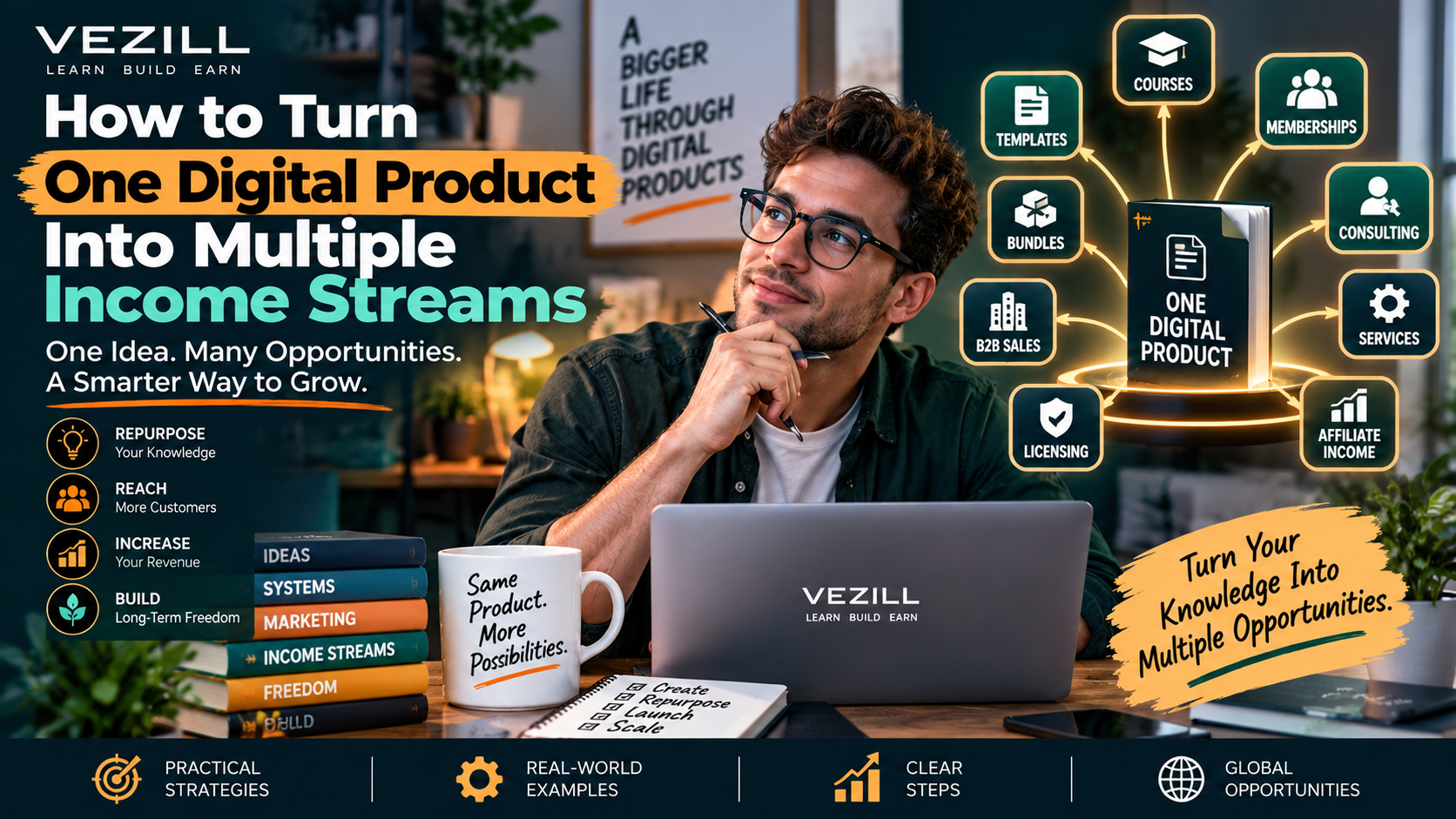
One useful digital product can become the foundation for several legitimate revenue streams—but not by selling the same information under different names. The better strategy is to identify the valuable assets inside the original product, understand what customers need next, and build genuinely different offers around the same validated problem.
A creator who has already built one useful ebook, spreadsheet, template, toolkit, course or planner has something more valuable than a file. They may have a framework, process, customer problem, workflow, design system, audience, dataset, method or trusted point of view that can support other products and services.
That distinction matters because “multiple income streams” is often explained badly. A PDF version and a video version are not automatically two businesses. Turning a guide into a course does not create new value if the course merely reads the guide aloud. A bundle is not stronger because it contains unrelated files. A subscription is not justified because recurring revenue sounds attractive.
You can turn one digital product into multiple income streams by identifying the valuable core asset inside it and adapting that value into different offers for different customer needs. A useful ebook, template, course, spreadsheet or toolkit can potentially generate revenue through direct sales, premium versions, bundles, licensing, training, services, subscriptions, affiliate recommendations, team packages and complementary products. The goal is not to duplicate the same file repeatedly, but to build a product ecosystem around one validated problem and customer outcome.
ONE PRODUCT → MANY MONETIZATION PATHS
If you are still unsure what valuable knowledge sits inside your original product, start with VEZILL's guide to identifying valuable knowledge you already have. It helps separate ordinary familiarity from knowledge that produces a useful result.
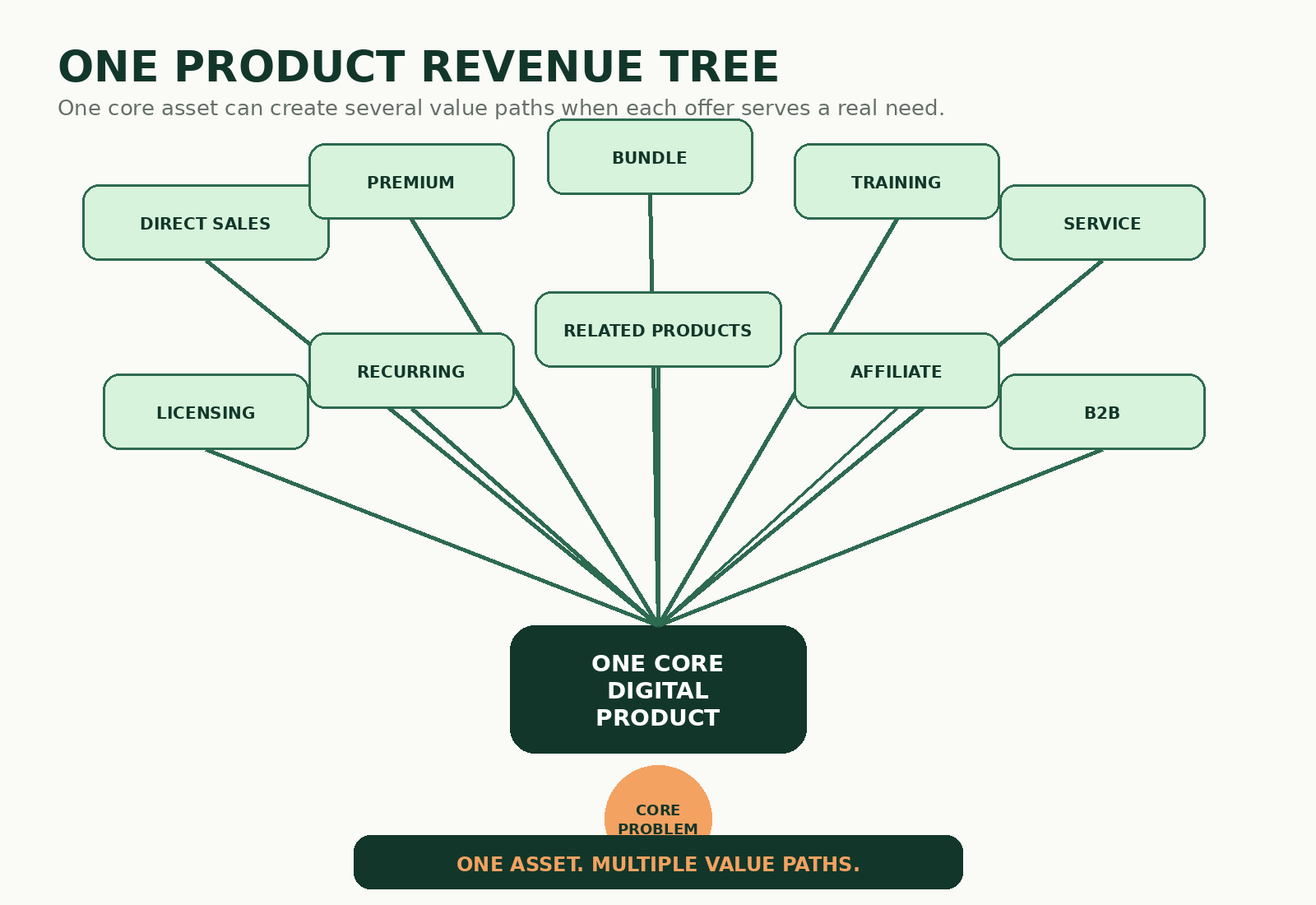 One core asset can support several value paths when each branch solves a real customer need.
Your original digital product may contain several reusable assets: information, a framework, a process, a template, data, a tool, experience, a design system, a customer problem, a customer result and the trust you have built around the topic.
Imagine an ebook called How to Manage Social Media for a Small Restaurant. Inside the ebook might be a posting calendar, caption framework, restaurant-specific examples, analytics process, weekly workflow, checklist and content strategy. Those pieces can potentially become separate tools, a training product, a premium toolkit or a service.
The principle is especially useful for professionals. VEZILL's guide to turning work experience into a digital product shows how repeated professional methods can become reusable assets without copying confidential employer or client material.
PRODUCT → ASSET → OUTCOME → NEW FORMAT → NEW BUYER / NEED → NEW OFFER
Suppose the original product is a bookkeeping guide. The deeper asset is not “a PDF.” It may be a monthly bookkeeping process. The outcome is helping a small business organize financial records. That same process could potentially become a spreadsheet, checklist, workshop, video course, business licence, consulting setup or annual update.
The important question is always: What useful thing inside the product can solve another version of the same customer problem?
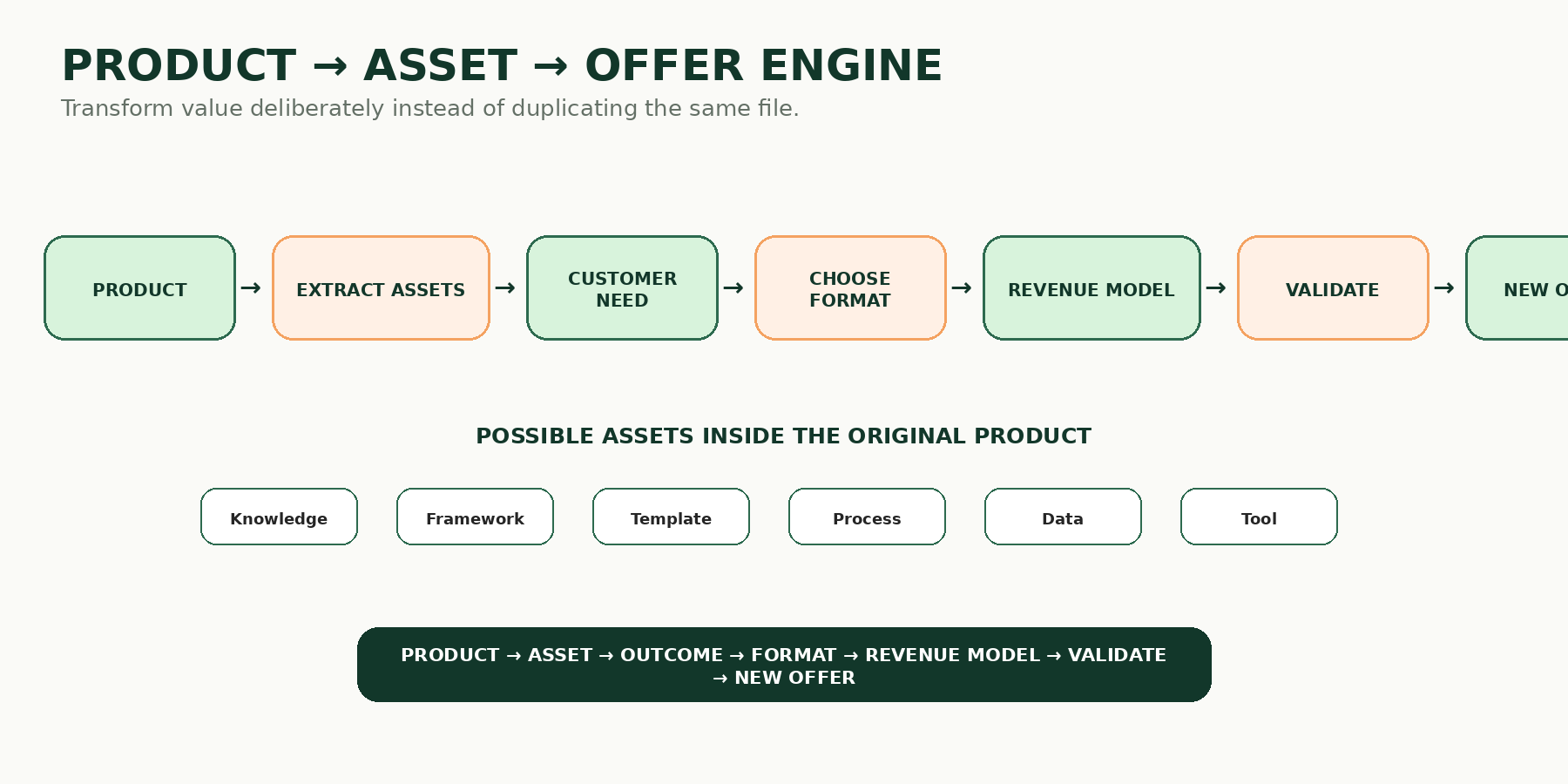 Transform value deliberately: extract the asset, match a customer need, choose a format and revenue model, then validate.
| Concept | Meaning | Examples |
|---|---|---|
| Format | How the information or tool is delivered. | PDF, video, spreadsheet, audio, template, app |
| Offer | What the customer actually buys. | Planner bundle, workshop ticket, company licence, setup package |
| Revenue model | How the business earns money. | One-time sale, subscription, licence, service fee, affiliate commission, consulting fee |
Changing format can improve usability, but a new format becomes a meaningful new offer only when it changes the customer experience, outcome or use case.
A validated core product can branch into six broad monetization families.
Direct sale, premium edition, bundle or business licence.
Course, workshop, webinar or consulting.
Implementation, customization or done-for-you work.
Membership, updates, subscription, template library or recurring research.
Affiliate income, partnerships or reseller licensing where legally permitted.
Complementary products, advanced products, software or community.
Not every core product needs all six branches. The objective is to identify the branches that make sense for the specific customer and economics.
The simplest model is customer → product → one-time payment. The product may be sold on a marketplace, direct website or ecommerce storefront. The creator needs a listing, checkout, delivery method, clear licence, refund approach and customer-support process.
Direct sales are useful because they provide evidence. Before building five extensions, learn whether customers actually buy and use the original. If distribution is the current problem, VEZILL's article on selling AI products without an existing audience explains why distribution can come from search, marketplaces, communities, partnerships and relevant outreach even without a large following.
A premium edition can expand the outcome without making the basic version intentionally incomplete. A basic budget spreadsheet may provide a budget tracker. A premium version might add a debt calculator, savings tracker, dashboard, instructions, scenario planning and extra templates.
Each version needs a clear buyer and reason to exist. Premium should mean additional value, not “we removed essential features from the cheaper version.”
A bundle can increase convenience and average order value when several products solve related parts of one problem. A freelancer business bundle might contain a proposal template, client onboarding questionnaire, project tracker and invoice tracker.
Avoid random bundle syndrome: putting unrelated products together because a larger file count looks more valuable. Bundles work best when the buyer would reasonably use the products together.
A guide can become a course if video, exercises, demonstrations, walkthroughs, assessments or guided implementation make the learning experience better.
A course should not be the PDF read aloud on video.
If the guide explains the strategy, the course can demonstrate the process. If the product is a spreadsheet, the course might show setup, formulas, examples and troubleshooting. That additional value also creates additional production and support obligations.
A spreadsheet template could support a two-hour implementation workshop. A hiring toolkit could support a live manager training session. A social-media planner could become a group planning workshop.
Workshops can also validate demand for a future course or service because you observe where participants get stuck in real time.
A product teaches a general method. Consulting applies judgment to a specific case. A social-media strategy guide may lead to a one-to-one strategy consultation. A budgeting tool may lead to an implementation session where the creator helps a business configure the system.
Consulting is less scalable than selling files but can generate more revenue per customer because it involves the creator's time and judgment.
Some customers do not want to learn how to do the task. They want the result delivered.
A product can therefore become a lead-generation asset for a higher-touch service. VEZILL's guide to packaging a freelance service is useful here because the service still needs a defined customer, outcome, scope, deliverables and price.
Customization keeps the underlying product but adapts it for a specific buyer. Examples include branded templates, customized dashboards, personalized reports, company versions or localized editions.
Customization can increase price, but it also reduces scalability. Track how many hours each customization requires so a profitable product does not quietly become an underpriced custom service.
Licensing allows the same intellectual property to serve customers with different usage needs. Depending on the product and licence design, a creator might offer personal, commercial, team, business, education or site licences.
For example, an individual teacher may buy one worksheet pack for personal classroom use, while a school may need a licence allowing multiple teachers to use the resource. The school is not necessarily buying a different worksheet—the licence grants different usage rights.
Licence terms should be written clearly and reviewed professionally where significant rights or business use are involved.
Resell Rights, Master Resell Rights and Private Label Rights are separate licensing concepts. Their exact meaning depends on the licence supplied with the product.
Owning a copy is not owning the copyright. Buying a product is not automatically having resell rights. Commercial use is not automatically resell rights. MRR is not copyright ownership.
VEZILL's Sell Your First Digital Product is an example of a current product whose page specifically states it includes MRR and also states restrictions. Always read the actual licence instead of assuming the label gives unlimited rights.
Subscriptions make sense when customers receive new value regularly—monthly templates, updated research, current data, new design assets, ongoing training, software or professional resources.
Recurring payment requires recurring value.
Charging monthly for a static PDF simply because subscriptions are attractive is usually a weak customer proposition.
A membership may provide a community, library, support, events, networking, training or resources. Membership often uses recurring payments, but the concept is broader than billing frequency: the customer joins an ongoing experience.
That also means ongoing work. Community moderation, events, new resources and member support can become significant operational responsibilities.
A useful product may naturally change over time. Version 1 can become Version 2. A tax-year guide can have an annual edition. A software guide may need a major update after the interface changes.
Possible models include free updates, discounted upgrades, paid major editions or annual releases. Do not repeatedly charge customers simply to correct errors that should have been fixed in the original product.
A photography guide may legitimately recommend editing software, hosting or equipment. If the creator participates in an affiliate program, those recommendations can produce supplementary commission revenue.
But recommendations should remain relevant and honest. Where affiliate disclosure rules apply, disclose the relationship clearly and conspicuously. The U.S. Federal Trade Commission, for example, specifically advises affiliate marketers to disclose commission relationships so readers can properly evaluate recommendations.
Affiliate revenue should complement the product, not corrupt it.
A newsletter, research report, course, community or resource hub may eventually attract sponsorship when it reaches a relevant audience. This is usually a distribution asset rather than an automatic extension of the original file.
Sponsors care about audience relevance, credibility and reach. Creating a PDF does not create sponsorship demand by itself.
Business buyers may need more than individual access. A consumer product can become a team package that includes a company licence, onboarding, customization, support or internal training.
HR templates, sales scripts, employee training, business spreadsheets, marketing systems, SOP templates and cybersecurity awareness resources can all have B2B versions where appropriate.
VEZILL's analysis of problems small businesses already pay freelancers to solve can help identify where a consumer resource might have a stronger B2B opportunity.
A creator who owns the necessary rights may negotiate a branded edition for a company or organization. A financial-literacy workbook could become a SACCO-branded edition under a suitable licence. A training company might commission a branded workbook for participants.
White-label rights are not automatic. The creator must own or control the content and any third-party assets sufficiently to grant those rights.
This is often the easiest expansion path. A freelancer proposal template can lead to a client onboarding template, then a project tracker, then an invoice tracker. Together they create a freelancer business bundle.
The pattern is customer problem cluster: solve the next closely related problem for the same audience.
A beginner Instagram content planner might eventually lead to a 90-Day Social Media Growth System for customers who have mastered the basics. The advanced product should reflect higher customer sophistication, deeper implementation or broader outcomes.
A proven spreadsheet or process can sometimes become a calculator, no-code tool, web application, mobile utility or micro-SaaS. A manual pricing spreadsheet might become an interactive pricing calculator.
Software introduces development, hosting, reliability, privacy, security, maintenance and customer support. Do not build software merely because it sounds more scalable. Build it when the repeated workflow and customer demand justify the complexity.
The product itself can generate educational content: blog posts, tutorials, YouTube videos, newsletters, short-form videos and social posts. These may not produce direct revenue immediately, but they can create DISCOVERY → TRUST → PRODUCT SALES.
Over time, the content layer may also support affiliate revenue, advertising or sponsorship where appropriate. VEZILL's article on marketing digital products explains why useful content and distribution are as important as the product page.
Sometimes giving away part of the product creates more value than selling every piece. A free website audit checklist could generate leads for a web-design consultation. A sample bookkeeping checklist could attract businesses that later purchase a setup service.
The decision depends on opportunity cost: what could the free resource help you sell next?
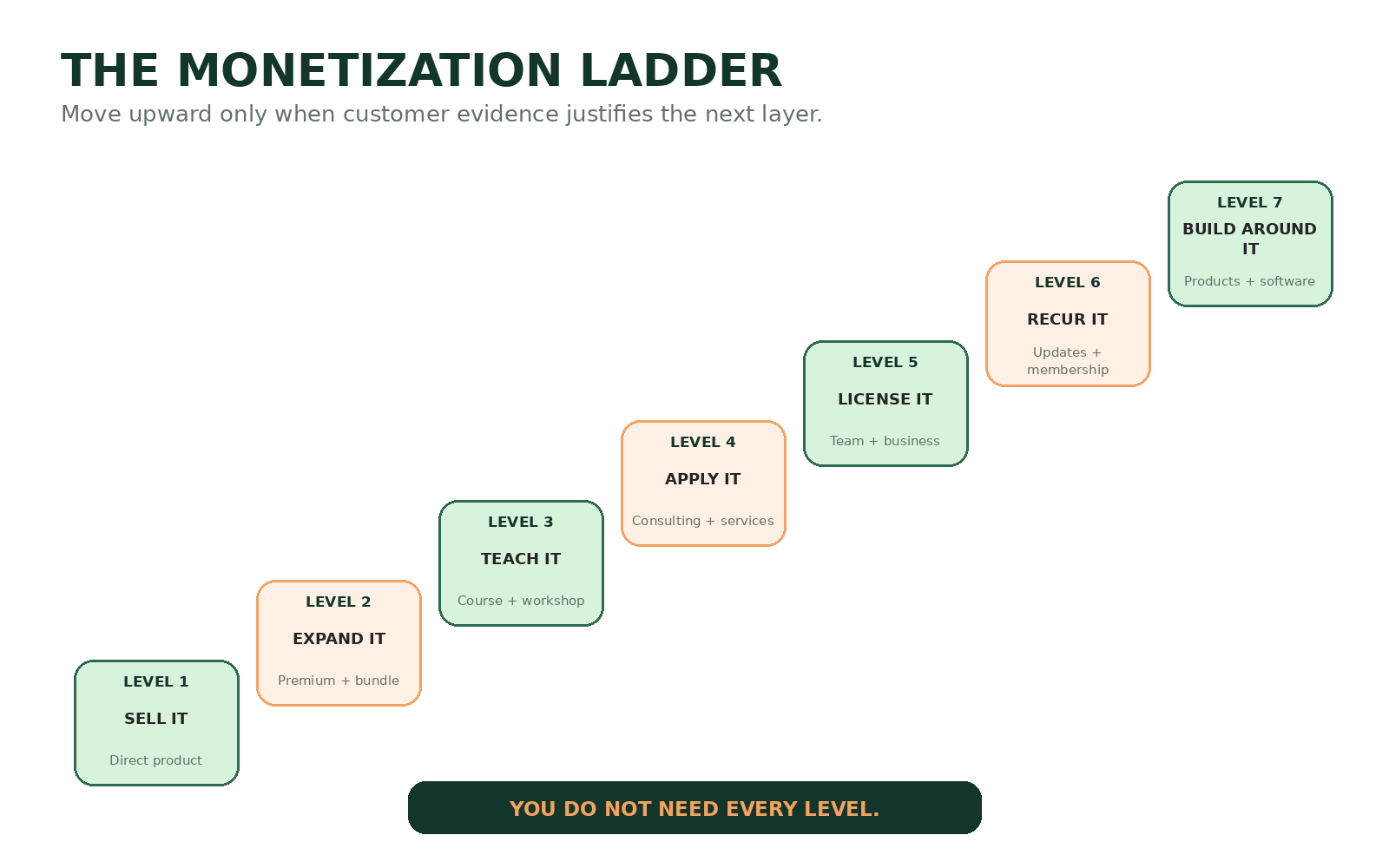 You do not need every monetization level. Move upward only when customer evidence supports the next layer.
You do not need every level. A strong product business might stop at Level 3. Another may move into B2B licensing but never create a membership.
| Model | Revenue Type | Scalability | Work Required | Support Level | Recurring Potential | Best For |
|---|---|---|---|---|---|---|
| Direct sale | One-time | High | Low after creation | Low–Medium | Low | Validated standalone products |
| Premium edition | One-time | High | Medium | Medium | Low | Customers needing deeper value |
| Bundle | One-time | High | Low–Medium | Medium | Low | Complementary products |
| Course | One-time / recurring | High | High | Medium–High | Medium | Skills requiring demonstration |
| Workshop | Ticket / corporate fee | Medium | High | High | Medium | Implementation |
| Consulting | Service fee | Low | High | High | Medium | Complex individual decisions |
| Customization | Project fee | Medium | Medium–High | High | Medium | Business buyers |
| Licensing | Licence fee | High | Medium | Medium | High | Teams and organizations |
| Subscription | Recurring | High | Ongoing | Medium | High | Continuously changing value |
| Membership | Recurring | Medium | Ongoing | High | High | Community and support |
| Affiliate | Commission | High | Low–Medium | Low | Medium | Relevant complementary recommendations |
| B2B/team | Licence/project fee | Medium–High | Medium | Medium–High | High | Business systems and training |
| Software | Sale / subscription | High | Very High | High | High | Repeated interactive workflows |
A personal budgeting spreadsheet could be adapted for a student, family, freelancer or small business. The categories, instructions, workflows and outcomes should change meaningfully. Merely changing the cover does not create a new useful product.
| Method | What It Means |
|---|---|
| Repurposing | Delivering the same knowledge in another useful format. |
| Repackaging | Combining or repositioning existing assets. |
| Expansion | Adding genuinely new value. |
| Licensing | Selling defined usage rights. |
| Customization | Adapting the product to a specific buyer. |
| Service | Applying expertise for the customer. |
Product cannibalization happens when two offers are so similar that one makes the other difficult to justify. Imagine a KSh 2,000 guide followed by a KSh 2,100 version containing the same guide plus every useful template. The original becomes awkward.
Each tier needs a clear buyer, outcome, scope, price logic and reason to exist. Ask: Who is this for? What problem does it solve? What result does it deliver? What is included? Why choose this rather than Product A? If the answers are nearly identical, merge the products.
FREE CONTENT → ENTRY PRODUCT → CORE PRODUCT → PREMIUM PRODUCT → BUNDLE → COURSE / WORKSHOP → SERVICE / CONSULTING → B2B / LICENSING → RECURRING VALUE
You do not need every level. The purpose is customer progression. Each step should solve the next relevant problem.
Multiple income streams can make a digital-product business more resilient, but adding more offers does not automatically make the business sustainable. VEZILL's guide to whether digital products can become a sustainable business explains why demand, margins, distribution, retention and adaptability still matter.
Consider a hypothetical buyer who purchases a template for KSh 800, a toolkit for KSh 2,000, a workshop for KSh 3,000 and an advanced bundle for KSh 4,000. The total hypothetical lifetime revenue is KSh 9,800.
This is not a typical-income claim. It simply illustrates why solving the customer's next problem can be more valuable than constantly acquiring strangers.
Original hypothetical product: Small Business Social Media Planner.
The point is not to build all ten. It is to see how one customer problem can support different levels of implementation, access and support.
Possible extensions: video lessons, teacher pack, school licence, mock-test bundle. Main risk: curriculum changes and unauthorized redistribution.
Possible extensions: premium dashboard, implementation workshop, SME licence, setup service, annual compliance-oriented update. Main risk: inaccurate or outdated financial guidance.
Possible extensions: premium template collection, business customization, brand workshop, commercial licence. Main risk: third-party asset licensing.
Possible extensions: interview training, manager workshop, company licence, onboarding toolkit. Main risk: employment-law changes and misuse of generic templates.
Possible extensions: advanced dashboard, training session, data-cleaning service, team licence. Main risk: software compatibility.
Possible extensions: crop-specific editions, training, cooperative licence, setup service. Main risk: overly broad recommendations across different farming contexts.
Possible extensions: Pro licence, documentation course, setup consulting, hosted micro-tool. Main risk: security and dependency maintenance.
Possible extensions: beginner course, coaching, sport-specific editions, membership. Main risk: making individualized health claims beyond appropriate competence.
Do not multiply a product that has not proven its value.
ORIGINAL SALES → CUSTOMER QUESTIONS → FEEDBACK → ADJACENT PROBLEM → TEST OFFER → WAITLIST / PILOT / PRE-SALE → BUILD
Use evidence rather than excitement. VEZILL's guide to validating a digital product before you build it gives a practical framework for testing demand before investing heavily.
AI can help extract frameworks, summarize content, restructure information, create draft lesson plans, turn chapters into lesson outlines, organize templates, suggest FAQs, analyze customer feedback, translate drafts and create marketing variations.
But AI should not blindly duplicate the product. Human review, fact checking, copyright checks, licensing checks, customer adaptation, quality control and confidentiality review remain necessary.
VEZILL's article on creating digital products with AI is useful for the production side, while what you can create and sell online using AI covers broader AI-assisted product opportunities.
If you transform one article into an ebook, course, checklist, newsletter and PDF but each layer contains essentially identical information, customers may reasonably feel they are buying the same thing repeatedly.
EACH PAID LAYER SHOULD ADD A NEW TYPE OF VALUE.
Think: information → organization → implementation → personalization → execution.
More offers do not help if nobody sees them. Use search, email, marketplaces, communities, referrals, partnerships, useful content and selective outreach. VEZILL's digital entrepreneurship with AI guide explains how products can fit into a broader digital-business system.
If your expansion moves toward serving companies, a clearer offer and distribution plan matter more than simply adding another file.
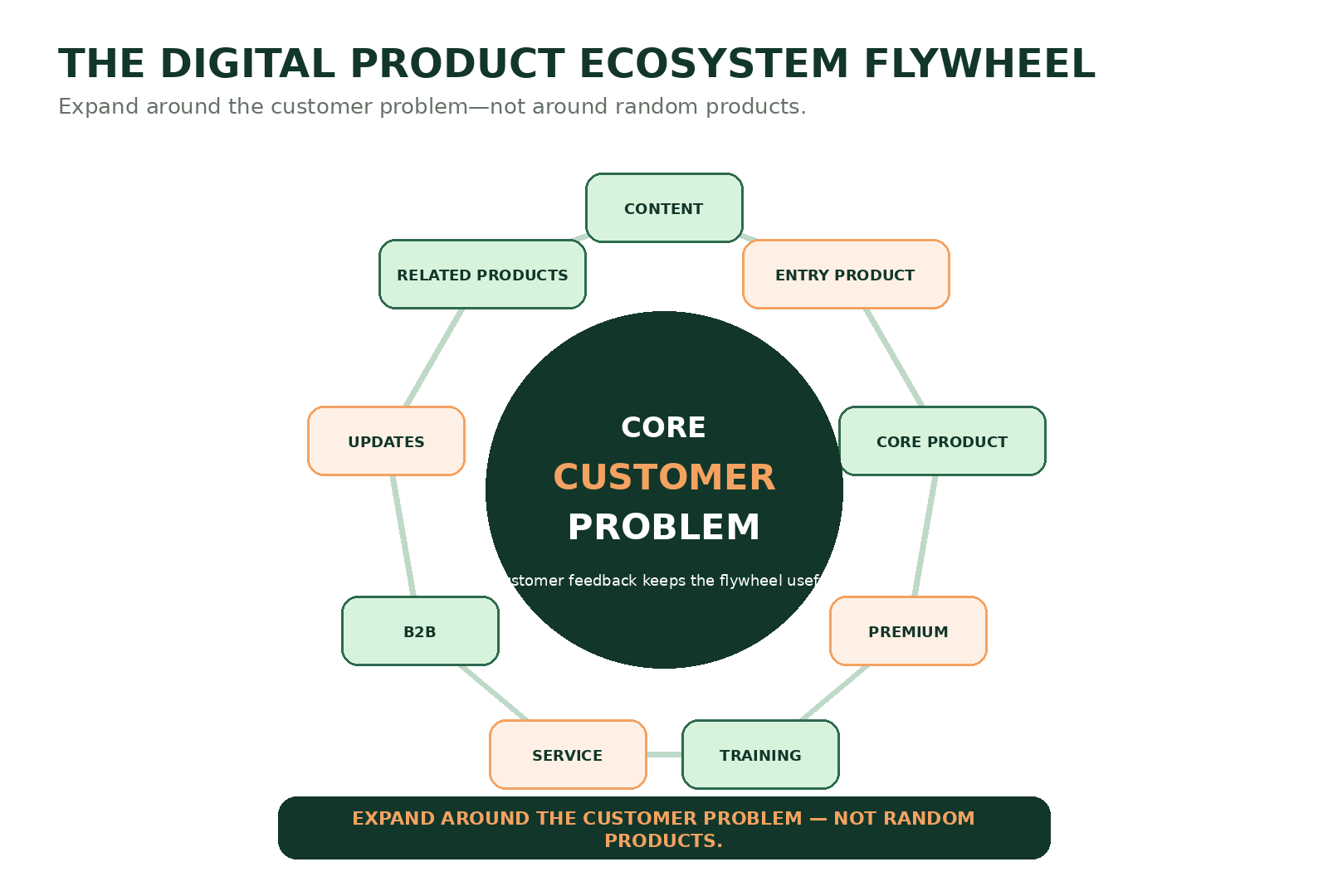 Expand around the customer's problem rather than building random products.
Consider a small-business bookkeeping template. A Kenyan creator might sell the direct download, build an advanced version, run a training workshop, offer setup help, create an SME team licence or publish a new annual edition when underlying requirements genuinely change.
An educational product could potentially have a student edition, teacher version, school licence, supporting video lessons and supplementary practice resources where the creator owns the content and respects current curriculum and copyright rules.
M-Pesa, mobile-first customer journeys and WhatsApp communication can make local distribution practical, but creators still need to think about pricing sensitivity, customer trust, business purchasing processes, cross-border payment limitations and support. VEZILL's guide to digital products to sell in Kenya provides local product examples, but demand must still be validated for the exact audience.
Creators who need stronger commercial skills can also look at current Inceptor training in digital marketing, graphic design with AI or data analysis where those skills directly improve the intended offer.
Copyright and licences determine what you may reproduce, modify, distribute, rebrand or permit other people to use. A creator can only sell licensing rights they actually control.
Remember these four distinctions:
Also review third-party fonts, stock assets, images, software licences and AI-generated materials before granting business, reseller or white-label permissions.
If a new revenue stream involves storing customer or team information in Kenya, the Office of the Data Protection Commissioner regulates data controllers and processors under the Data Protection Act. Tax and business obligations should be verified using current KRA and professional guidance for the specific model.
☐ Does the original product sell?
☐ Do customers get useful results?
☐ What do customers ask for next?
☐ Is the new offer genuinely different?
☐ Can I explain the difference in one sentence?
☐ Do I own the necessary rights?
☐ Can I support it?
☐ What does it cost to maintain?
☐ Does it strengthen or confuse the brand?
☐ Can I test it before building fully?
☐ Is the expected margin worthwhile?
☐ What happens if it fails?
Do not attempt ten streams in 30 days. Choose one.
Once you see twenty possible monetization paths, the next danger is trying to build all of them. The right first extension is usually the one closest to demonstrated customer behaviour.
Start with evidence from the original product. If buyers repeatedly ask for more templates, a bundle or premium toolkit may be the logical extension. If they understand the information but struggle to implement it, a workshop or setup service may be stronger. If companies ask whether several employees can use the file, investigate a team licence. If customers need continuously changing information, an update product or subscription may be appropriate.
| Customer Signal | Possible Expansion to Test | Why |
|---|---|---|
| “Can you add more examples/tools?” | Premium version or bundle | The customer wants greater depth around the same outcome. |
| “Can you show me how to use this?” | Tutorial, workshop or course | The gap is implementation, not information. |
| “Can you set this up for me?” | Customization or service | The buyer values execution. |
| “Can my team use this?” | Team/business licence | The usage rights and buyer type have changed. |
| “Will this be updated?” | Update plan or annual edition | The subject has continuing maintenance value. |
| “Do you have something for the next stage?” | Advanced or complementary product | The customer has moved to an adjacent problem. |
This approach is stronger than choosing revenue streams based on what appears fashionable online. A creator may want a membership because recurring revenue sounds attractive, but customer behaviour may actually point toward a simple business licence or one-time workshop.
Another way to expand income from one product is not to change the product at all, but to diversify where it is discovered and purchased. A marketplace can provide category discovery and a familiar buying environment. A direct website can provide more control over brand, customer journey and complementary offers. Search content, email, social media and partnerships can feed either route.
The trade-off is operational. Every additional selling channel can introduce different fees, refund processes, licence presentation, customer records and support expectations. A creator should avoid creating inconsistent prices or rights accidentally across channels.
One practical model is to keep the core product consistent while using different channels for different acquisition purposes. A marketplace listing may capture buyers already browsing for digital resources. Your own content may attract search traffic. Email can introduce existing customers to a related bundle. A workshop may convert a small group of buyers into consulting customers.
The point is distribution resilience, not channel count. VEZILL's article on how AI can help small businesses with marketing, automation and digital products also shows how one business can use the same underlying expertise across operations, content and new revenue opportunities.
Individual consumers and organizations often value the same core asset differently because the usage context changes. A single employee using a template is not the same as a company deploying it across a department.
A B2B version may therefore include defined team access, an internal-use licence, onboarding, manager instructions, customization, support or periodic updates. The higher price is not justified merely because the buyer is a company. It should reflect broader usage rights, additional service or greater organizational value.
For example, imagine an original customer-service response toolkit created for solo ecommerce sellers. An individual licence might allow one business owner to use the templates. A company version could support ten support agents, include onboarding guidance, internal editing rules and a workshop explaining how to adapt the templates without making misleading promises. The intellectual asset is related, but the offer is materially different.
Business sales can also have longer decision cycles. Buyers may ask for invoices, procurement documents, privacy explanations, licence terms or a demonstration. That makes B2B potentially valuable but not automatically easier.
Do not price extensions by multiplying the page count or file count. Price should reflect customer value, usage rights, delivery effort, support, acquisition cost, maintenance and alternatives.
A premium edition should be expensive enough to reflect additional utility without making the basic product look deliberately crippled. A workshop includes live time and capacity limits. A team licence covers broader usage. A customized version requires labour. A subscription creates an ongoing obligation to deliver new value. These differences should be visible in the pricing logic.
Before launching, write one sentence explaining why the new offer costs more or is billed differently. If you cannot explain the distinction clearly, customers may interpret the new stream as duplicate monetization rather than added value.
This is also where a productized-service mindset helps. A service extension should state exactly what is included, what is excluded, how many revisions or support interactions are covered and what happens when the request exceeds scope.
Product ecosystems are most defensible when they grow from real customer behaviour. Reviews show what people value. Support tickets reveal confusion. Refund reasons expose mismatched expectations. Search queries reveal adjacent needs. Service conversations reveal situations a static product cannot handle.
Keep a simple “next problem” log. Whenever a customer asks for something the product does not solve, record it. Do not immediately build it. Wait for patterns. If the same adjacent problem appears repeatedly and belongs to the same customer group, it becomes a candidate for validation.
This prevents the catalogue from becoming random. The ecosystem grows outward from a stable customer problem instead of following every new trend.
Extract the useful assets inside it and test adjacent offers such as premium versions, bundles, training, licensing, services or complementary products.
Yes when the new format improves usability or serves a different need. Simply converting a PDF to video does not automatically create new value.
Yes, if the course adds demonstrations, exercises, walkthroughs, feedback or guided implementation rather than reading the ebook aloud.
Yes. The product can teach the method while the service applies or implements it for the customer.
Recurring revenue can come from genuine ongoing value such as updates, memberships, subscriptions, research, software or new resource libraries.
Potentially, if you own or control the necessary rights and create clear business or team licence terms.
Commercial rights may permit using a product in business activity, while resell rights specifically concern selling copies. The exact licence controls what is permitted.
Yes. AI can help restructure, summarize and extract components, but human review, licensing checks and customer-specific adaptation remain necessary.
They can if offers overlap. Each product should have a clear buyer, problem, outcome, scope and reason to exist.
There is no ideal number. Add one expansion at a time when customer evidence and economics support it.
Yes. Kenyan creators can combine direct sales, training, services, B2B licences and other models while accounting for payments, pricing, compliance and customer needs.
Usually not immediately. First determine whether the problem is demand, positioning, distribution, pricing or product quality before multiplying the catalogue.
The smartest way to create multiple income streams from one digital product is not to keep selling the same information under different names. It is to use one validated customer problem as the foundation for multiple genuinely useful offers, formats, services and licensing models.
ONE VALUABLE PRODUCT → IDENTIFY CORE ASSETS → STUDY CUSTOMER NEEDS → EXTRACT ADDITIONAL VALUE → CHOOSE MONETIZATION MODEL → VALIDATE → BUILD → CONNECT → CREATE CUSTOMER PROGRESSION → BUILD A PRODUCT ECOSYSTEM
The real asset is the problem you know how to solve.
Discover more articles you might be interested in

Learn where to find reliable step-by-step guides online, how to choose the right tutorial for your task, check whether it is current and follow instructions safely.
By Davie

Stop searching broad topics and start finding the exact knowledge you need. Learn how to define your problem, search smarter, choose reliable sources, verify answers and take action.
By Davie

Quick Knowledge or an online course? Learn when a focused answer is enough, when structured learning is better, and how to choose the right learning depth for your goal.
By Davie
Can selling digital products become a sustainable long-term business? Learn what makes the model durable, why products fail, how AI changes the market and how to build recurring value.
By Davie
Get the updates, on newly released, popular & fast-moving MRR digital products
Up to Top