
Most first digital products don't fail because they're badly made — they fail because nobody wanted them in the first place. It's an easy trap: an idea feels exciting to you, so you assume it will excite buyers too. Validation replaces that assumption with evidence, and it takes far less time than people expect.
This guide walks through exactly how to test an idea before you invest real time in it. Once your idea is validated, our Sell Your First Digital Product guide takes you from validated idea all the way to your first sale.
To validate a digital product idea before building it: (1) check whether people are already searching for it, (2) scan competitors and marketplaces to see if similar products sell consistently, (3) ask real people in your niche if they'd pay for it, (4) test with a minimum offer before building the full version, and (5) only build once you have a genuine "yes" signal.
Validation takes a day or two and costs nothing — building an unvalidated product can cost weeks and end in silence. The order matters: validate first, build second.
Once validated, publish and sell it on Vezill with instant delivery and resell rights.
The most common beginner mistake is building in isolation — finishing an entire ebook, course, or template pack before ever checking whether anyone was looking for it. By the time it's published, there's no room left to pivot cheaply. Validation flips the order: cheap tests first, real building only once demand is confirmed.
Run every new idea through this before writing a single page.
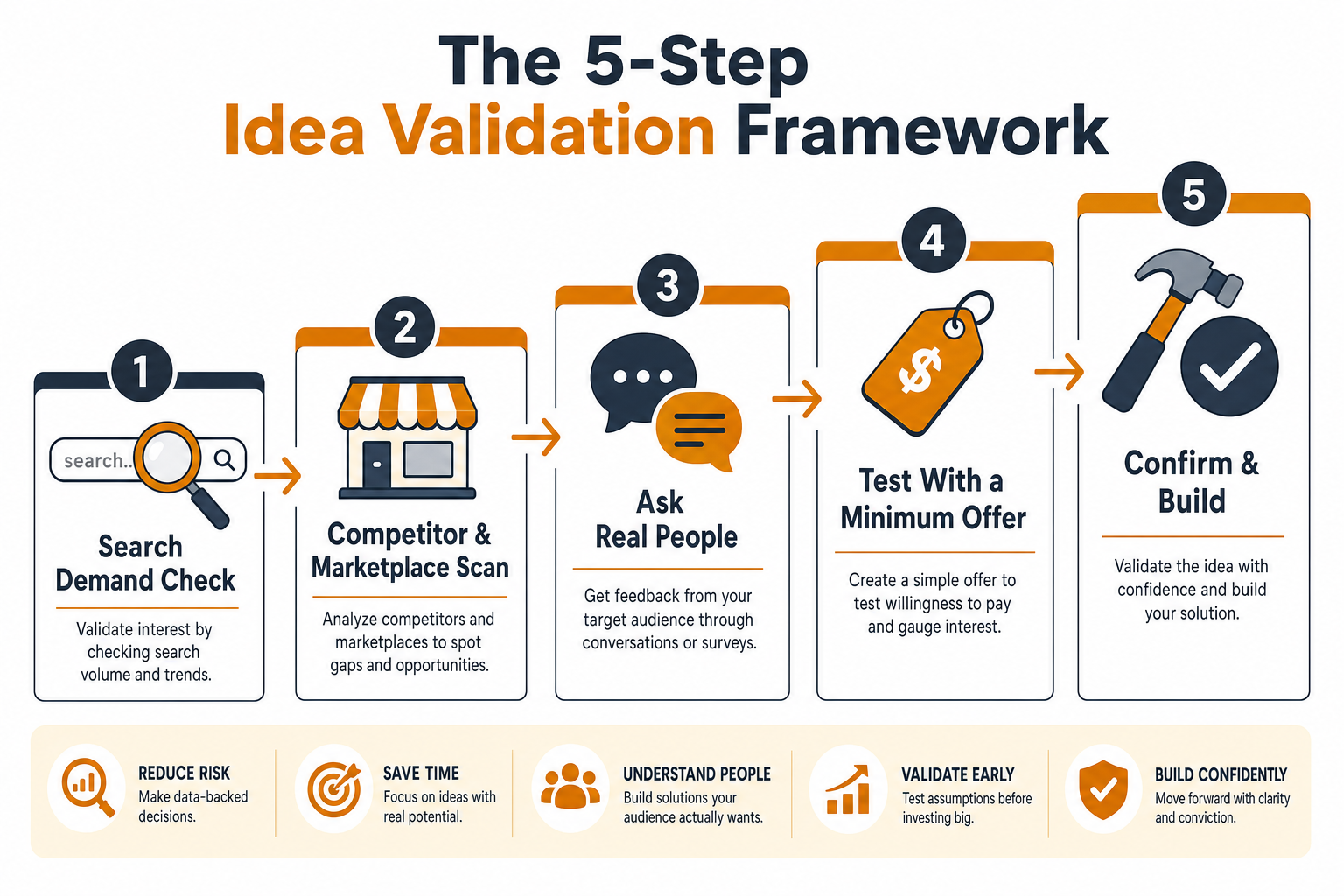 Five checks stand between a guess and a genuinely validated idea.
Each step gets progressively more concrete — from "does anyone search for this" to "will someone actually pay." Skipping straight to building means skipping every one of these safety checks.
You don't need paid research tools to validate an idea — the signals are already public.
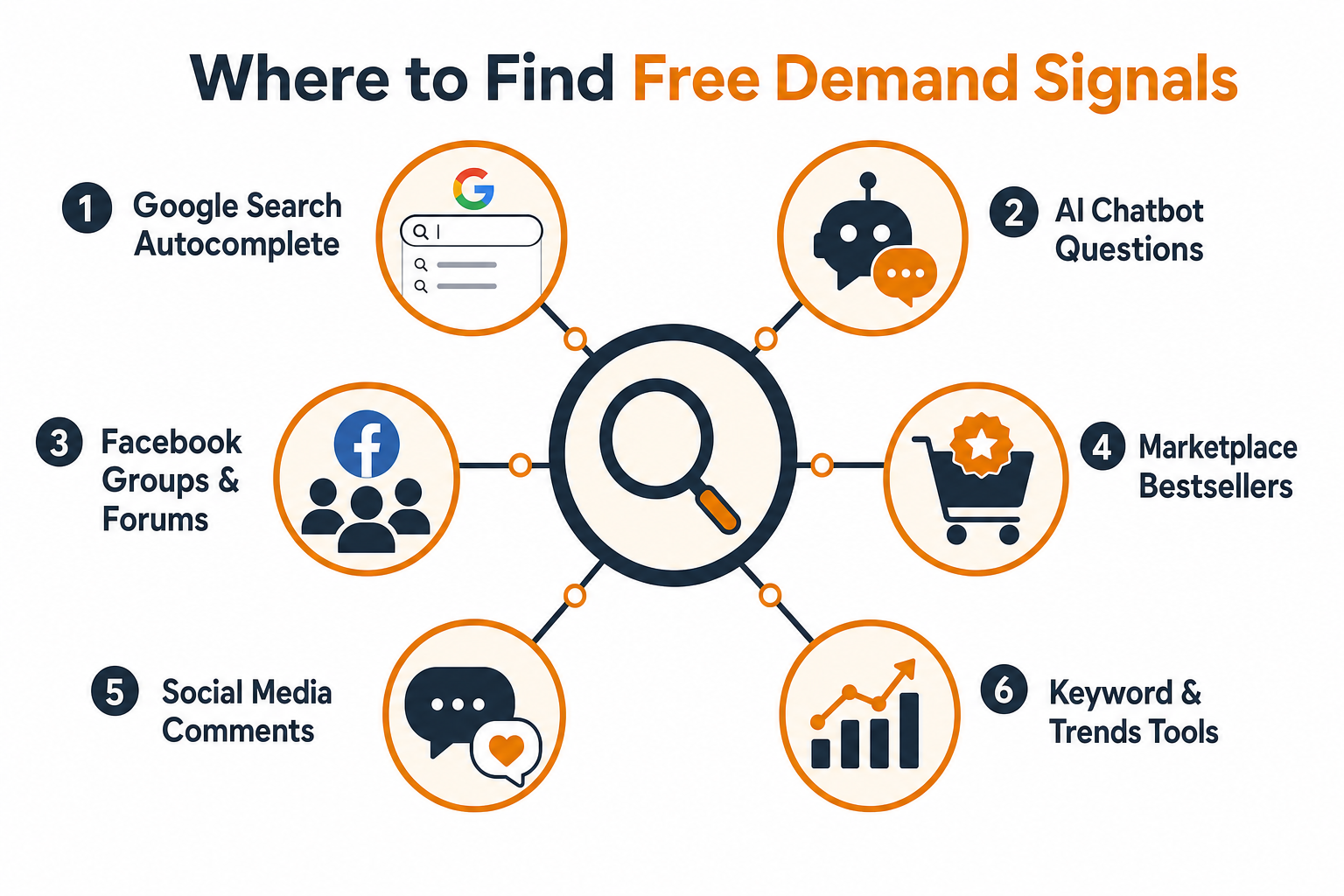 Six free places to check before spending a single hour building.
Type your idea into Google and note the autocomplete suggestions, ask an AI assistant what people commonly search for in your niche, and scan Facebook groups or forums for recurring questions. If you're validating something education-related, how students can start a digital business shows exactly which questions students actually search for.
The fastest, most honest validation test is simple: offer a stripped-down version before building the full thing, and see if anyone pays.
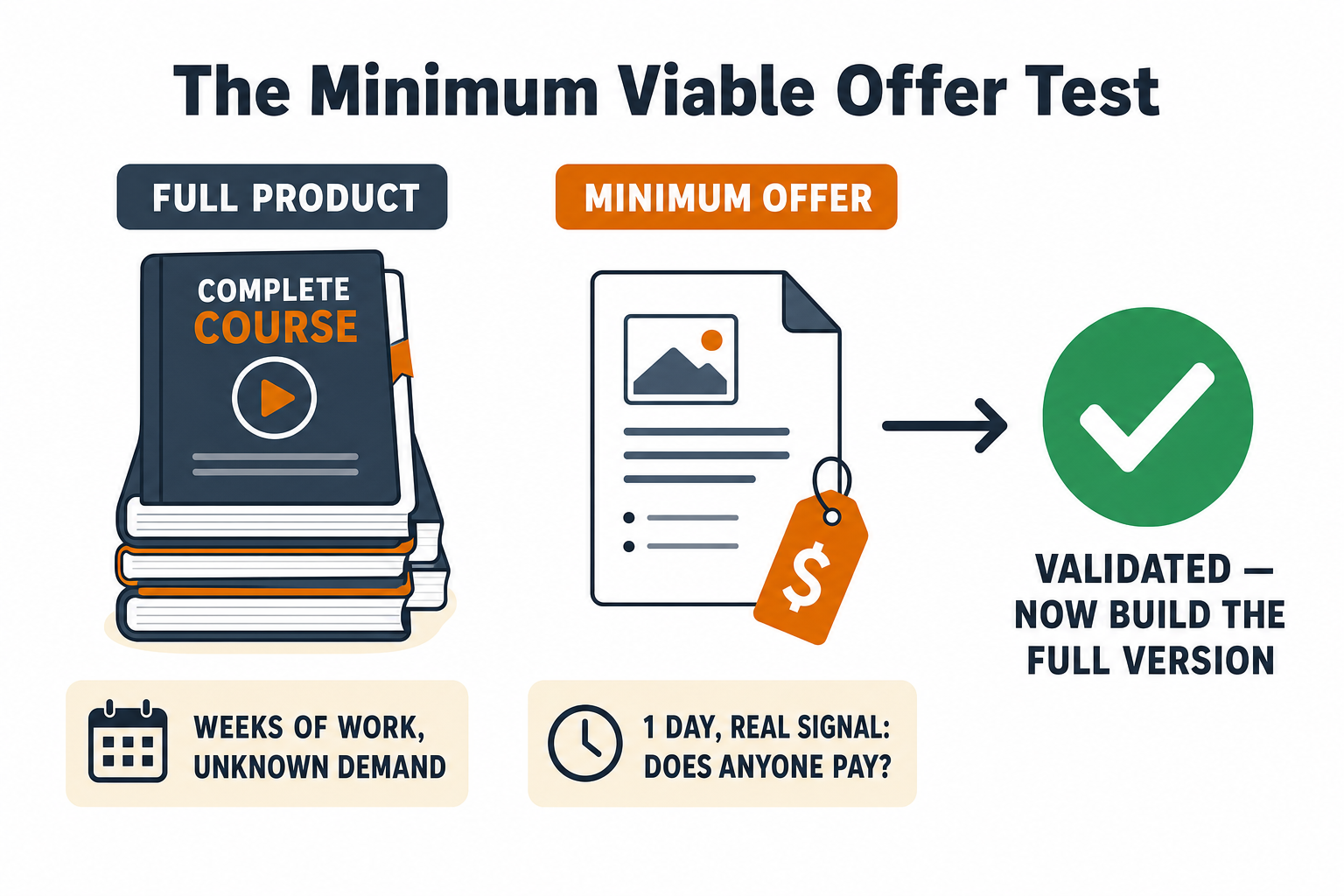 A one-day minimum offer tells you more than a month of guessing.
This could be a single chapter, a short checklist version, or a small bundle at a lower price. If people pay for the minimum version, you have real evidence to build the complete one with confidence — see How to Create and Launch New Products Every Month for the repeatable version of this exact cycle.
Real money beats opinions: A friend saying "that sounds like a good idea" is not validation. Someone actually paying — even a small amount — is. Weight evidence accordingly.
Learn to read the signals honestly, even when you're emotionally attached to the idea.
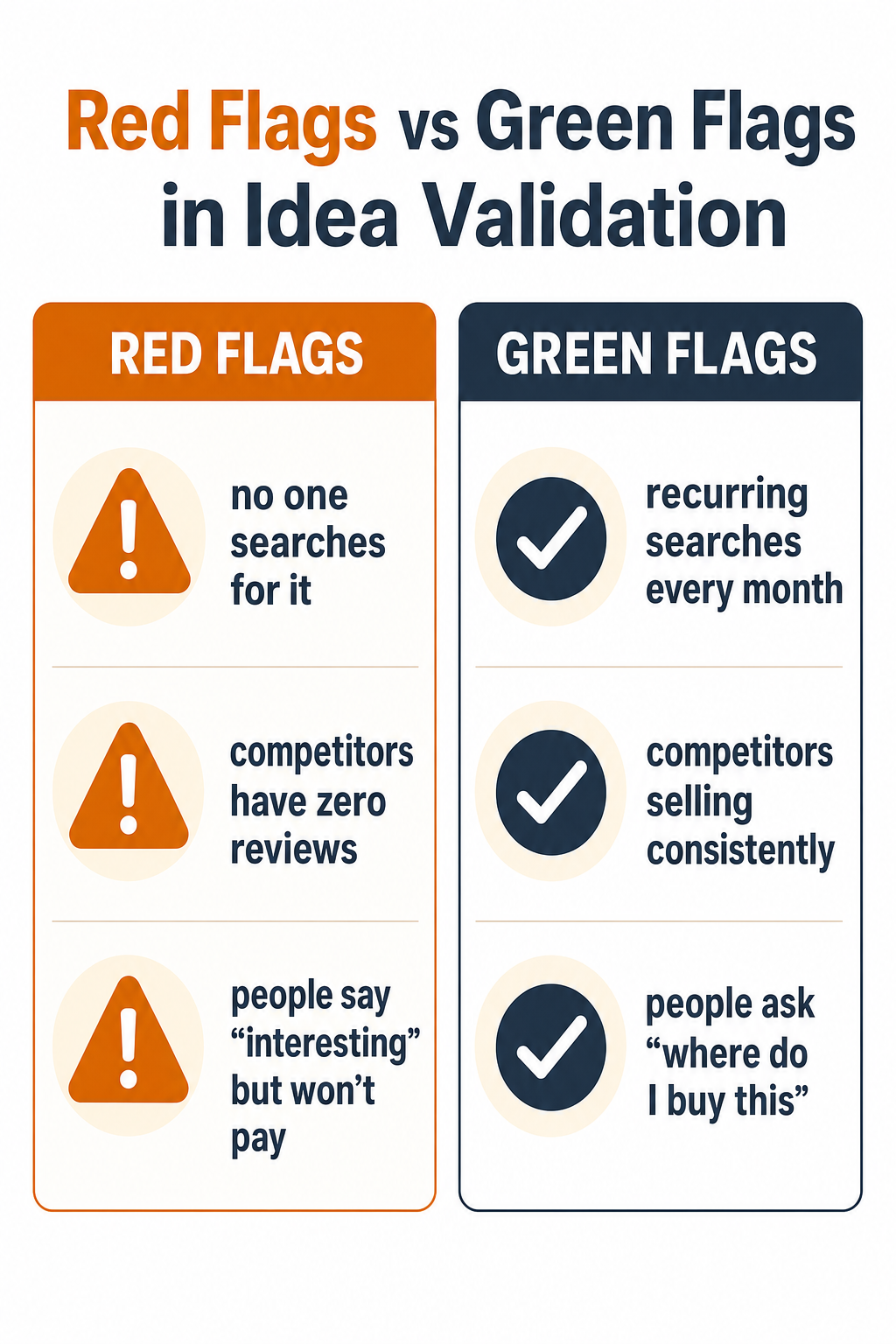 Learn to spot the difference before you invest real time.
If your research turns up mostly red flags, that's useful information, not failure — it means you've saved yourself weeks of wasted work and can pivot to a stronger idea instead.
Niche expertise validates differently — the question isn't just "does demand exist" but "does demand exist for products at my specific angle." Someone with a specialised skill, like a music coach turning lessons into digital products, can validate faster by checking demand within that specific community rather than the broad market. The same logic applies to any specialised skill you're packaging.
Once you have a genuine green-flag signal, move quickly while the momentum and research are fresh. If you're working with minimal resources, the best online business ideas you can start from home with minimum capital confirms that digital products remain one of the lowest-cost, fastest-to-launch options once an idea is validated.
Asking only friends and family — they'll rarely tell you the truth about paying.
Confusing likes and compliments with sales intent — attention is not the same as a buyer.
Validating too broadly — "fitness" is too wide; "home workouts for new moms" is testable.
Ignoring existing competitors — competition with consistent sales is a green flag, not a warning sign.
Overthinking instead of testing — a one-day minimum offer beats a month of debating.
The gap between an idea that sells and one that goes silent usually isn't quality — it's whether anyone was actually looking for it. Spend a day checking demand signals, asking real people, and testing a minimum offer before you build the full version. It's the cheapest insurance you'll ever buy for your time.
Pick your current idea and run it through the five-step framework today — and once it's validated, the complete guide takes you from there to your first sale.
Create your free Vezill account, package your validated idea, and publish your first digital product this week.
Create your Vezill store now →
Check whether people are already searching for it, scan competitors and marketplaces for consistent sales, ask real people in your niche if they'd pay, and test with a small minimum offer before building the full product. Only proceed once you have a genuine paying-customer signal.
Offer a stripped-down minimum version — a single chapter, checklist, or small bundle — at a low price before building the complete product. If people pay for the minimum version, that's real evidence to build with confidence.
No. Competitors who are consistently selling similar products are usually a green flag showing real, proven demand. The absence of any competition often signals the opposite: nobody wants it, or it's too early for the market.
Yes. Free demand signals include Google search autocomplete, questions people ask AI chatbots, discussions in Facebook groups and forums, marketplace bestseller lists, and comments on social media posts in your niche.
Basic validation can be done in a day or two using free research methods. A minimum viable offer test to check real payment intent typically takes a few days to a week, which is far less time than building an entire unvalidated product.
Treat it as useful information rather than failure. A lack of demand signals means you've avoided weeks of wasted effort, and you can refine or pivot the idea to a narrower angle with clearer evidence of demand before building.
Discover more articles you might be interested in

Learn where to find reliable step-by-step guides online, how to choose the right tutorial for your task, check whether it is current and follow instructions safely.
By Davie

Stop searching broad topics and start finding the exact knowledge you need. Learn how to define your problem, search smarter, choose reliable sources, verify answers and take action.
By Davie

Quick Knowledge or an online course? Learn when a focused answer is enough, when structured learning is better, and how to choose the right learning depth for your goal.
By Davie

Learn how to turn one useful digital product into multiple income streams through premium versions, bundles, courses, licensing, services, subscriptions, B2B sales and complementary products.
By Davie
Get the updates, on newly released, popular & fast-moving MRR digital products
Up to Top
Comments All
Brian
@brian
It makes so much sense to test an idea first instead of spending time and money building something people may not even need. The tips were simple and easy to understand, and this is definitely something I’d keep in mind before creating a digital product. Has anyone here tried validating an idea before building it? 😊
September 07,2026 At 09:37 PM
Jesse
@jesse
A useful read if you’re thinking about creating a digital product. I liked the emphasis on testing the idea first instead of spending time and money building something nobody wants. Definitely worth checking out before launching a new product.
August 26,2026 At 11:08 PM