
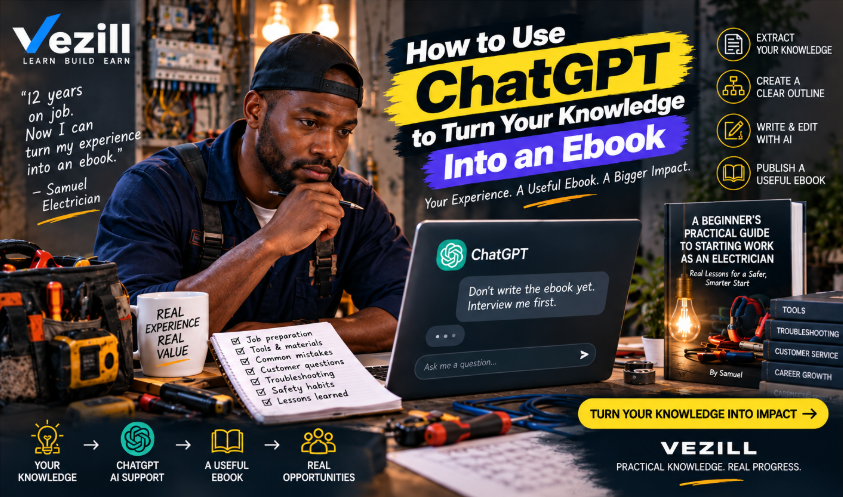
Use ChatGPT first as an interviewer and organizer, not as a machine that fills pages. This workflow shows how to extract what you genuinely know, structure it for a reader, draft responsibly, verify claims and package a useful ebook.
Samuel has worked as an electrician for about twelve years. He knows how he prepares for a job, how he organizes tools, what beginners often forget, which customer questions repeat, how he documents work and what professional habits make jobs run more smoothly.
He wants a practical beginner ebook, so he types: “Write me a 50-page ebook about becoming an electrician.” The result sounds polished but generic. It does not contain Samuel’s real lessons, his examples or the nuances he learned through repeated work.
He changes the relationship with one instruction: “Do not write the ebook yet. Interview me first.”
THE FIRST JOB OF CHATGPT IS NOT TO WRITE YOUR EBOOK.A one-line generation request gives ChatGPT very little of you. It knows the topic but not your reader, your experience, your examples, your limits or the result the ebook should produce.
The output can drift toward generic advice, repetition, invented examples or unsupported claims. The problem is not that ChatGPT cannot draft. The problem is that drafting began before enough source material existed.
DO NOT START WITH GENERATION. START WITH EXTRACTION.Before interviewing yourself, define the reader. “People interested in electrical work” is broad. “Someone considering entry-level electrical work who wants to understand practical habits, preparation and professional routines” is useful.
Ask who the reader is, what they already know, what frustrates them, what they are trying to do and what the ebook should deliberately not cover.
Interview mode is powerful because useful knowledge often appears when you are asked about first experiences, repeated problems, mistakes, exceptions, decisions, customer questions and tools.
One question at a time gives you room to answer naturally and lets ChatGPT follow promising details instead of treating the process like a survey.
Your first knowledge dump does not need to sound literary. Speak naturally, dictate answers, paste rough notes, provide checklists you own and upload your own documents where supported.
OpenAI’s current documentation says ChatGPT can work with supported documents, spreadsheets, presentations and other files uploaded in a conversation. OpenAI File Uploads FAQ. ChatGPT also offers file Library functionality for supported accounts. OpenAI Library guidance.
After a substantial interview, your raw material will be messy. That is expected. Ask ChatGPT to cluster recurring themes, processes, mistakes, decision rules, examples, tools, warnings and lessons while separating what you explicitly said from what it inferred.
Experienced people often skip steps because those steps feel obvious. Ask ChatGPT what a beginner would still need explained and where you are assuming prior knowledge.
Do not structure the ebook around everything you know. Structure it around the sequence the reader needs: starting point, questions, understanding, action and realistic result.
Now the outline has source material behind it. It may include foundations, process, examples, mistakes, troubleshooting, tools, checklists and an action plan—but only where useful.
The outline should follow the reader’s journey, not the order in which your memories appeared.
Chapter-by-chapter drafting makes verification easier, reduces repetition and gives you tighter control over voice, examples and research gaps.
“Make it sound human” is not an editorial system. Voice is a pattern of vocabulary, sentence length, formality, teaching style, technical depth and example choice.
Separate creator knowledge from external facts. Your experience can support a story, process or example. It does not automatically prove a universal claim about law, science, medicine, technical standards, market data or current policy.
ChatGPT can currently search the web and surface source links for current information. OpenAI web-search guidance. Finding a source is still not the same as confirming that it supports the exact claim.
Do not use circular verification: ChatGPT wrote the claim, therefore ChatGPT saying it is correct does not count as independent evidence. Flag dates, numbers, legal claims, medical claims, technical specifications, quotations and named studies for manual verification.
Look for repeated introductions, vague transitions, generic motivation, redundant summaries, inflated wording and anecdotes nobody supplied. The goal is not to make the ebook long. The goal is to make every page earn its place.
A practical ebook becomes stronger when readers can use the information. Convert useful sections into checklists, worksheets, templates, exercises, scripts or decision aids where those formats improve application.
After drafting chapters individually, review the manuscript as a system. Check for contradictions, repeated sections, undefined terms, weak transitions, inconsistent advice, unsupported claims, safety issues and sections that do not serve the reader’s promised result.
Title generation works better after the buyer, problem and result are clear. Ask for clarity and searchability rather than hype or guaranteed outcomes.
ChatGPT can help prepare title-page copy, subtitle, introduction, chapter headings, callout text, worksheet copy, back-cover description, product description, SEO title, SEO description, tags, image prompts and a cover brief.
Layout, typography, image licensing, export quality and accessibility still require deliberate production work.
I want to create an ebook using knowledge I already have. Before we create anything, help me define the ideal reader. Ask me one question at a time about who I want to help, what they already know, what they struggle with and what result I want the ebook to help them achieve. Do not create the ebook yet.KNOWLEDGE INTERVIEWCOPY PROMPT
Act as a knowledge-extraction interviewer. I have experience in [SUBJECT], and I want to turn what I genuinely know into a practical ebook for [READER]. Interview me one question at a time. Ask about the processes I use, problems I have solved, mistakes I learned from, questions people ask me, tools I use, decisions I make, examples I remember, misconceptions I encounter and what I wish I knew when I started. Ask follow-up questions whenever an answer is vague or interesting. Do not write the ebook yet. Do not invent information for me. Your goal is to extract my knowledge.PATTERN EXTRACTIONCOPY PROMPT
Review everything I have told you so far. Do not write the ebook. Extract the recurring themes, processes, mistakes, decision rules, examples, tools, warnings and lessons. Separate what I explicitly told you from anything you inferred. Flag areas where you need more information from me.KNOWLEDGE GAPCOPY PROMPT
Based only on what I have told you, what important questions would a beginner still have? What explanations are incomplete? Where am I assuming prior knowledge? Which claims need evidence or verification? Do not fill the gaps yourself yet—show them to me first.READER JOURNEYCOPY PROMPT
Using the knowledge we extracted, define the reader's starting point and realistic end result. Then arrange the knowledge in the order the reader needs it, not the order I originally told it to you.OUTLINECOPY PROMPT
Create a practical ebook outline using only the useful knowledge we have extracted plus clearly marked research gaps. Organize the chapters around the reader's progression from [STARTING POINT] to [RESULT]. Remove repetition. Do not add chapters simply to make the ebook longer. For every chapter, state its purpose and what the reader should be able to understand or do afterward.CHAPTER DRAFTCOPY PROMPT
Draft Chapter [X] using the approved outline and the knowledge I supplied during our interview. Preserve my real examples and practical lessons. Do not invent personal experiences, statistics, quotes, customers, credentials or results. If additional factual information is needed, mark it [RESEARCH NEEDED]. Keep the chapter practical and specific. End with a short application section or checklist where useful.VOICE STYLECOPY PROMPT
Study these examples of how I naturally explain things. Identify my sentence length, vocabulary, level of formality, use of examples and teaching style. Create a short style guide. Then edit the chapter to follow that style without copying phrases unnecessarily or exaggerating my personality.RESEARCH CHECKLISTCOPY PROMPT
Review this chapter and identify every claim that should be externally verified. Do not pretend my personal experience proves a general fact. Create a research checklist and recommend the type of primary or authoritative source needed for each claim.FACT CHECKCOPY PROMPT
Act as a skeptical fact-checking editor. Review this chapter and classify claims as: (1) directly supported by my experience, (2) externally verifiable factual claim, (3) opinion/recommendation, (4) unsupported or unclear. Flag dates, numbers, legal claims, medical claims, technical specifications, quotations and named studies for manual verification. Do not invent citations.USEFULNESS DENSITYCOPY PROMPT
Edit this chapter for usefulness density. Remove sentences that repeat an idea without adding explanation, evidence, context, example or action. Preserve necessary nuance. Do not shorten merely for the sake of shortening.APPLICATIONCOPY PROMPT
Review this chapter and identify places where explanation should become something the reader can use. Suggest a checklist, worksheet, example, template, exercise or decision aid only where it improves application.MANUSCRIPT AUDITCOPY PROMPT
Audit this manuscript as a whole. Look for repetition, contradictions, abrupt transitions, undefined terms, inconsistent advice, weak examples, unsupported claims and sections that do not help the reader reach the promised result. Do not rewrite everything yet. Give me an editorial diagnosis first.TITLE POSITIONINGCOPY PROMPT
Generate 20 ebook titles based on the actual reader, problem and result of this manuscript. Avoid hype, guaranteed outcomes and vague cleverness. Prioritize clarity and searchability. For each title, explain the promise in one sentence.
This original VEZILL editorial workflow keeps knowledge extraction, organization, drafting and verification separate so the creator can see where each piece comes from.
 Use AI as an organizing layer around genuine source knowledge.
Ask ChatGPT to extract facts, processes, decisions, mistakes, stories, tools, examples, warnings, context and limitations. Good ebooks do not only contain answers. They contain the context that helps the reader use those answers responsibly.
 A richer extraction stack produces more useful source material.
Every chapter should have a purpose, answer a question, contain useful knowledge, support application, provide appropriate proof or examples and state important limits. If it fails, delete, merge or rewrite it.
 Do not add pages. Add usefulness.
A strong practical ebook often moves from explanation to example, then to a reusable checklist or tool, then to action. Not every chapter needs every format, but application should be visible where the reader needs it.
 A useful ebook helps the reader do more than read.
I want to turn knowledge and experience I genuinely have into a practical ebook. You are my knowledge-extraction interviewer, developmental editor and writing assistant.

Do not begin by writing the ebook.

Phase 1 — Reader: Help me define exactly who the ebook is for and what useful result it should help them achieve.
Phase 2 — Extraction: Interview me one question at a time to extract my processes, lessons, mistakes, examples, tools, decision rules, stories, warnings and limitations.
Phase 3 — Gaps: Identify what a beginner would still need explained and ask follow-up questions. Never invent experience for me.
Phase 4 — Structure: Organize my knowledge into themes and propose an outline based on the reader's journey.
Phase 5 — Drafting: After I approve the outline, help me draft one chapter at a time using my knowledge. Clearly flag claims that require outside research.
Phase 6 — Verification: Identify facts, statistics, legal claims, scientific claims, technical claims and other information requiring authoritative sources.
Phase 7 — Editing: Help remove repetition, generic AI filler and unsupported statements while preserving my voice.
Phase 8 — Application: Suggest useful checklists, examples, worksheets, templates or action steps where they genuinely improve the ebook.

Rules: Never invent my personal experiences, customers, income, credentials, quotes, case studies or results. Distinguish what I told you from what you inferred or researched. Ask before filling important gaps. Prioritize usefulness over length.
Notice that the final column tells ChatGPT what to extract from the person’s experience. The topic alone is not enough.
| Knowledge / Experience | Reader | Ebook Idea | What ChatGPT Should Extract |
|---|---|---|---|
| Hotel manager | New receptionist | Your First 30 Days at the Hotel Front Desk | handover routines, guest questions, mistakes, escalation, checklists |
| Chef | New line cook | Kitchen Prep Habits I Wish I Learned Earlier | prep routines, timing, waste, communication, beginner mistakes |
| Car detailer | Beginner mobile detailer | First 30 Days as a Mobile Car Detailer | setup routines, customer questions, workflow, mistakes, job-prep habits |
| Photographer | First-time wedding photographer | Your First Wedding Photography Workflow | shot planning, client questions, timeline issues, backups, mistakes |
| Farmer | Small beginner farmer | Simple Farm Record-Keeping for Beginners | records, recurring decisions, seasonal notes, cost-tracking habits |
| Bookkeeper | Freelancer | Month-End Bookkeeping Without the Chaos | closing routine, missing documents, checks, client questions |
| Recruiter | New hiring manager | How to Run a Structured Candidate Interview | question design, scoring, bias checks, follow-up, note-taking |
| Teacher | New primary teacher | Your First Week in the Classroom | setup, routines, common surprises, parent communication, checklists |
| Graphic designer | New freelancer | A Practical Client Briefing Guide for Designers | intake questions, scope, revisions, files, misunderstandings |
| Web designer | Small-business freelancer | Launch Your First Client Website Without Missing the Basics | briefing, content collection, QA, launch checks, handover |
| Digital marketer | Small-business owner | Plan Your First 30-Day Marketing Campaign | goals, channels, content, metrics, review habits |
| Salesperson | New B2B rep | Discovery Calls: Questions That Reveal the Real Problem | questions, objections, qualification, notes, follow-up |
| Event planner | First-time planner | Build a Reliable Event Run-of-Show | timing, vendor handoffs, contingencies, checklist |
| Property manager | New landlord | Tenant Move-In: A Practical Inspection Workflow | photos, checklists, documentation, handover routines |
| Customer-service manager | New team leader | Build a Simple Complaint Escalation Playbook | categories, escalation, documentation, follow-up |
| Tailor | Beginner tailor | Client Measurement and Fitting Workflow | measurement habits, fit checks, notes, common omissions |
| Ecommerce seller | New seller | Launch Your First 20 Product Listings | listing workflow, photos, descriptions, QA, buyer questions |
| Freelancer | New independent worker | Client Onboarding for Your First Five Projects | briefing, scope, files, payment checkpoints, handover |
| Data analyst | Junior analyst | A Beginner’s Data Analysis QA Workflow | data checks, assumptions, documentation, reporting mistakes |
| Importer | First-time importer | Supplier Comparison Before Your First Order | questions, comparison fields, risk checks, documentation |
The same workflow can support regional products such as Starting a Small Catering Service in Kenya: Practical Lessons, M-PESA Record-Keeping for Small Businesses, a First-Time Importer Supplier Preparation Guide, a Small Farm Record-Keeping Guide, a Kenyan Graduate Job Search Workbook or an Event Planning Checklist for Kenyan Weddings.
Where an ebook touches KRA rules, customs, employment law, finance, health or other current regulation, verify the latest official source before publication. Local experience can add context without replacing the authority that establishes the rule.
Knowledge extraction does not require you to upload information you do not have the right to share. Avoid passwords, private keys, confidential customer records, proprietary employer documents, trade secrets, sensitive personal data and private contracts.
OpenAI’s current Data Controls guidance says signed-in users can control whether conversations help improve models through the “Improve the model for everyone” setting. OpenAI Data Controls FAQ. OpenAI also documents current consumer privacy controls and Temporary Chat behavior. OpenAI consumer privacy guidance.
EXTRACT YOUR KNOWLEDGE WITHOUT UPLOADING INFORMATION YOU DO NOT HAVE THE RIGHT TO SHARE.Use AI to organize your own knowledge and properly sourced material—not to disguise somebody else’s book as your own. Copyright, contractual rights, licensing and human-authorship requirements can vary by jurisdiction and use case.
The U.S. Copyright Office explains that copyright protects original expression while ideas, procedures, systems and methods are treated differently. U.S. Copyright Office overview.
USE AI TO ORGANIZE YOUR KNOWLEDGE—NOT TO DISGUISE SOMEONE ELSE'S WORK AS YOUR OWN.ChatGPT should not invent your experience, customers, testimonials, revenue, qualifications, research, citations or case studies. It should not automatically decide which claims are true or replace necessary professional review.
AI CAN HELP WRITE THE SENTENCE.VEZILL’s About page positions VEZILL around practical knowledge: useful know-how packaged for people who need to apply it. ChatGPT can assist with extraction and production, but it is not the underlying reason the product is valuable.
PERSON WHO KNOWS HOW → CHATGPT HELPS EXTRACT & ORGANIZE → PRACTICAL KNOWLEDGE → EBOOK → VEZILL → PERSON WHO NEEDS TO KNOW HOW YOUR KNOWLEDGE IS THE VALUE.Related VEZILL reading: How to Identify Valuable Knowledge You Already Have, How Can I Turn My Work Experience Into a Digital Product?, What Can I Create and Sell Online Using AI?, How to Create and Sell Digital Products Online, Why Human Experience Still Matters in the Age of AI, How Can I Use AI/ChatGPT to Make Money Online?. Buyers can discover practical resources through VEZILL Products and review platform information in the VEZILL FAQ.
A practical mistake is trying to complete extraction, outlining, research, drafting and editing in one uninterrupted burst. Treat the ebook like a project with checkpoints. At the end of each major phase, ask ChatGPT to summarize only what has been established so far: the reader, the promised result, the source knowledge you supplied, unresolved questions and the approved outline. Keep that summary as a working brief.
This makes corrections cheaper. If ChatGPT misunderstood your audience during the interview, fix that before ten chapters are drafted. If a story was inferred rather than supplied, remove it before it becomes part of the manuscript. If a factual claim needs external research, flag it before polishing the prose around it.
REVIEW THE SOURCE MATERIAL BEFORE YOU REVIEW THE WRITING.For longer projects, keep a compact source-of-truth note containing the approved reader, scope, tone, chapter list, terminology and non-negotiable boundaries. Reuse it when drafting later chapters. This is especially helpful when a conversation becomes long or when you move material between chats or files.
If ChatGPT adds an anecdote you never told it, do not simply edit the wording. Correct the source boundary. Tell it which statements came from you and which were inferred. If it introduces a statistic without a source, move that claim into the research queue. If it broadens your ebook beyond its original promise, return to the reader and result you approved at the beginning.
A useful correction prompt is: “Stop drafting. List every statement in the last section that did not come from my supplied knowledge or a verified source. Separate inference, general knowledge and sourced fact. Then rewrite only after I approve the list.”
Another common drift is generic expansion. A chapter about one practical workflow suddenly becomes a history lesson, a motivational essay and a list of unrelated tips. When that happens, ask: “What part of this section directly helps the reader achieve the chapter objective? Remove the rest.”
WHEN THE MODEL DRIFTS, RETURN TO SOURCE, READER AND RESULT.Current ChatGPT web search can help locate recent sources, and file uploads can help you work with your own notes and documents. Those capabilities are useful for ebook production because they let you keep research and source material close to the writing process. But neither feature changes the responsibility test: does the source actually support the sentence you are publishing?
For an official regulation, open the regulator's page. For a scientific claim, inspect the study or authoritative review. For a product specification, check current manufacturer documentation. For your own story, compare the draft against what you actually said. ChatGPT can speed up the search and synthesis step, but important claims should remain traceable.
A simple research ledger can contain four columns: claim, source, date checked and where the claim appears in the manuscript. This makes later updates easier, especially for ebooks containing current rules, prices, statistics or software instructions that may change after publication.
The creator and ChatGPT can both miss the same thing: what a beginner does not understand. Give a draft chapter, checklist or worksheet to someone who resembles the intended reader. Ask them where they became confused, what they expected to find, which instructions were difficult to apply and what they still needed to ask afterward.
Do not ask only, “Did you like it?” That usually produces polite feedback. Ask the reader to use the resource. Observe where they pause, misinterpret a term or cannot complete a step. Those moments reveal missing context more reliably than praise.
THE FINAL TEST OF PRACTICAL KNOWLEDGE IS WHETHER THE INTENDED READER CAN USE IT.After testing, keep a revision log instead of making random edits. Record the reader's confusion, the chapter affected, the change you made and whether the revision solved the issue. This prevents useful nuance from being removed merely because one sentence felt long. It also gives you evidence for future updates: if several readers stumble over the same definition or workflow, that is a stronger signal than one isolated preference.
The same log can guide version two of the ebook. Repeated support questions may become a new FAQ, a confusing process may deserve a diagram, and a frequently downloaded worksheet may become a separate template. In this way, the ebook improves from observed use rather than from endlessly asking AI to “make it better.”
Yes. It can help draft an ebook, but a stronger workflow starts with your source knowledge, a defined reader and human verification instead of topic-only generation.
Ask ChatGPT to interview you first, organize the answers into themes, expose gaps, build a reader-centered outline, draft one chapter at a time and flag claims that require verification.
Use a staged prompt that separates reader definition, extraction, gaps, structure, drafting, verification and editing. The master prompt in this guide does that.
It can help draft the whole manuscript, but you should review each chapter, preserve your voice, verify important claims and take responsibility for the final work.
Give ChatGPT samples of your natural writing or explanations and ask it to model your vocabulary, sentence length, formality and teaching style.
Yes. Asking one question at a time is a practical way to extract processes, lessons, mistakes, examples and decision rules before drafting.
Yes. It can cluster notes, interviews and supported files into themes, processes, FAQs, examples and gaps, provided you review the organization.
Separate personal experience from externally verifiable claims and confirm important dates, statistics, technical claims and legal or scientific statements with authoritative sources.
AI assistance does not automatically prevent selling an ebook, but you must comply with applicable law, tool terms, licensing rules and marketplace policies.
Copyright treatment of AI-assisted and AI-generated material depends on jurisdiction and human authorship. Use current legal guidance for your location.
Do not upload information you do not have the right to share. Remove confidential details and review current OpenAI data controls before submitting sensitive material.
You can sell through your own website or a suitable digital marketplace. VEZILL is designed for practical digital knowledge products including ebooks and guides.
At the beginning Samuel asked for an ebook about electrical work and received generic text. Now his source material is twelve years of genuine knowledge: beginner mistakes, work habits, customer questions, professional lessons, safe workflows, tools and checklists.
ChatGPT interviews him, organizes those answers, reveals gaps, creates a reader-centered outline and helps draft the manuscript. Samuel verifies important claims and removes anything he cannot responsibly stand behind.
The ebook becomes something focused such as Starting Your Electrical Career: Practical Lessons I Wish I Knew Earlier—not an attempt to summarize an entire profession.
CHATGPT DID NOT GIVE SAMUEL 12 YEARS OF EXPERIENCE.Do not ask AI to invent the book you could write. Use AI to help you discover, organize and communicate the book already hiding inside what you know.
VEZILLUse ChatGPT as the assistant. Keep your knowledge, judgment and responsibility at the center.
EXPLORE VEZILL → VEZILL — Practical Knowledge, Packaged for Action.
Discover more articles you might be interested in
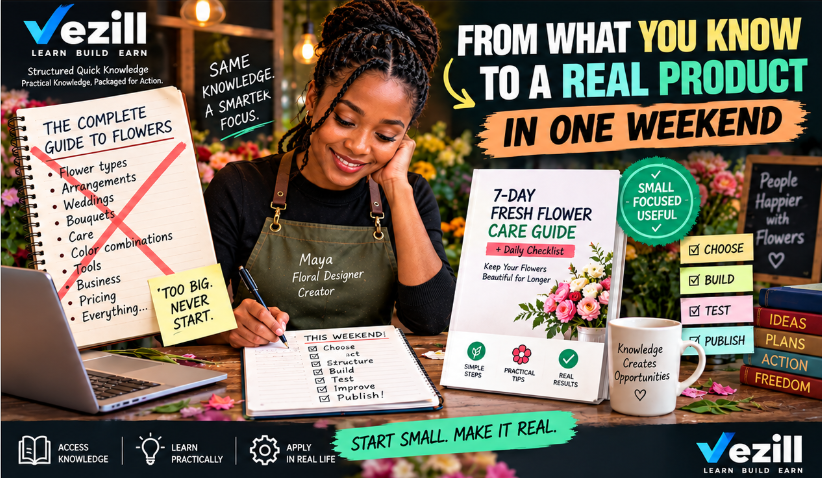
how to create your first knowledge product in one weekend
By Davie
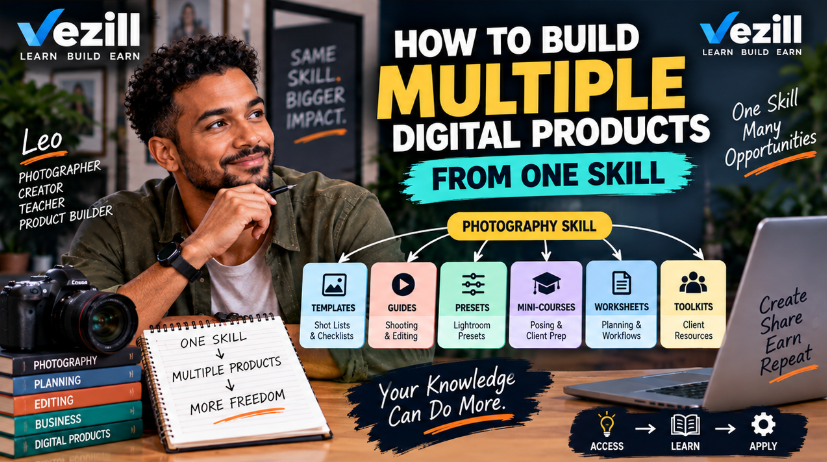
how to build multiple digital products from one skill
By Davie

how to find problems people will pay you to solve
By Davie
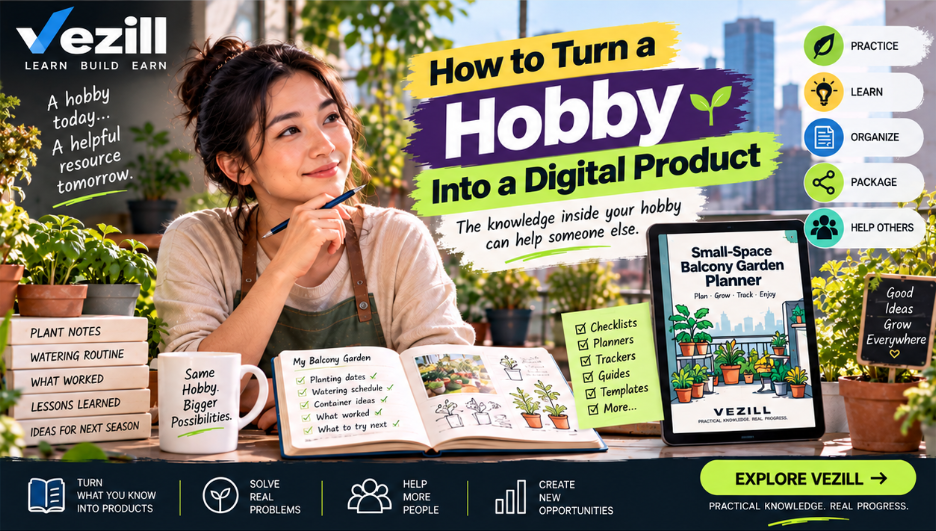
How to turn a hobby into a digital product
By Davie
Get the updates, on newly released, popular & fast-moving MRR digital products
Up to Top