How to Create Your First Knowledge Product in One Weekend
A Friday-to-Sunday execution plan for turning one useful piece of knowledge into a focused, tested and honest Version 1—without pretending a weekend can replace research, expertise or market validation.
FRIDAY EVENING — MAYA FINALLY MAKES THE IDEA SMALLER
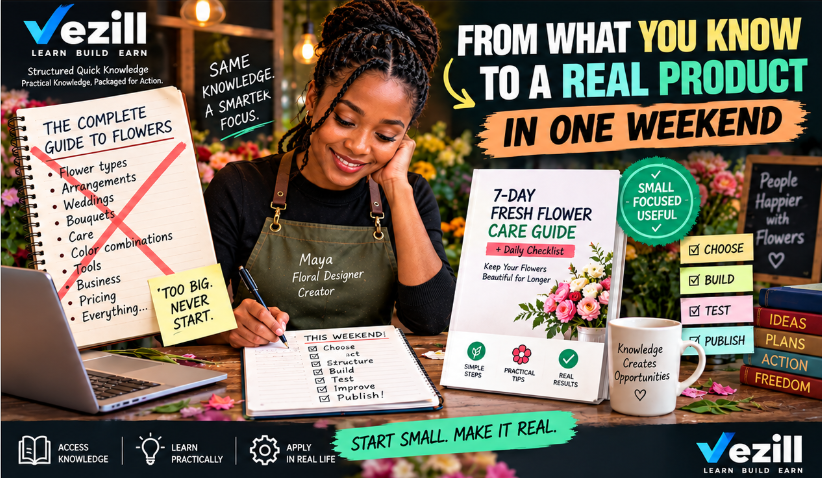
The flower shop is quiet. The last bouquet has been collected, buckets are being emptied, and Maya has cleaned the scissors she used all afternoon. For months, one unfinished task has followed her: CREATE DIGITAL PRODUCT. Her first idea was enormous: The Complete Guide to Flowers—flower types, arrangements, weddings, bouquets, care, color combinations, tools, business, pricing and everything else she knows.
That is exactly why she never starts. Tonight she asks a different question: What useful thing do customers repeatedly ask me that I can explain clearly? One question returns: “How do I keep my flowers fresh after I take them home?” She writes: home flower buyer → unclear care routine → simple evidence-informed routine → 7-Day Fresh Flower Care Guide + Daily Checklist.
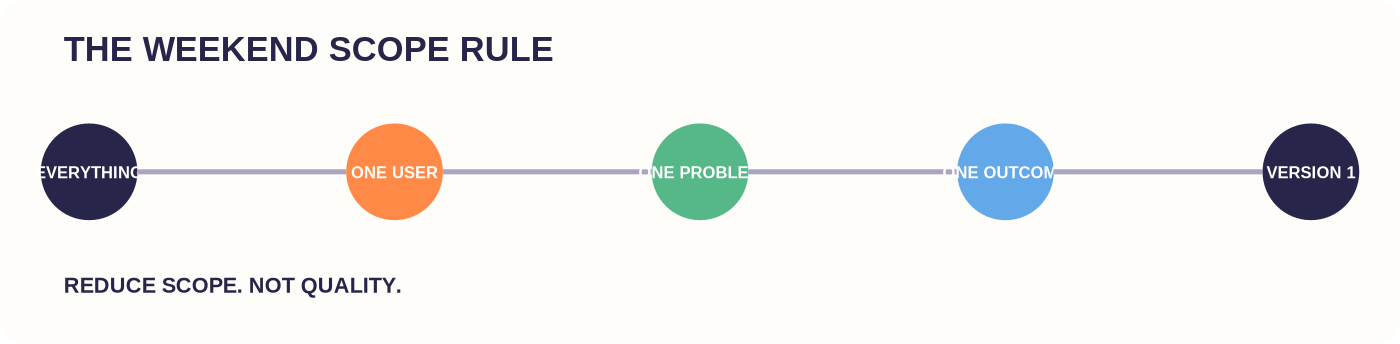
ONE WEEKEND WORKS BY REDUCING SCOPE, NOT REDUCING QUALITY.
QUICK ANSWER
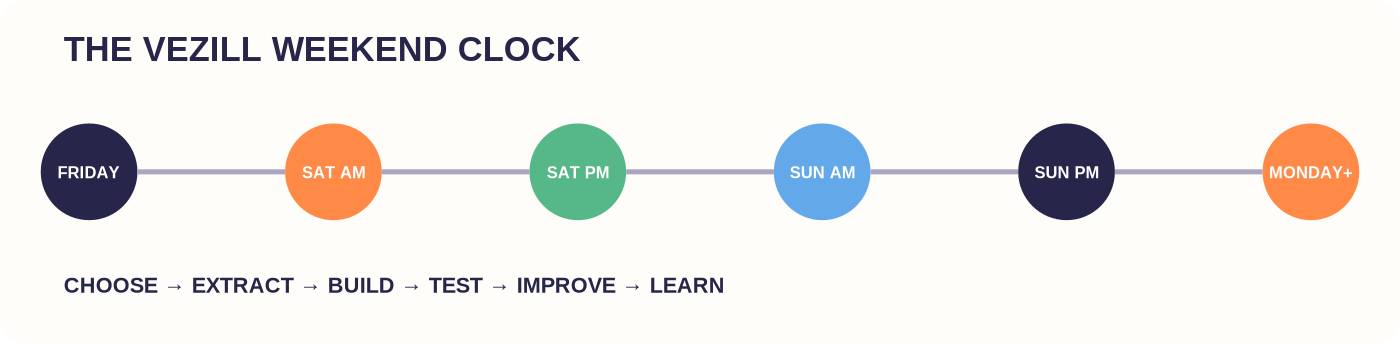
Can you create a knowledge product in one weekend? Sometimes. A weekend can be enough for a focused first version when you already possess or can responsibly verify the underlying knowledge and keep the job narrow. Choose one audience, one problem, one useful outcome and one appropriate format; then choose, extract, structure, build, test, improve and package.
The weekend does not prove demand and is not permission to skip accuracy, safety, privacy, ownership or testing. GOV.UK prototyping guidance emphasizes making and testing prototypes before committing heavily, while its usability guidance recommends watching actual or likely users attempt realistic tasks. Prototyping guidance · Usability testing.
Version 1 is not low quality
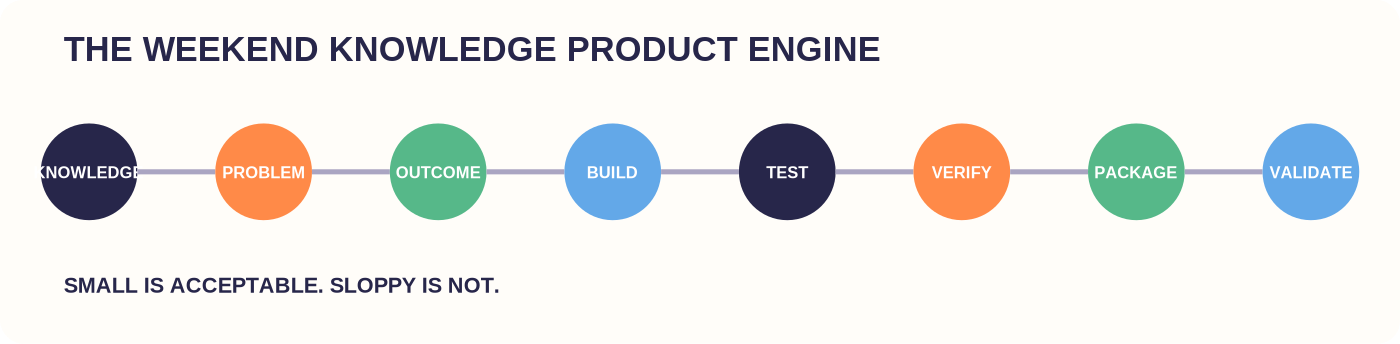
Version 1 means focused, bounded, useful, accurate, clear, tested enough for its stated purpose, honest about limitations and open to improvement. It does not mean unfinished, misleading, factually careless, AI-generated filler, copied content, broken templates or unsafe advice. SMALL IS ACCEPTABLE. SLOPPY IS NOT.
Your first product should solve one job. Think: one type of person + one problem + one outcome + one use case. “People who want to learn flowers” is too broad. “Someone who brings home fresh-cut flowers and needs a simple care routine” gives Maya a boundary.
Before the weekend: the Go / No-Go test
Ask: Do I actually know this? Can I explain the task accurately? Can factual claims be verified? Is the problem narrow enough? Can the promised outcome fit a small product? Can I test the instructions? Do I own the material? Does it involve regulated or high-risk advice? Does it depend on rapidly changing information? If critical answers are unclear, research first rather than forcing the deadline.
THE VEZILL WEEKEND PRODUCT TEST
Score 1–5 on: narrow audience, specific problem, clear outcome, supportable knowledge, small scope, simple format, limited dependencies, testable instructions, low update burden, responsible risk, clear boundaries and realistic build time.
GREEN: plausible weekend Version 1. YELLOW: reduce scope or research more. RED: do not rush. A high score is a planning aid—not proof of demand.
What can actually be built in one weekend?
Potentially suitable products include a focused guide, checklist, worksheet, planner, template, reference sheet, decision tree, prompt cards, workflow, tracker, spreadsheet, simple calculator, script pack, small workbook, SOP or starter toolkit. A comprehensive certification course, complex software platform, huge academy, highly regulated manual or research-heavy reference product usually does not belong inside a two-day deadline.
IF THE PRODUCT NEEDS 17 CHAPTERS, THE PROBLEM MAY STILL BE TOO LARGE.
Friday evening: the 90-minute scope sprint
0–15: list 5–10 things you genuinely know how to do. 15–30: list repeated questions and sticking points. 30–45: choose one problem using evidence you already have. 45–60: complete: “After using this product, the user should be able to ____.” 60–75: choose the format. 75–90: write the brief. By Friday night, do not build the product; decide what it is.
ONE-PAGE PRODUCT BRIEF
Working title: ____ Target user: ____ Situation: ____ Specific problem: ____ Desired outcome: ____ They need to know: ____ They do not need: ____ Format: ____ Promise: ____ Boundary: ____ Source of knowledge: ____ Facts to verify: ____ Safety/professional concerns: ____ Version 1 includes: ____ Version 1 excludes: ____ Test method: ____
WHAT YOU EXCLUDE IS PART OF PRODUCT DESIGN.
Saturday morning: extract knowledge before you design
Do not begin with fonts or a cover. Use voice notes, rough notes, process walkthroughs, examples, old notes you own and checklists. Ask: what happens first? What decisions occur? What does a beginner misunderstand? What do I check? What commonly goes wrong? What example clarifies this? What needs an external source?
THE VEZILL KNOWLEDGE EXTRACTION LOOP
DO THE TASK → DESCRIBE THE STEPS → EXTRACT DECISIONS → EXTRACT CHECKS → EXTRACT MISTAKES → EXTRACT EXAMPLES → MARK FACTS TO VERIFY → REMOVE IRRELEVANT KNOWLEDGE → BUILD THE CORE.
You are not emptying your brain into a PDF. You are selecting the knowledge required for one result.
Saturday afternoon: structure around the user's task
A practical sequence might be: Start Here → What You Need → Step 1 → Step 2 → Step 3 → Decision/Check → Common Mistakes → Troubleshooting → Quick Reference → Action Checklist → Next Step. The order follows the user's task, not the creator's desire to sound comprehensive.
ACCESS → LEARN → APPLY
ACCESS: Can the user quickly understand what this is for? LEARN: Can they understand the necessary knowledge? APPLY: Can they actually use it?
For every section ask whether it helps the user understand, decide or act. If not, remove it, move it, simplify it or justify it.
Saturday evening: build Version 1
Now create the artifact. Keep the stack simple: a document editor for a guide, spreadsheet for calculations or tracking, presentation/design tool for cards, or PDF export for a worksheet. CONTENT FIRST → FUNCTION SECOND → DESIGN THIRD. Design should improve hierarchy, readability, navigation, comprehension and usability—not merely decorate.
Accessibility belongs in the build. W3C recommends meaningful headings, clear instructions, meaningful link text and text alternatives; its design guidance also emphasizes sufficient contrast, not relying on color alone, consistent navigation and different viewport sizes. W3C writing guidance · W3C design guidance.
50 weekend-sized knowledge products to investigate
These are hypotheses, not validated opportunities. Each example deliberately shrinks a broad subject into one bounded job.
Cooking & Baking — Examples 1–5
EXAMPLE 1
Cake Baking Preparation Checklist
Person / skill: Home baker Broad idea to avoid: Complete Baking Encyclopedia Narrow problem: forgets preparation steps Weekend-sized product: Cake Baking Preparation Checklist Format: checklist Promised outcome: prepare a cake bake consistently Leave out: advanced pastry theory and dozens of recipes Validate / verify: test on real bakes; verify food-safety and technical claims.
EXAMPLE 2
Sunday Meal-Prep Planning Sheet
Person / skill: Meal-prep cook Broad idea to avoid: Everything About Meal Prep Narrow problem: loses track of ingredients and prep order Weekend-sized product: Sunday Meal-Prep Planning Sheet Format: planner Promised outcome: turn a chosen menu into a prep sequence Leave out: medical diets and a huge recipe library Validate / verify: verify storage and food-safety guidance.
EXAMPLE 3
Basic Bread Mise-en-Place Card
Person / skill: Bread hobbyist Broad idea to avoid: Complete Bread Course Narrow problem: forgets what to prepare before a basic loaf Weekend-sized product: Basic Bread Mise-en-Place Card Format: reference card Promised outcome: gather ingredients, tools and timing Leave out: advanced fermentation science Validate / verify: verify recipe-specific technical claims.
EXAMPLE 4
Weeknight Cooking Setup Checklist
Person / skill: Home cook Broad idea to avoid: Master Every Kitchen Technique Narrow problem: repeats setup mistakes Weekend-sized product: Weeknight Cooking Setup Checklist Format: checklist Promised outcome: prepare workspace and ingredients Leave out: professional-chef theory Validate / verify: test whether it reduces forgotten steps.
EXAMPLE 5
Simple Cake Decorating Prep Sheet
Person / skill: Cake decorator Broad idea to avoid: Ultimate Decorating Academy Narrow problem: beginners arrive unprepared Weekend-sized product: Simple Cake Decorating Prep Sheet Format: worksheet Promised outcome: prepare tools, icing, cake and workspace Leave out: complex structural cake work Validate / verify: verify food handling guidance.
Photography / Creative — Examples 6–10
EXAMPLE 6
Small Event Essential Shot-List Planner
Person / skill: Event photographer Broad idea to avoid: Complete Photography Course Narrow problem: forgets essential coverage Weekend-sized product: Small Event Essential Shot-List Planner Format: planner Promised outcome: plan essential coverage Leave out: camera theory and editing mastery Validate / verify: test across real small-event scenarios.
EXAMPLE 7
Portrait Session Client Prep Sheet
Person / skill: Portrait photographer Broad idea to avoid: Portrait Photography Bible Narrow problem: clients do not know how to prepare Weekend-sized product: Portrait Session Client Prep Sheet Format: guide + checklist Promised outcome: arrive prepared for a portrait session Leave out: posing mastery and retouching Validate / verify: test with likely clients.
EXAMPLE 8
Design Client Asset Checklist
Person / skill: Graphic designer Broad idea to avoid: Complete Design Handbook Narrow problem: clients send incomplete assets Weekend-sized product: Design Client Asset Checklist Format: checklist Promised outcome: collect needed brand files and content Leave out: design theory and software training Validate / verify: test against actual workflow.
EXAMPLE 9
Illustration Brief Worksheet
Person / skill: Illustrator Broad idea to avoid: Learn Illustration From Scratch Narrow problem: commission briefs are vague Weekend-sized product: Illustration Brief Worksheet Format: worksheet Promised outcome: collect purpose, dimensions and references Leave out: drawing instruction and pricing advice Validate / verify: test with likely clients.
EXAMPLE 10
Basic Product Photo Planning Sheet
Person / skill: Content photographer Broad idea to avoid: Master Product Photography Narrow problem: small sellers forget useful shot types Weekend-sized product: Basic Product Photo Planning Sheet Format: planner Promised outcome: plan a consistent simple shot set Leave out: advanced studio lighting Validate / verify: test with intended sellers.
Small Business — Examples 11–15
EXAMPLE 11
Small Shop Closing Checklist
Person / skill: Retail operator Broad idea to avoid: Complete Operations Manual Narrow problem: closing tasks are inconsistently remembered Weekend-sized product: Small Shop Closing Checklist Format: SOP/checklist Promised outcome: close using a repeatable routine Leave out: tax, HR and security engineering Validate / verify: adapt to the business and verify safety steps.
EXAMPLE 12
Appointment Preparation Worksheet
Person / skill: Salon owner Broad idea to avoid: Salon Business Masterclass Narrow problem: appointment prep is scattered Weekend-sized product: Appointment Preparation Worksheet Format: worksheet Promised outcome: collect necessary pre-appointment information Leave out: medical/dermatological advice Validate / verify: check privacy and necessity of fields.
EXAMPLE 13
Small Event Prep Tracker
Person / skill: Caterer Broad idea to avoid: Catering Business Bible Narrow problem: small-event prep is scattered Weekend-sized product: Small Event Prep Tracker Format: tracker Promised outcome: track agreed preparation tasks Leave out: full food-safety manual and pricing Validate / verify: verify safety content separately.
EXAMPLE 14
Simple Order Status Tracker
Person / skill: Online seller Broad idea to avoid: Complete Ecommerce Course Narrow problem: orders lack consistent status tracking Weekend-sized product: Simple Order Status Tracker Format: spreadsheet Promised outcome: track order, payment, dispatch and completion Leave out: tax and payment-processing advice Validate / verify: test formulas and privacy fields.
EXAMPLE 15
Client Onboarding Starter Checklist
Person / skill: Consultant Broad idea to avoid: Run a Consultancy Course Narrow problem: onboarding steps vary Weekend-sized product: Client Onboarding Starter Checklist Format: checklist Promised outcome: run a defined onboarding sequence Leave out: legal contracts Validate / verify: test workflow; seek legal review where needed.
Freelancing — Examples 16–20
EXAMPLE 16
Website Content Preparation Workbook
Person / skill: Web designer Broad idea to avoid: Complete Freelancing Course Narrow problem: clients do not know what content to prepare Weekend-sized product: Website Content Preparation Workbook Format: workbook Promised outcome: collect core page content before design Leave out: coding and hosting administration Validate / verify: test with small-business clients.
EXAMPLE 17
Copywriting Brief Builder
Person / skill: Copywriter Broad idea to avoid: Copywriting Empire Guide Narrow problem: briefs omit audience and offer context Weekend-sized product: Copywriting Brief Builder Format: worksheet Promised outcome: collect minimum project inputs Leave out: persuasion theory and revenue promises Validate / verify: test without exposing client data.
EXAMPLE 18
Weekly Client Task Planner
Person / skill: Virtual assistant Broad idea to avoid: VA Masterclass Narrow problem: weekly tasks lack priorities Weekend-sized product: Weekly Client Task Planner Format: planner Promised outcome: clarify priorities, owners and deadlines Leave out: full project-management training Validate / verify: test with realistic workflow.
EXAMPLE 19
Design File Handoff Checklist
Person / skill: Freelance designer Broad idea to avoid: Freelance Design Course Narrow problem: file handoff is inconsistent Weekend-sized product: Design File Handoff Checklist Format: checklist Promised outcome: deliver agreed files consistently Leave out: contract law Validate / verify: test on actual project types.
EXAMPLE 20
Footage Handoff Preparation Sheet
Person / skill: Video editor Broad idea to avoid: Video Editing Academy Narrow problem: footage arrives disorganized Weekend-sized product: Footage Handoff Preparation Sheet Format: guide + checklist Promised outcome: label and transfer assets clearly Leave out: editing instruction Validate / verify: verify current tool instructions.
Career / Job Search — Examples 21–25
EXAMPLE 21
Interview Example Preparation Worksheet
Person / skill: Career mentor Broad idea to avoid: Ultimate Career Course Narrow problem: job seekers prepare examples too late Weekend-sized product: Interview Example Preparation Worksheet Format: workbook Promised outcome: organize evidence before an interview Leave out: guaranteed answers or hiring promises Validate / verify: test clarity and current conventions.
EXAMPLE 22
CV Evidence Collection Sheet
Person / skill: Recruiter Broad idea to avoid: Complete CV Masterclass Narrow problem: applicants forget facts before drafting Weekend-sized product: CV Evidence Collection Sheet Format: worksheet Promised outcome: collect roles, dates and achievements Leave out: universal CV rules Validate / verify: validate local conventions.
EXAMPLE 23
First 1:1 Preparation Card
Person / skill: Team lead Broad idea to avoid: Management Academy Narrow problem: new supervisors underprepare for 1:1s Weekend-sized product: First 1:1 Preparation Card Format: prompt card Promised outcome: prepare a simple agenda Leave out: HR/legal policy Validate / verify: defer regulated HR matters.
EXAMPLE 24
Job Application Tracker
Person / skill: Job-search coach Broad idea to avoid: Get Any Job Guide Narrow problem: applications are scattered Weekend-sized product: Job Application Tracker Format: spreadsheet Promised outcome: track roles, dates and follow-up Leave out: salary and hiring guarantees Validate / verify: test formulas and privacy.
EXAMPLE 25
Portfolio Evidence Checklist
Person / skill: Portfolio mentor Broad idea to avoid: Personal Branding Course Narrow problem: beginners do not know what evidence to collect Weekend-sized product: Portfolio Evidence Checklist Format: checklist Promised outcome: gather project evidence Leave out: finished portfolio design Validate / verify: test against target field.
Content / Social Media — Examples 26–30
EXAMPLE 26
Weekly Content Planning Worksheet
Person / skill: Social media manager Broad idea to avoid: Complete Social Media Course Narrow problem: businesses plan reactively Weekend-sized product: Weekly Content Planning Worksheet Format: worksheet Promised outcome: plan a manageable content week Leave out: algorithm and growth guarantees Validate / verify: verify platform-specific claims.
EXAMPLE 27
Video Planning One-Pager
Person / skill: YouTube creator Broad idea to avoid: YouTube Success Masterclass Narrow problem: recording begins without structure Weekend-sized product: Video Planning One-Pager Format: worksheet Promised outcome: define hook, sections and proof Leave out: algorithm hacks Validate / verify: test on several videos.
EXAMPLE 28
Newsletter Issue Planning Card
Person / skill: Newsletter writer Broad idea to avoid: Newsletter Growth Bible Narrow problem: every issue starts from zero Weekend-sized product: Newsletter Issue Planning Card Format: prompt card Promised outcome: plan one issue around one need Leave out: deliverability engineering Validate / verify: test whether it shortens planning.
EXAMPLE 29
Announcement Template Pack
Person / skill: Community manager Broad idea to avoid: Community Building Course Narrow problem: announcements are rewritten each time Weekend-sized product: Announcement Template Pack Format: script pack Promised outcome: draft common operational notices Leave out: crisis and legal notices Validate / verify: adapt templates to context.
EXAMPLE 30
Guest Episode Research Worksheet
Person / skill: Podcaster Broad idea to avoid: Podcasting A to Z Narrow problem: guest episodes lack preparation Weekend-sized product: Guest Episode Research Worksheet Format: worksheet Promised outcome: prepare context and questions Leave out: audio engineering Validate / verify: test with public-source research.
Home / Organization — Examples 31–35
EXAMPLE 31
One-Room Declutter Decision Sheet
Person / skill: Home organizer Broad idea to avoid: Complete Home System Narrow problem: decluttering starts without decisions Weekend-sized product: One-Room Declutter Decision Sheet Format: decision guide Promised outcome: work through one room Leave out: whole-house renovation Validate / verify: test disposal guidance locally.
EXAMPLE 32
Weekly Home Reset Checklist
Person / skill: Household planner Broad idea to avoid: Home Management Binder Narrow problem: weekly tasks are forgotten Weekend-sized product: Weekly Home Reset Checklist Format: checklist Promised outcome: run a short weekly reset Leave out: professional maintenance procedures Validate / verify: test sequence.
EXAMPLE 33
Pre-Move Admin Checklist
Person / skill: Moving coordinator Broad idea to avoid: Complete Moving Guide Narrow problem: admin tasks are forgotten Weekend-sized product: Pre-Move Admin Checklist Format: checklist Promised outcome: track key pre-move tasks Leave out: legal tenancy advice Validate / verify: localize jurisdiction-specific items.
EXAMPLE 34
Wardrobe Inventory Sheet
Person / skill: Wardrobe organizer Broad idea to avoid: Complete Style Course Narrow problem: people cannot see what they use Weekend-sized product: Wardrobe Inventory Sheet Format: tracker Promised outcome: record useful wardrobe categories Leave out: body-image advice Validate / verify: test category usefulness.
EXAMPLE 35
Household Bill Calendar
Person / skill: Household organizer Broad idea to avoid: Personal Finance Masterclass Narrow problem: bill dates are scattered Weekend-sized product: Household Bill Calendar Format: planner Promised outcome: record recurring due dates Leave out: investment, debt and tax advice Validate / verify: test calculations.
Students / Learning — Examples 36–40
EXAMPLE 36
7-Day Revision Planner
Person / skill: Study-skills tutor Broad idea to avoid: Study Mastery Course Narrow problem: revision is not broken into sessions Weekend-sized product: 7-Day Revision Planner Format: planner Promised outcome: turn a syllabus slice into a week plan Leave out: grade guarantees Validate / verify: align to actual syllabus.
EXAMPLE 37
Post-Lesson Review Sheet
Person / skill: Tutor Broad idea to avoid: Everything About Note Taking Narrow problem: students do not know what to review Weekend-sized product: Post-Lesson Review Sheet Format: worksheet Promised outcome: capture ideas, gaps and next actions Leave out: teaching outside competence Validate / verify: test with one subject.
EXAMPLE 38
Vocabulary Error Log
Person / skill: Language mentor Broad idea to avoid: Fluency in 30 Days Narrow problem: learners repeat vocabulary errors Weekend-sized product: Vocabulary Error Log Format: tracker Promised outcome: record recurring errors Leave out: fluency guarantees Validate / verify: test fields with learners.
EXAMPLE 39
Assignment Brief Breakdown Sheet
Person / skill: University mentor Broad idea to avoid: University Success Guide Narrow problem: briefs are not translated into tasks Weekend-sized product: Assignment Brief Breakdown Sheet Format: worksheet Promised outcome: identify deliverables and constraints Leave out: doing assessed work for the student Validate / verify: respect academic integrity.
EXAMPLE 40
Topic Confidence Audit
Person / skill: Exam-prep coach Broad idea to avoid: Ace Every Exam Narrow problem: learners cannot see weak topics Weekend-sized product: Topic Confidence Audit Format: worksheet Promised outcome: prioritize topics for study Leave out: predicted grades Validate / verify: align to official syllabus.
Events / Hospitality — Examples 41–45
EXAMPLE 41
Event-Day Responsibility Checklist
Person / skill: Event planner Broad idea to avoid: Complete Event Course Narrow problem: responsibilities are scattered Weekend-sized product: Event-Day Responsibility Checklist Format: checklist Promised outcome: assign responsibilities before an event Leave out: large-event safety manuals Validate / verify: verify venue and safety needs.
EXAMPLE 42
7-Day Fresh Flower Care Guide + Daily Checklist
Person / skill: Florist Broad idea to avoid: Complete Guide to Flowers Narrow problem: home buyers are unsure how to care for bouquets Weekend-sized product: 7-Day Fresh Flower Care Guide + Daily Checklist Format: guide + checklist Promised outcome: follow a simple evidence-informed routine Leave out: floral business and unsupported longevity promises Validate / verify: verify species-sensitive advice.
EXAMPLE 43
Room Turnover Checklist
Person / skill: Guesthouse host Broad idea to avoid: Hospitality Masterclass Narrow problem: room-turnover steps vary Weekend-sized product: Room Turnover Checklist Format: SOP/checklist Promised outcome: run a consistent room reset Leave out: building and food safety manuals Validate / verify: test against property rules.
EXAMPLE 44
Family Group Photo Planning Sheet
Person / skill: Wedding photographer Broad idea to avoid: Wedding Photography Academy Narrow problem: couples do not plan family groupings Weekend-sized product: Family Group Photo Planning Sheet Format: worksheet Promised outcome: list desired groupings Leave out: guaranteed coverage Validate / verify: test with couples.
EXAMPLE 45
Event Load-Out Checklist
Person / skill: Small-event caterer Broad idea to avoid: Catering Empire Course Narrow problem: non-food logistics are forgotten Weekend-sized product: Event Load-Out Checklist Format: checklist Promised outcome: confirm agreed equipment before departure Leave out: food and vehicle safety procedures Validate / verify: verify safety requirements.
Digital / Tech Skills — Examples 46–50
EXAMPLE 46
Website Content Starter Workbook
Person / skill: Web designer Broad idea to avoid: Build Websites Course Narrow problem: clients cannot prepare page content Weekend-sized product: Website Content Starter Workbook Format: workbook Promised outcome: gather core content before design Leave out: coding and hosting configuration Validate / verify: test with likely clients.
EXAMPLE 47
Weekly Status Tracker
Person / skill: Spreadsheet user Broad idea to avoid: Excel Masterclass Narrow problem: weekly status is inconsistent Weekend-sized product: Weekly Status Tracker Format: spreadsheet Promised outcome: record owner, task and next step Leave out: complex automation Validate / verify: test formulas and accessibility.
EXAMPLE 48
Simple App Flow Worksheet
Person / skill: No-code builder Broad idea to avoid: No-Code App Academy Narrow problem: beginners build before mapping flow Weekend-sized product: Simple App Flow Worksheet Format: worksheet Promised outcome: map users, screens and actions Leave out: security and production deployment Validate / verify: test with a prototype.
EXAMPLE 49
AI Task Brief Template
Person / skill: AI power user Broad idea to avoid: Ultimate AI Course Narrow problem: people prompt without context Weekend-sized product: AI Task Brief Template Format: template Promised outcome: define goal, inputs and review criteria Leave out: correctness guarantees Validate / verify: require human verification.
EXAMPLE 50
Monthly Website Content Check
Person / skill: Website owner Broad idea to avoid: Website Maintenance Course Narrow problem: routine content checks are forgotten Weekend-sized product: Monthly Website Content Check Format: checklist Promised outcome: review links and key content Leave out: cybersecurity audit and legal compliance Validate / verify: keep security out of scope.
Sunday morning: test the product, not just the cover
Walk through every instruction, link, formula, spreadsheet field, template, page and example. Ask whether someone can understand it without you beside them, whether anything is missing or ambiguous, whether the sequence works, whether claims are supported, whether the file works on mobile, and whether the promise matches what the artifact delivers. DO NOT SELL INSTRUCTIONS YOU HAVE NOT WALKED THROUGH YOURSELF.
The Stranger Test
Where possible, give Version 1 to one or more people who resemble the intended user. Do not explain it first. Give them a realistic task and observe where they stop, hesitate, misunderstand, skip or ask for help. Then ask what they thought the product would help them do, what was confusing, what was missing and what felt unnecessary. One friendly tester gives usability evidence—not market validation.
THE VEZILL USEFULNESS TEST
Score 1–5: clarity, specificity, accuracy, actionability, sequence, completeness for the stated job, ease of use, format fit, visual readability, example quality, safety/responsibility and promise match.
Fix the lowest scores first. Do not spend Sunday redesigning the cover while the instructions remain confusing.
Sunday afternoon: improve without destroying scope
Classify feedback as CRITICAL (blocks use), IMPORTANT (makes use harder), OPTIONAL (preference/polish), or OUT OF SCOPE (turns the product into something else). Not every suggestion belongs in Version 1. FEEDBACK SHOULD IMPROVE THE PROMISE. IT SHOULD NOT DESTROY THE SCOPE.
Sunday evening: package the actual deliverable
Finalize title, subtitle, audience, outcome, file name, version, date, format, cover/first page, instructions, sources where required, appropriate disclaimers and support/contact method if offered. Test the final file, mobile display and download path. Then prepare the product description and thumbnail. Publish, share for testing, run a small validation test, revise—or wait for more evidence.
The 10-page challenge
Imagine Version 1 can only be ten useful pages: Start Here, What You Need, three core steps, a decision guide, common mistakes, one example, an action checklist and a quick reference. Ten is not a universal ideal; the constraint forces prioritization. A legitimate product might need three pages or thirty. DO NOT SELL PAGES. SELL CLARITY AND USEFULNESS.
Format should follow the job
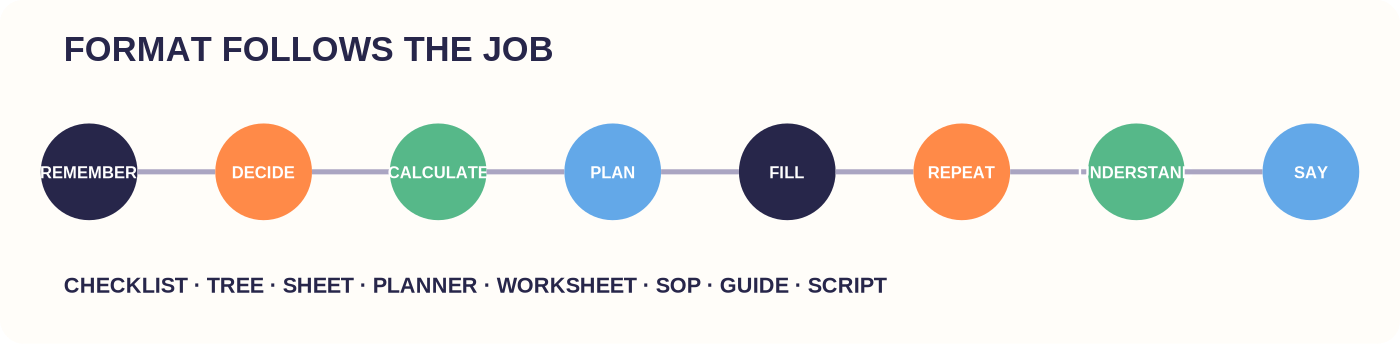
Need to remember? Checklist. Decide? Decision tree. Calculate or track? Spreadsheet. Plan? Planner. Fill in thinking? Worksheet. Repeat a process? SOP. Understand? Guide. See examples? Example library. Use wording? Script/template. Reference quickly? Reference card. Do not start with “I want to make an ebook.” Start with: What format makes this task easier?
Five deeper weekend case studies
1. Maya — florist
Maya rejects a giant flower encyclopedia and scopes a 7-Day Fresh Flower Care Guide + Daily Checklist. Her factual care guidance is checked against university extension sources. NC State Extension recommends a clean vase, removing leaves below the waterline, placing arrangements away from direct sun and drafts, monitoring water, and changing water every 2–3 days with fresh stem cuts. Illinois Extension likewise stresses clean vessels, removing submerged foliage and avoiding heat/direct sunlight. Species and conditions differ, so Maya does not promise every bouquet will last seven days.
2. Photographer
The broad idea is a complete photography course. The weekend hypothesis is a Small Event Essential Shot-List Planner. Friday defines the event type and scope; Saturday extracts the photographer's real planning method; Sunday tests whether another photographer can use the planner without extra explanation. It does not guarantee that every moment will be captured.
3. Freelance web designer
Instead of teaching web design, the creator builds a Website Content Preparation Workbook for small-business clients. It collects business description, services, contact details, images, brand assets, FAQs and calls to action before design. Its job is preparation—not coding.
4. Home baker
Instead of a complete baking ebook, the creator investigates a Cake Baking Preparation + Troubleshooting Checklist. Recipe-specific and food-safety guidance is verified rather than improvised, and the product stays within a narrow stated use case.
5. Social media manager
Instead of a complete marketing course, the creator builds a Weekly Content Planning Worksheet for small businesses. It helps define goals, themes, post ideas and production needs while avoiding algorithm predictions and guaranteed growth.
Use AI as a packaging assistant, not a source of fake expertise
AI can interview you, transcribe rough thinking, organize notes, identify repetition, propose structure, clarify language, generate test questions and run a QA pass. It must not fabricate your experience, credentials, customer stories, statistics, laws, research, demand, testimonials or sales. OpenAI's current guidance warns that ChatGPT can produce incorrect information and fabricated citations and recommends verifying important claims. OpenAI guidance.
VEZILL WEEKEND PRODUCT AI PROMPT
PHASE 1 — SCOPE I want to create a SMALL first knowledge product from knowledge I genuinely have. My skill: [ ]. My real experience: [ ]. People who ask me about this: [ ]. Questions/problems observed: [ ]. Weekend time: [ ]. Do not generate the product yet. Identify the smallest useful problem I may be able to address. Show target user, problem, outcome, what I know, what needs research, risk, format and complexity. Separate user evidence, inference, assumption and missing evidence. Do not claim demand.
PHASE 2 — EXTRACT: Interview me one question at a time about preparation, steps, decisions, checks, mistakes, troubleshooting, examples, exceptions and quality control. Do not invent expertise.
PHASE 3 — STRUCTURE: Using only supported knowledge, propose the simplest structure for the stated outcome and flag claims requiring verification.
PHASE 4 — QA: Critically check clarity, sequence, missing steps, ambiguity, duplication, unsupported claims, scope creep, format fit, promise match and safety concerns.
The Sunday fact-checking sprint
Label claims A — MY EXPERIENCE, B — VERIFIABLE FACT, or C — PROFESSIONAL / REGULATED CLAIM. Experience can be described honestly. Verifiable facts need reliable sources. Regulated or high-risk claims need heightened caution and may require qualified review. “I usually do X” is not the same as “X is scientifically proven to do Y.” EXPERIENCE CAN INFORM A PRODUCT. IT SHOULD NOT DISGUISE ITSELF AS SCIENTIFIC EVIDENCE.
Copyright, ownership and privacy still apply
Check whether you wrote the text, own or licensed the graphics/photos, copied employer material, reproduced a course, reused someone else's template, or exposed customer information. U.S. Copyright Office guidance explains that copyright protects original expression but not ideas, methods or systems themselves; laws differ by jurisdiction, so this is not universal legal advice. Copyright Office Circular 31.
In Kenya, the Office of the Data Protection Commissioner says personal data should be processed lawfully, fairly, transparently and for explicit purposes, with data-subject rights including information, access, objection, correction and deletion in specified circumstances. Do not casually publish customer names, phone numbers, emails, addresses, payment details, private messages or client documents. ODPC guidance.
TWO RULES
A WEEKEND DEADLINE DOES NOT SHORTEN COPYRIGHT LAW.
EXTRACT THE LESSON. PROTECT THE PERSON.
When not to create it in one weekend
Do not rush products requiring substantial expert review in medical treatment, legal advice, investment recommendations, tax advice, structural engineering, electrical safety, chemical handling, high-risk agricultural chemicals, mental-health treatment or complex health/nutrition claims. Slow down when you lack real knowledge, information changes rapidly, licensing is needed, original datasets are required, significant software must be developed or the product cannot be tested responsibly. SOMETIMES THE MOST RESPONSIBLE WEEKEND DECISION IS TO KEEP RESEARCHING.
Kenya and Africa: local context can be the knowledge
Locally relevant weekend hypotheses might include an Event-Day Responsibility Checklist, Small Event Shot Planner, Client Measurement Preparation Sheet, Weekly Content Planning Worksheet or Website Content Preparation Workbook. The useful knowledge may be partly contextual: how people coordinate, communicate and work locally. But do not assume Kenyan buyers behave like U.S. buyers; validate locally.
For KRA, SHA, eCitizen, education systems, tax, employment law or other regulated/current processes, use official Kenyan sources and update the product as systems change. LOCAL KNOWLEDGE CAN BE VALUABLE BECAUSE CONTEXT CHANGES HOW A TASK IS DONE.
Publishing is not validation
By Sunday night you may have a file, listing, landing page or testable Version 1. You do not automatically have product-market fit, proven demand, customers, profitability or a scalable business. SUNDAY NIGHT CAN GIVE YOU A PRODUCT. THE MARKET STILL HAS TO GIVE YOU EVIDENCE.
What to do Monday
Monday is not automatically “start product #2.” Observe usage, share appropriately, collect questions, fix errors, test positioning, talk to likely users and measure behavior. Then decide: KEEP · IMPROVE · REPOSITION · EXPAND · BUNDLE LATER · DROP. The weekend creates Version 1. Monday begins the learning loop.
Where VEZILL fits
VEZILL's model treats knowledge as the value and the digital product as the container. This workflow is: what you know → practical knowledge → one problem → package → knowledge product → person who needs to know how → access → learn → apply.
Can I really create a knowledge product in one weekend?
What is the easiest knowledge product to create first?
How do I choose a topic for my first knowledge product?
How long should my first digital guide or ebook be?
Should my first product be a guide, checklist, template or workbook?
How do I know if my knowledge is good enough to package?
Can I use AI to create my first knowledge product?
How do I fact-check a digital product created quickly?
How do I test my product before publishing it?
Does publishing a product mean the idea is validated?
What should I do after creating my first knowledge product?
Where can I publish a knowledge product after I create it?
Sunday night: Maya has something small enough to be real
On Friday, Maya's notebook said THE COMPLETE GUIDE TO FLOWERS and nothing existed. On Sunday it says: one clear user, one specific problem, one bounded outcome, one tested Version 1. She checked the sequence, verified factual care claims, tested the checklist, improved unclear instructions, checked the file and reviewed the promise.
She has not built a floristry empire, proven demand or created twenty products. She finished one small product a real person can use. MAYA DID NOT FINISH EVERYTHING SHE KNOWS. SHE FINISHED ONE USEFUL PIECE OF IT.