
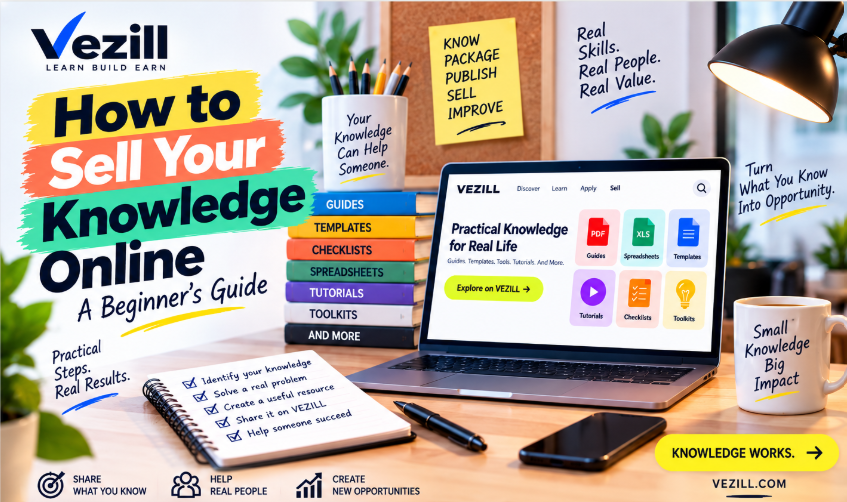
Turn useful skills, experience and processes into practical digital resources people can buy, apply and benefit from—without pretending to know more than you do.
Mary has worked in a small catering business for six years. She knows how to estimate food quantities for events, calculate ingredient costs, prepare quotations, organize preparation, reduce waste and price smaller catering jobs. To her, much of that knowledge feels ordinary because she uses it every week.
When she hears people talk about selling digital products, she imagines influencers with huge audiences, expensive cameras, advanced software or university credentials. She thinks, “I do not have anything to sell online.”
But Mary has something beginners still struggle with: she knows how to solve problems they have not yet learned to solve. Her knowledge could become a small-event catering cost calculator, a catering quotation template, a 50–100 guest preparation checklist or a beginner pricing guide.
WHAT FEELS OBVIOUS TO YOU MAY STILL BE VALUABLE TO SOMEONE WHO HAS NOT LEARNED IT YET. QUICK ANSWER
You can sell your knowledge online by identifying a specific problem you genuinely know how to solve, choosing the person who needs that knowledge, packaging your process into a useful format such as a guide, template, checklist, spreadsheet, tutorial or toolkit, validating demand, creating the resource, pricing it, publishing it and improving it using buyer feedback.
KNOW SOMETHING USEFUL → SOLVE A SPECIFIC PROBLEM → PACKAGE IT → PUBLISH → HELP SOMEONE APPLY IT → GET PAID YOU ARE NOT SELLING INFORMATION JUST BECAUSE YOU KNOW IT.
YOU ARE SELLING ORGANIZED USEFULNESS.
Selling knowledge online does not mean transferring thoughts out of your head. It means converting useful skills, experience, processes or organized information into a digital resource another person can access and apply. That resource might be a guide, ebook, template, checklist, spreadsheet, calculator, tutorial, SOP, framework, workbook, prompt pack, reference sheet, mini-course or toolkit.
The transformation usually looks like this: experience or skill → lessons → process → resource → buyer → application. The resource is the container. The value is the useful knowledge inside it and the degree to which it helps someone accomplish something.
That is why VEZILL’s article on turning work experience into a digital product focuses on extracting one repeatable problem, identifying a target user and packaging a useful outcome rather than simply writing “an ebook about what you know.”
Beginners often ask, “What do I know that anyone would pay for?” The easiest place to start is not with a product format. Start by looking at the useful things already embedded in your work, projects, hobbies and routines.
You may know how to create invoices, edit videos, prepare specific meals, build budgets, design posters, use Excel, build a simple website, grow vegetables, manage a social page or repair a common problem. A skill becomes more commercially interesting when it maps to a specific buyer and outcome.
You may have solved stock problems, event-budget problems, client-finding problems, study problems, meal-planning problems, record-keeping problems or software setup problems. The lesson is often hidden in the fix.
What do people repeatedly ask you to do? What procedure have you performed enough times that you now have a sequence, shortcut or checklist? Repeatable work often contains the raw material for a practical knowledge product.
A mistake can become valuable when you understand why it happened, how to prevent it and how another person can detect the same problem early.
You may not have invented the underlying facts. You may have simplified them, contextualized them, tested a workflow, built a calculator, created examples or converted a confusing process into a checklist. That organization can be useful—as long as you respect copyright, licensing and the rights of original creators.
To go deeper, use VEZILL’s framework for identifying valuable knowledge you already have.
Use this as a brainstorming exercise. It is an original VEZILL framework, not a scientific assessment of expertise.
WHAT I KNOW
Skills, subjects and processes I understand.
WHAT I DO
Tasks I perform repeatedly.
WHAT PEOPLE ASK ME
Recurring questions and requests.
WHAT I HAVE SOLVED
Problems I can now solve more reliably.
WHAT I LEARNED THE HARD WAY
Mistakes, warnings and lessons.
TOOLS I CREATED
Templates, spreadsheets, prompts, formulas and checklists.
KNOW → DO → SOLVE → LEARN → PACKAGE
 Product opportunities often hide inside repeated tasks, solved problems and tools you already use.
A beginner learning Excel does not necessarily need the world’s best data scientist. They may need someone who can clearly show them how to build a first monthly expense tracker. A new caterer may not need a hospitality professor. They may need a reliable food-quantity calculator and quotation template created by someone who has actually used them.
YOU DO NOT HAVE TO KNOW EVERYTHING ABOUT A SUBJECT TO TEACH ONE THING YOU LEGITIMATELY KNOW HOW TO DO.
That does not give permission to exaggerate. Never invent qualifications, experience, results or expertise. Teach within the boundaries of what you actually know and can responsibly support. Medical, legal, regulated financial, electrical, structural and other safety-critical topics may require recognized professionals or authoritative sources.
TEACH WITHIN THE BOUNDARIES OF WHAT YOU ACTUALLY KNOW.
“Excel” is not a product. “Cooking” is not a product. “Facebook advertising” is not a product. Those are broad knowledge areas. A useful product needs boundaries.
BROAD KNOWLEDGE → SPECIFIC PERSON → SPECIFIC PROBLEM → SPECIFIC RESULT → PRODUCT
Excel → small-business owner → cannot track expenses → wants monthly visibility → Small Business Expense Tracker + Setup Guide.
Cooking → beginner living alone → keeps wasting groceries → wants simple weekly meals → 7-Day Beginner Meal Planning System.
Social media → small salon → does not know what to post → needs consistency → 30-Day Salon Social Media Content Planner.
PEOPLE RARELY BUY “KNOWLEDGE.”
THEY BUY HELP MOVING FROM A PROBLEM TOWARD A RESULT.
 A useful knowledge product needs a defined person, problem and outcome.
WHAT I KNOW + WHO NEEDS IT + WHAT THEY ARE TRYING TO DO + WHAT STOPS THEM + THE SHORTEST USEFUL PATH = PRACTICAL KNOWLEDGE PRODUCT
The formula is conceptual, not mathematical. Its purpose is to stop creators from beginning with file type. If you start with “I want to make a PDF,” you may fill pages before defining the problem. If you start with the desired result, the correct format becomes easier to see.
START WITH THE RESULT, NOT THE PDF.
| If the buyer needs... | A useful format might be... |
|---|---|
| Explanation | Guide or concise ebook |
| Repeated process | Checklist |
| Numbers or calculations | Spreadsheet or calculator |
| Ready-made structure | Template |
| Exact operational sequence | SOP |
| Visual demonstration | Video tutorial |
| Questions to ask AI | Prompt pack |
| Multiple connected resources | Toolkit |
| Practice | Workbook |
| Broader capability | Course |
DO NOT TURN EVERY IDEA INTO AN EBOOK.
Sometimes a one-page checklist is more useful than seventy pages of text. A spreadsheet can save more time than a long explanation. A short video may be better when the buyer must see a physical action. A course makes more sense when the user needs broad capability, repeated practice and feedback.
THE BEST FORMAT IS THE ONE THAT MAKES THE KNOWLEDGE EASIER TO APPLY.
If someone needs to create their first invoice, they may not need a twenty-hour accounting course. If they want to become an accountant, a quick guide is obviously insufficient.
ONE TASK → QUICK KNOWLEDGE
REPEATED SKILL → DEEPER LEARNING + PRACTICE
This is the distinction developed in VEZILL’s Quick Knowledge vs Online Courses article: match the depth of learning to the depth of capability the goal requires.
Do not spend two weeks creating a 100-page ebook before checking whether the problem matters to the buyer you have in mind. Validation does not need to begin with complex market research. Start by looking for evidence that the problem already exists.
Useful places to investigate include Google search suggestions, search results, forums, Reddit, YouTube comments, customer reviews, social communities, support questions, questions from clients, product reviews and direct conversations with target users.
Look for repeated frustration, workarounds, recurring mistakes, time-consuming tasks, repeated questions, requests for templates or examples and evidence that people already spend money or effort trying to solve the problem.
DO NOT ASK ONLY, “DO PEOPLE LIKE MY IDEA?”
ASK, “DO PEOPLE ALREADY HAVE THIS PROBLEM?”
This is an original VEZILL decision framework for thinking about demand—not a scientific validation method.
LEVEL 1 — ASSUMPTION · “I think people need this.” LEVEL 2 — SEARCH · People actively search for the problem. LEVEL 3 — DISCUSSION · People repeatedly ask about it. LEVEL 4 — WORKAROUND · People already try to solve it manually. LEVEL 5 — SPENDING · People pay for related solutions. LEVEL 6 — DIRECT DEMAND · People ask you for help. LEVEL 7 — PURCHASE · Someone pays for your solution. A SALE IS STRONGER VALIDATION THAN A LIKE.
A minimum viable product is a familiar startup idea. For knowledge products, a more useful beginner question is: what is the smallest resource that can genuinely help the buyer achieve the promised result?
MUP — MINIMUM USEFUL PRODUCT
Instead of a 100-page guide to freelancing, the first useful product might be a Freelance Client Discovery Call Question Sheet. Instead of a complete restaurant business course, it might be a Restaurant Food Cost Calculator. Instead of “Everything About Social Media,” it might be a 30-Day Instagram Planner for Barbershops.
SMALLER DOES NOT MEAN LOWER VALUE IF IT SOLVES THE PROBLEM FASTER.
A weak knowledge product often becomes information stacked on information. A stronger practical resource helps the buyer move.
EXPLAIN → SHOW → DO → CHECK → ADJUST
Explain: what must the buyer understand? Show: what does a good example look like? Do: what should the buyer actually do next? Check: how can they tell whether it worked? Adjust: what should they change if the result differs?
This is the difference between a document that is merely readable and a resource designed for application.
 Practical knowledge becomes more useful when it includes action and a way to check the result.
AI can help with outlining, editing, rewriting, formatting, brainstorming examples, generating questions, simplifying explanations, organizing notes, converting processes into checklists, translating, proofreading, product descriptions and FAQ generation.
VEZILL’s article What Can I Create and Sell Online Using AI? makes the same quality distinction: AI can accelerate production, but it does not replace expertise, fact-checking, consent, licensing or distribution.
DO NOT ASK AI TO INVENT YOUR EXPERIENCE.
USE AI TO HELP ORGANIZE THE EXPERIENCE YOU ACTUALLY HAVE.
Do not fabricate customer stories, results, qualifications, research, statistics, citations or case studies. If AI helps draft a formula, workflow or factual explanation, verify it before selling it as part of a product.
HUMAN KNOWLEDGE + AI ASSISTANCE → BETTER PACKAGED KNOWLEDGE, WHEN USED RESPONSIBLY.
1Is the buyer clear? 2Is the problem clear? 3Is the promised outcome realistic? 4Is the information accurate? 5Is the process understandable? 6Are examples included? 7Can the buyer actually apply it? 8Are important limitations explained? 9Is the resource easy to use? 10Does it deliver what the sales page promises? A DIGITAL PRODUCT IS NOT FINISHED WHEN THE FILE EXPORTS.
IT IS FINISHED WHEN THE BUYER CAN USE IT.
There is no universal pricing formula. Price can depend on specificity, usefulness, time saved, difficulty solved, alternatives, target customer, creator credibility, included tools, depth, support, market conditions and purchasing power.
DO NOT PRICE BY PAGE COUNT.
A three-page calculator can be more useful than a 100-page ebook. A checklist that prevents a costly mistake may be more valuable than a large bundle the buyer never uses.
PRICE ≠ NUMBER OF PAGES
VALUE ≈ RELEVANCE + UTILITY + CONVENIENCE + TRUST + OUTCOME
That value equation is conceptual rather than mathematical. It is a reminder to price around usefulness and market fit instead of file size alone.
Possible channels include your own website, digital-product or knowledge marketplaces, ecommerce stores, an email audience, social platforms that direct to a store and professional communities where promotion is allowed. The right channel depends on where the target buyer already looks for solutions.
VEZILL’s live How to Sell Your Content Online on Vezill page says creators can upload digital products, share product links and sell through the platform. The page currently lists formats including ebooks, courses and tutorials, video, audio, templates, worksheets, checklists, scripts, software, apps, tools, guides, PDFs, planners and digital downloads.
For buyers, the VEZILL Products page acts as the marketplace discovery layer. For broader platform positioning, see About VEZILL and the VEZILL FAQ.
PEOPLE WHO KNOW HOW → VEZILL → PEOPLE WHO NEED TO KNOW HOW
A large following can make distribution easier, but it is not the only route. Search engines, useful blog content, niche communities, referrals, existing customers, partnerships, email, marketplace discovery, direct outreach where appropriate, short educational content, SEO and AI-search discoverability can all help a relevant buyer find a relevant product.
YOU DO NOT NEED EVERYONE'S ATTENTION.
YOU NEED THE ATTENTION OF PEOPLE WITH THE PROBLEM YOU SOLVE.
This is another reason specificity matters. “Business advice for everyone” is difficult to position. “Weekly stock-count sheet for a small retail shop” gives both search engines and people a clearer understanding of who the resource is for.
A good sales page explains the problem, buyer, result, included resources, how the product works, legitimate reasons to trust it, important limitations and the next action. It does not need fake countdown timers, fabricated testimonials or impossible promises.
THE PROBLEM
What is difficult?
THE BUYER
Who is it for?
THE RESULT
What will it help them do?
WHAT'S INCLUDED
Guide, sheet, template, video?
WHY TRUST IT
Experience, method, examples, evidence.
LIMITATIONS + CTA
What it does not promise and what to do next.
A GOOD SALES PAGE EXPLAINS THE VALUE.
IT DOES NOT NEED TO INVENT URGENCY.
Show the product to people who genuinely match the target buyer. Ask previous clients where appropriate. Publish a useful related article. Share a free sample. Demonstrate the template. Show the workflow before and after. Answer relevant questions in communities without spamming. Publish educational short-form content. Ask early buyers for feedback and improve the product.
The goal of the first sale is not merely revenue. It is evidence. Did the buyer understand the offer? Did the resource solve the problem? What did they actually use? What confused them?
That customer-centered approach also helps avoid the problem discussed in VEZILL’s Why Most Digital Products Never Sell article: creating first and discovering too late that the market does not value the offer.
SALE → FEEDBACK → IMPROVE → BETTER PRODUCT → BETTER POSITIONING
Ask early buyers what they bought it for, which part was most useful, where they were confused, what they expected but did not find, what almost stopped them buying and what additional tool would make the resource more useful.
YOUR FIRST CUSTOMERS CAN TEACH YOU HOW TO BUILD THE SECOND VERSION.
The point of these examples is specificity. Notice that the product is defined by a buyer and a problem, not only by a broad skill.
| Knowledge / Experience | Target Buyer | Problem | Product Idea | Best Format |
|---|---|---|---|---|
| Excel | Small shop owner | Cannot see monthly expenses | Monthly Expense Tracker + Setup Guide | Spreadsheet + guide |
| Bookkeeping | Freelancer | Mixes personal and business transactions | Weekly Bookkeeping Checklist | Checklist |
| Social media | Salon owner | Doesn't know what to post | 30-Day Salon Content Planner | Template |
| Graphic design | Small business owner | Creates inconsistent posts | Brand Starter Template Pack | Templates |
| Web design | New freelancer | Forgets launch checks | Website Launch Checklist | Checklist |
| Video editing | Beginner creator | Videos feel slow | Short-Form Editing Pacing Guide | Guide |
| Cooking | Person living alone | Wastes groceries | 7-Day Meal Planning System | Planner |
| Baking | Home baker | Gets inconsistent cakes | Cake Troubleshooting Cheat Sheet | Guide |
| Farming | Small farmer | Poor record keeping | Crop Record-Keeping Template | Spreadsheet |
| Event planning | First-time planner | Misses small tasks | Event Run-of-Show Template | Template |
| Wedding planning | Couple | Cannot control spending | Wedding Budget Tracker | Spreadsheet |
| CV writing | Job seeker | CV is too generic | Role-Specific CV Checklist | Checklist |
| Interviews | Graduate | Doesn't know how to practice | Interview Practice Workbook | Workbook |
| Project management | New PM | Cannot track dependencies | Project Dependency Tracker | Spreadsheet |
| Photography | Beginner | Confused by manual settings | Exposure Practice Cards | Reference cards |
| Customer service | Small shop | Replies are inconsistent | Customer Reply SOP | SOP |
| Sales | Freelancer | Discovery calls wander | Client Discovery Question Sheet | Checklist |
| SEO | Small site owner | Doesn't know what to audit | Small-Site SEO Audit Checklist | Checklist |
| Digital marketing | New marketer | Cannot plan campaigns | Campaign Planning Workbook | Workbook |
| Email marketing | Small business | No welcome sequence | 5-Email Welcome Sequence Framework | Template |
| Ecommerce | New seller | Forgets product-page essentials | Product Page Checklist | Checklist |
| Import/export | First-time importer | Cannot compare suppliers | Supplier Comparison Scorecard | Spreadsheet |
| Logistics | Small distributor | Misses dispatch details | Daily Dispatch Checklist | Checklist |
| Construction | Site administrator | Records are inconsistent | Site Daily Report Template | Template |
| Plumbing | Apprentice | Needs diagnostic sequence | Basic Leak Diagnosis Flowchart | Guide |
| Carpentry | Beginner | Misplans cuts | Cut List Planning Sheet | Worksheet |
| Mechanics | Car owner | Doesn't know what to tell mechanic | Vehicle Symptom Log | Template |
| Tailoring | Beginner tailor | Forgets measurements | Garment Measurement Sheet | Template |
| Hair/beauty | Salon assistant | Booking details get lost | Client Service Record Card | Template |
| Fitness | Beginner | Doesn't track workouts | Beginner Workout Log | Tracker |
| Teaching | Teacher | Needs consistent lesson prep | Lesson Planning Template | Template |
| Studying | Student | Studies without recall practice | Weekly Revision Planner | Planner |
| Research | University student | Loses source notes | Literature Review Matrix | Spreadsheet |
| Data analysis | Junior analyst | Forgets analysis checks | Data Analysis QA Checklist | Checklist |
| Power BI | Beginner analyst | Measures are inconsistent | DAX Measure Planning Sheet | Worksheet |
| Python | Beginner coder | Cannot debug systematically | Python Debugging Checklist | Checklist |
| WordPress | Site owner | Updates break site | Pre-Update Backup Checklist | Checklist |
| Cybersecurity | Small business | Basic controls are scattered | Security Hygiene Checklist | Checklist |
| AI prompting | Office worker | Prompts are vague | Task-to-Prompt Framework | Prompt template |
| AI workflows | Small team | Automation steps are unclear | AI Workflow Mapping Sheet | Worksheet |
| Small business | New owner | Tasks are undocumented | Simple SOP Starter Kit | Toolkit |
| Inventory | Retail shop | Stock counts don't reconcile | Stock Count & Variance Sheet | Spreadsheet |
| Restaurant management | Restaurant owner | Food costs drift | Food Cost Calculator | Spreadsheet |
| Hospitality | Guesthouse owner | Check-in is inconsistent | Guest Check-In SOP | SOP |
| Cleaning | Cleaning business | Quality varies by worker | Room Cleaning Checklist | Checklist |
| Budgeting | Young professional | Cannot see spending patterns | Monthly Budget Dashboard | Spreadsheet |
| Personal organization | Busy parent | Forgets recurring tasks | Home Routine Planner | Planner |
| Freelancing | New freelancer | Calls lack structure | Client Onboarding Kit | Toolkit |
| Remote work | Job seeker | Applications are scattered | Remote Job Application Tracker | Spreadsheet |
| Entrepreneurship | First-time founder | Idea is too broad | Problem Validation Workbook | Workbook |
A person with real bookkeeping experience could package a Daily M-PESA Reconciliation Spreadsheet + Guide for a small business. A caterer could create a 50–200 Guest Food Quantity Calculator. A job-search coach could create a Kenyan Job Application Tracker + Interview Preparation Workbook. A retail operator could build a simple stock tracker. A farmer could create a crop record-keeping template.
Importing offers another example. A knowledgeable practitioner might create a Supplier Comparison Checklist based on genuine experience, while directing buyers to current official sources for customs, tax and regulatory requirements.
LOCAL EXPERIENCE CAN TURN GLOBAL INFORMATION INTO CONTEXT-SPECIFIC PRACTICAL KNOWLEDGE.
Kenya’s creator ecosystem is also expanding. A 2026 UNESCO report on digital content creation in Kenya found that many creators face gaps in media and information literacy and legal knowledge, underscoring why responsible creation, rights awareness and source quality matter alongside monetization. Read the UNESCO summary.
The opportunity is not Kenya-only. VEZILL can remain globally relevant while still recognizing that local context can make a practical resource more useful for a specific audience.
SELL KNOWLEDGE YOU HAVE THE RIGHT AND RESPONSIBILITY TO SHARE.
Do not sell copied ebooks, plagiarized guides, stolen templates, pirated resources, fake certificates, fabricated expertise, false financial promises, fake medical advice, unverified dangerous procedures, misleading guaranteed-income systems, AI-generated misinformation or copyrighted material you do not have permission to distribute.
The U.S. Copyright Office explains that copyright protects original works of authorship fixed in a tangible form, while ideas, procedures, methods, systems and facts are generally treated differently from the specific creative expression of those ideas. Copyright rules vary by jurisdiction, so creators should understand the rights that apply to the material they use. Read the Copyright Office overview.
The practical rule is simpler: build from knowledge you legitimately possess or have permission to use, create your own expression, respect licenses and never assume that something being available online makes it free to copy.
AI makes generic explanations easier to obtain. That means creators should move beyond selling information that a buyer can receive instantly from any chatbot. The stronger opportunity is in tested processes, proprietary templates, calculators, workflows, original examples, local knowledge, checklists, curated resources, practical frameworks and specialized context.
THE FUTURE KNOWLEDGE PRODUCT MAY BE LESS ABOUT GIVING PEOPLE MORE INFORMATION AND MORE ABOUT HELPING THEM APPLY THE RIGHT INFORMATION.
This does not mean every product needs to be unique in the sense of never having existed before. It means the creator should contribute useful organization, context, experience, tools or execution support beyond generic output.
VEZILL’s About page currently positions the platform as a digital knowledge marketplace connecting people who know how with people who need to know how. The marketplace supports practical digital knowledge in multiple forms, while the seller page gives creators a direct route to upload and sell digital products.
PEOPLE WHO KNOW HOW → PACKAGE USEFUL KNOWLEDGE → VEZILL → PEOPLE WHO NEED TO KNOW HOW KNOWLEDGE IS THE VALUE.
DIGITAL PRODUCTS ARE THE CONTAINER.
THE MARKETPLACE IS THE DELIVERY MECHANISM.
That framing is useful because it separates the value from the file. A spreadsheet, PDF, checklist or tutorial is only the container. The buyer cares about whether the resource helps them understand, decide, calculate, build, fix, organize or complete something.
Creators can start with what they already know, use work experience as raw material where appropriate, learn how AI can assist without replacing responsibility, and then use VEZILL’s seller flow to package and publish legitimate digital knowledge.
 Knowledge is the value; digital products are the container; the marketplace helps people discover and access them.
Yes. If you have useful knowledge you can responsibly package around a specific problem or outcome, you can turn it into a digital resource such as a guide, template, checklist, spreadsheet, tutorial or toolkit.
Look for tasks you perform repeatedly, problems you have solved, questions people ask you, mistakes you have learned from and tools or processes you already use.
You do not need to know everything about a subject, but you should stay within the boundaries of what you genuinely know and avoid claiming qualifications or results you do not have.
Choose a specific buyer and problem, define the result, select the best format, validate demand, create a minimum useful product, check quality, price it, publish it and improve it from feedback.
The easiest useful format depends on the task. A checklist, template or spreadsheet may be easier and more useful than a long ebook when the buyer needs a repeatable process or tool.
Look for search demand, repeated questions, workarounds, existing spending, direct requests for help and—most importantly—actual purchases.
Yes. AI can help organize, edit and clarify legitimate knowledge, but it should not fabricate expertise, experience, evidence, testimonials, research or results.
There is no universal formula. Consider usefulness, specificity, target buyer, alternatives, trust, included tools, support and the value of the problem solved rather than page count alone.
No. A large audience can help distribution, but search, referrals, niche communities, content, email, marketplaces and direct outreach can also connect you with buyers.
You can sell through your own website, ecommerce tools, digital-product or knowledge marketplaces and other channels where your target buyer already looks for solutions.
Yes, if you created them or have the right to sell them and they genuinely help the buyer perform a task or solve a problem.
VEZILL’s current seller page says creators can sign up, upload a digital product, share the product link and sell through the platform.
THE BIG IDEA
You probably know more useful things than you think. But not everything you know needs to become a product. The opportunity appears where what you know intersects with what someone else is trying to do.
KNOWLEDGE → PROBLEM → PROCESS → RESOURCE → BUYER → APPLICATION → RESULT
Do not start by asking, “What ebook should I create?” Ask: “What do I know that could make a specific task easier for someone else?”
The internet does not need more information for the sake of information. It needs useful knowledge that helps people do something.
IF YOU KNOW HOW, PACKAGE IT.
IF YOU NEED TO KNOW HOW, FIND IT. TURN WHAT YOU KNOW INTO PRACTICAL KNOWLEDGE — EXPLORE VEZILL → VEZILL — Practical Knowledge, Packaged for Action.
Discover more articles you might be interested in
how to create your first knowledge product in one weekend
By Davie
how to build multiple digital products from one skill
By Davie
how to find problems people will pay you to solve
By Davie
How to turn a hobby into a digital product
By Davie
Get the updates, on newly released, popular & fast-moving MRR digital products
Up to Top
Comments All
Jayden
@jayden
You don’t always need to learn something new before you can start earning online. Sometimes the knowledge you already have can be useful to someone else, and this shows how you can turn it into something people are willing to pay for.
September 19,2026 At 04:58 PM