
Most people who sell digital products online obsess over the product and ignore the path that leads a buyer to it. That’s backwards. A brilliant ebook, course, or template earns nothing if nobody moves smoothly from “who are you?” to “take my money.” That path is your sales funnel, and the single most important page in it is your sales page.
This guide breaks down exactly how a digital products sales funnel works, then shows you — section by section — how to write a sales page that converts browsers into buyers. Whether you sell ebooks, online courses, planners, or AI prompt packs, the principles are the same. If you’re just getting started, our beginner walkthrough on how to make money selling digital products online pairs perfectly with everything below.
A digital products sales funnel is the step-by-step path a buyer takes from first discovering your product to paying for it — usually Awareness → Interest → Consideration → Conversion → Retention & Referral. Your sales page sits at the conversion stage and does the actual selling.
A high-converting sales page follows a proven structure: a magnetic headline, a clear promise, the problem it solves, benefits (not just features), social proof, an irresistible offer, a risk-reversal guarantee, an FAQ, and one strong call to action. Write for a real person, back every claim with proof, and remove every reason to say “no.”
On Vezill, you can build this entire funnel for free — host your product, get an instant sales page, and even let buyers resell it for you.
A sales funnel is the journey a customer takes from the moment they first hear about you to the moment they buy — and, ideally, buy again. It’s called a “funnel” because you start with a large audience at the top and only a fraction reach the bottom as paying customers. Your job is to guide as many people through as possible by removing friction and building trust at every step.
Think of it as a series of small “yes” decisions: yes, this is relevant to me → yes, I trust this → yes, this solves my problem → yes, I’ll buy. Every stage exists to earn the next yes.
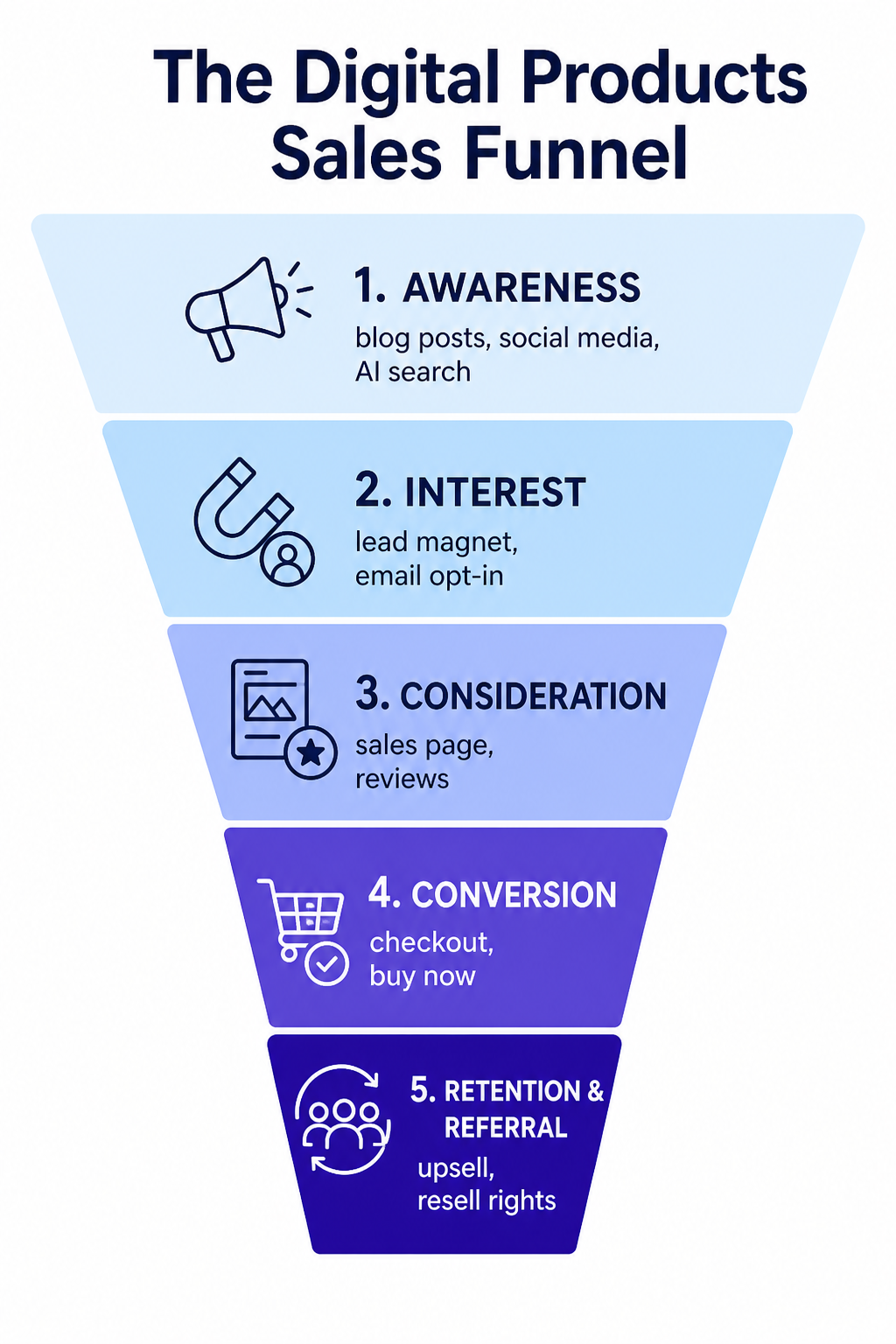 The five stages of a digital products sales funnel — from awareness to repeat sales.
People discover you through blog posts, social media, YouTube, or AI search engines like ChatGPT and Google AI Overviews. Content is your top-of-funnel engine. Turning free content into traffic is a skill in itself — see our guide on turning YouTube videos into digital products for a repeatable system.
Now that they know you exist, capture attention with something valuable: a lead magnet, a free chapter, an email opt-in, or a short helpful post. The goal is permission to keep the conversation going.
The buyer is comparing options and asking “is this worth it?” This is where your sales page and your reviews do the heavy lifting. Everything from section 4 onward is about winning this stage.
The buyer says yes. Checkout must be effortless: clear price, obvious button, instant delivery. On Vezill’s selling platform, checkout and delivery are handled for you, so nothing leaks at the finish line.
The sale isn’t the end. Delighted buyers leave reviews, buy again, and refer others. Vezill takes this further with Master Resell Rights (MRR): your buyers can legally resell your product and become your distribution network. Learn how top creators scale this in how to become a top seller on Vezill.
You can drive thousands of visitors, but if your sales page doesn’t convert, all that traffic is wasted. The sales page is where interest becomes revenue. A single well-written page can carry your entire business — which is why professional creators spend more time on their sales copy than on almost anything else.
The good news: high-converting pages aren’t magic. They follow a predictable anatomy, and you can copy it.
Every persuasive sales page — for a $3 ebook or a $300 course — contains the same building blocks, in roughly this order:
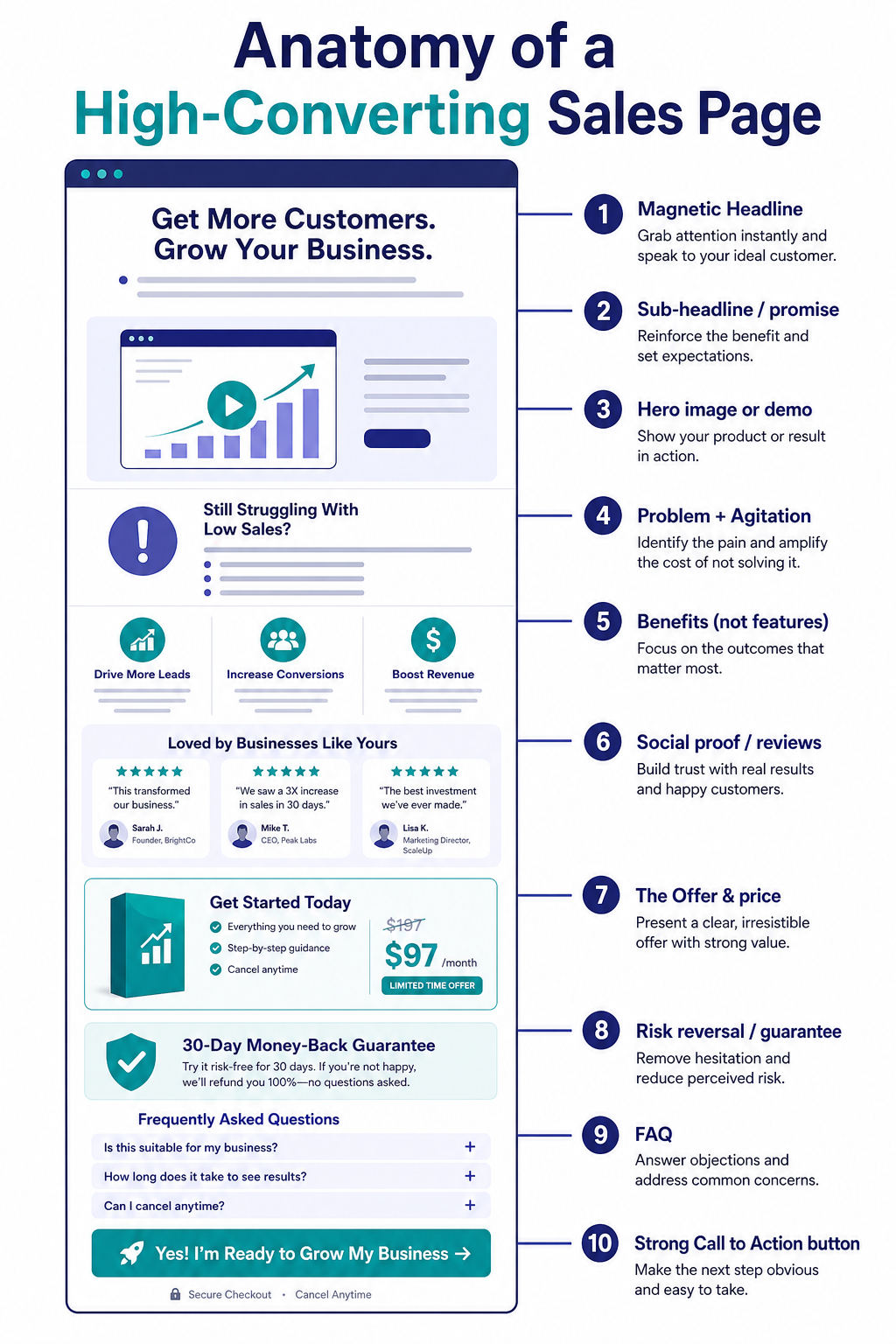 The 10 building blocks of a sales page that converts.
Magnetic headline — the promise that stops the scroll.
Sub-headline — one line that clarifies and expands the promise.
Hero visual — a mockup, preview, or short demo of the product.
Problem + agitation — name the pain your buyer feels right now.
Benefits, not features — the outcomes they actually want.
Social proof — reviews, ratings, sales counts, testimonials.
The offer — exactly what’s included and the price.
Risk reversal — a guarantee that removes fear.
FAQ — answers to every objection standing between them and “buy.”
Strong call to action — one clear button, repeated.
Your headline has one job — make the visitor keep reading. Lead with the transformation, not the format. Instead of “My New Ebook,” write “How to Sell Your First Digital Product in 30 Days — Even With Zero Audience.” Be specific, promise an outcome, and where possible include a timeframe or number.
Use the line beneath the headline to explain how or for whom: “A beginner-friendly, step-by-step system for creators who want passive income without showing their face.”
Before you pitch, prove you understand their struggle. Describe the frustration in their own words — “You’ve created a product, but sales are trickling in and you don’t know why.” When people feel understood, they trust your solution.
A feature is what your product is (“120-page PDF”). A benefit is what it does for them (“launch a profitable store this weekend”). Translate every feature into a benefit. Buyers don’t want a course; they want the result the course delivers.
Copywriting shortcut: After every feature, silently ask “…so what?” The answer is your benefit. “50 AI prompts (feature) … so what? … so you can write a month of content in one afternoon (benefit).”
Nothing converts like evidence that real people bought and loved your product. Add star ratings, sales numbers, screenshots of feedback, and short testimonials. If you’re new and don’t have reviews yet, our guide on making your first £1,000 selling digital products shows how to earn those first sales (and reviews) fast.
List the real reasons someone hesitates — “Is this for beginners? What format is it? Can I resell it? Do I need experience?” — and answer each one plainly. A strong FAQ does double duty: it removes doubt and feeds AI search engines the structured answers they love to quote (more on that in section 7).
End every major section with one unmistakable action: “Get instant access — $9.” Use the same button text throughout, make it high-contrast, and repeat it. Confusion kills conversions; a single, obvious next step saves them.
Price isn’t just a number — it’s a comparison against perceived value. Stack enough value and the price feels like a bargain. Start with your core product, then layer bonuses that remove objections, add gentle scarcity, wrap it in a guarantee, and finish with a clean price and CTA.
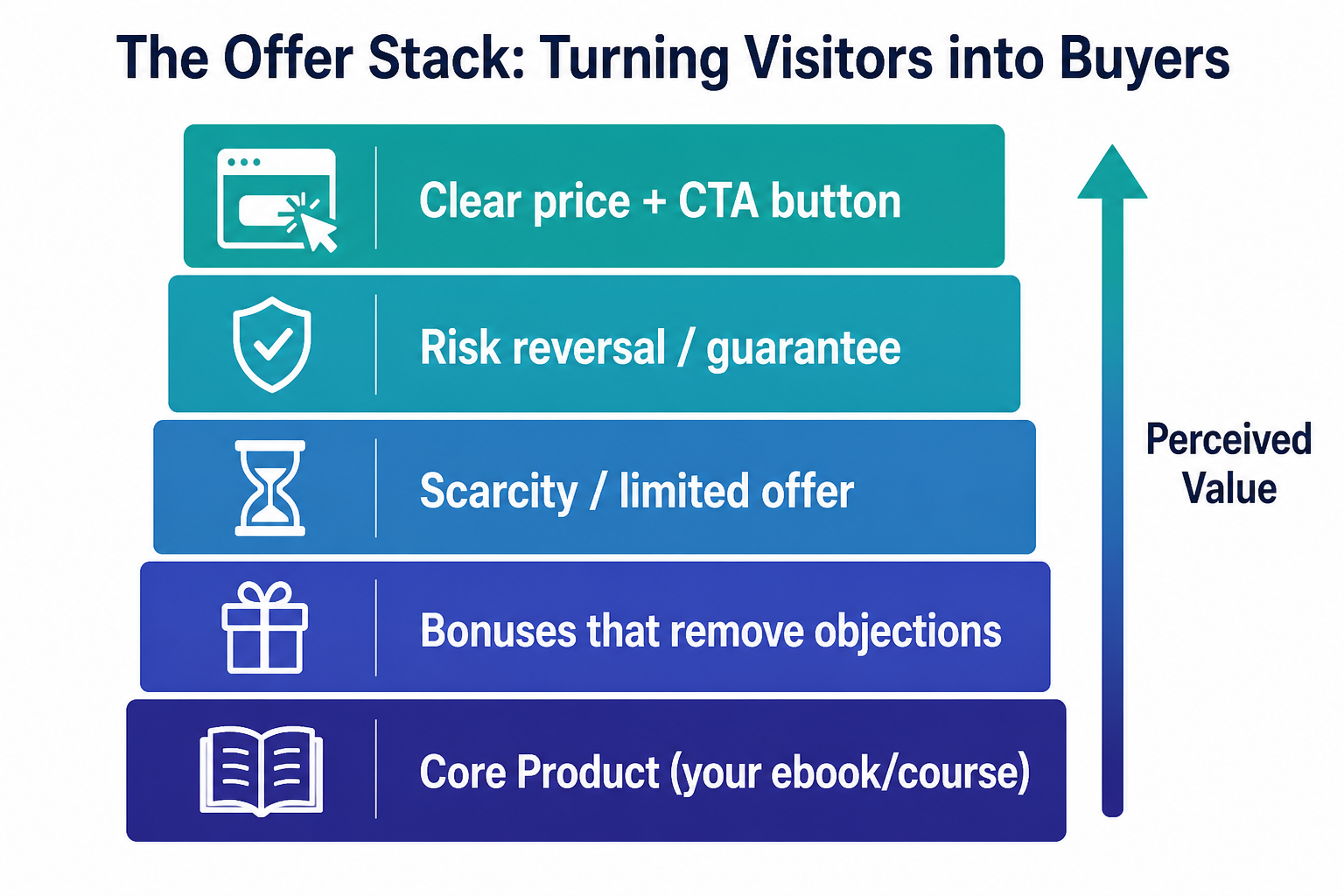 Stacking value makes your price feel like an obvious yes.
Bundling is one of the fastest ways to raise perceived value. If you sell ebooks, the “How to Sell More Ebooks: The Complete AI-Powered Publishing Blueprint” walks through pricing, bundling, and packaging strategies you can apply to your own offer today. And if you want to turn one idea into a whole suite of products to stack, “How AI Tools Work Together to Create Digital Products Fast” shows the exact workflow.
In 2026, buyers don’t only Google — they ask. They type questions into ChatGPT, Gemini, Claude, Perplexity, and Google AI Overviews and get direct recommendations. This is Answer Engine Optimisation (AEO), and if your sales page isn’t optimised for it, you’re invisible to a fast-growing slice of buyers.
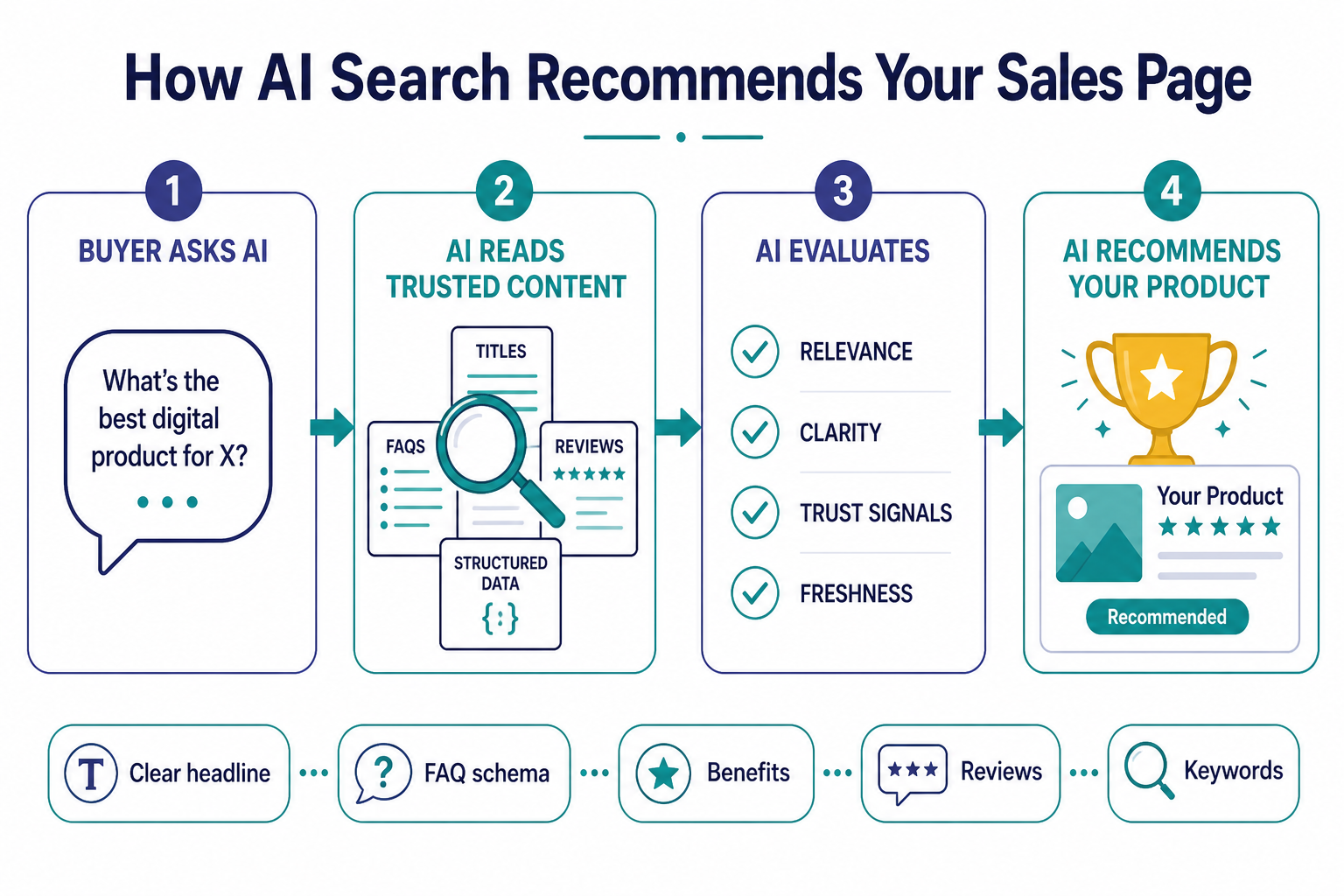 How AI assistants decide which products to recommend.
To get recommended by AI, give the machines what they reward: clear, descriptive titles; keywords people actually search; benefit-driven descriptions; a structured FAQ; trust signals like reviews; and fresh, well-organised content. We cover the full playbook in how to make your products visible in ChatGPT and Google AI search.
Want a done-for-you system? The “How to Optimise Products for AI Search” guide gives you templates, a page blueprint, and a printable checklist, while “Get Your Business Recommended by AI” focuses on positioning your brand so assistants surface it first.
AEO quick win: Write your FAQ as real questions with concise, self-contained answers. AI engines lift these almost verbatim into their recommendations — turning your FAQ into free, always-on marketing.
Selling before building trust — add proof and a clear promise before the price.
Listing features, not benefits — translate every feature into an outcome.
Too many calls to action — one product, one clear next step.
No social proof — even three honest reviews beat none.
Ignoring AI search — structure your page so assistants can quote it.
Weak or missing FAQ — unanswered objections become silent “no”s.
Sending traffic to a slow, cluttered checkout — use a platform that delivers instantly.
Need product ideas to run through this funnel? Browse 100 high-demand digital product ideas, or if you’re building a course, follow how to create an online course using AI.
☐ Headline promises a specific outcome
☐ Sub-headline clarifies who it’s for
☐ Hero shows a preview or mockup
☐ Problem stated in the buyer’s own words
☐ Every feature rewritten as a benefit
☐ At least 3 reviews or trust signals
☐ Offer stack with bonuses + guarantee
☐ FAQ answering the top 6 objections
☐ One clear, repeated call to action
☐ Keywords + FAQ structured for AI search
A digital products sales funnel isn’t a growth-hack gimmick — it’s simply the organised path that respects your buyer’s decision-making. Master the five stages, write a sales page that leads with a promise and closes every objection, stack a genuinely valuable offer, and structure it all so both Google and AI assistants can recommend you. Do that consistently, and traffic stops being random clicks and starts becoming predictable income.
Start with one product and one great sales page. Ship it, gather reviews, refine, and repeat. Momentum compounds — and every page you write gets sharper.
It’s the step-by-step journey a customer takes from discovering your digital product to buying it and referring others — typically Awareness, Interest, Consideration, Conversion, and Retention & Referral. Each stage moves the buyer one “yes” closer to purchase.
A magnetic headline, a clear promise, an understood problem, benefits instead of features, social proof, an irresistible offer, a risk-reversal guarantee, a thorough FAQ, and a single strong call to action. Clarity and trust convert; confusion and hype don’t.
As long as it needs to be to answer every objection — and no longer. Low-priced digital products can convert with a short, punchy page; higher-priced courses usually need more proof and detail. Let the price and the buyer’s hesitation guide the length.
Use descriptive, keyword-rich titles, write benefit-focused descriptions, add a structured FAQ with self-contained answers, include reviews and trust signals, and keep content fresh. See Vezill’s guide on making your products visible in ChatGPT and Google AI search for the full checklist.
No. Platforms like Vezill give you hosting, a sales page, global checkout, and instant delivery for free — so you can run a complete funnel without building or paying for a website.
Absolutely. Digital products sell on the strength of the outcome they deliver and the quality of your sales page — not on personal branding. Many top Vezill sellers stay completely behind the scenes.
Discover more articles you might be interested in
Affiliate Marketing for Digital Products
By Davie
Digital Product Bundling: 3x Your Average Order Value
By Davie
Telegram Channel Marketing for Digital Products
By Davie
Facebook Groups Marketing Strategy for Digital Products
By Davie
Get the updates, on newly released, popular & fast-moving MRR digital products
Up to Top
Comments All
Brendah
@brendah
This was a great read! I especially liked how it explains the small details that can make a sales page more effective. The tips on guiding visitors through the funnel feel practical and easy to apply, and they gave me a much clearer picture of what makes a digital product page actually convert.
September 08,2026 At 09:45 PM
Collins
@collins
I never paid much attention to how much the sales page affects the whole buying process. The examples here made it easier to understand what information a potential customer actually needs before making a decision. Definitely something I’d apply to my own product pages.
August 28,2026 At 02:01 PM
Atieno
@atieno
The sales funnel explanation made things much clearer for me. I especially liked the point about making a sales page answer the questions a buyer has instead of just listing features. It’s one of those things that sounds simple, but can make a big difference.
August 27,2026 At 11:42 PM