
Public Facebook posts fight an algorithm designed to show them to almost nobody. Facebook Groups flip that: members join because they care about the topic, notifications bring them back, and conversations happen in a space built for trust rather than a feed built for scrolling. For anyone selling digital products, that's a warm audience sitting right there — you just need a strategy that respects the community instead of spamming it.
This guide covers the full system: which groups to use, what to post, and how to turn membership into sales without getting removed for spamming.
A Facebook Groups marketing strategy for digital products means using niche communities — either one you start or ones you join — to build trust and sell without ads. The system: (1) choose between starting your own group or joining existing ones (or both), (2) give real value consistently before ever pitching, (3) follow a give-give-give-ask content rhythm, (4) place a soft offer where members naturally see it, and (5) move interested members to a DM or product link for instant delivery.
Groups outperform public pages because members already trust the community and engage far more — a focused group of 500 the right people beats 50,000 random followers.
Deliver what you sell in the group through Vezill for instant checkout, reviews, and resell rights.
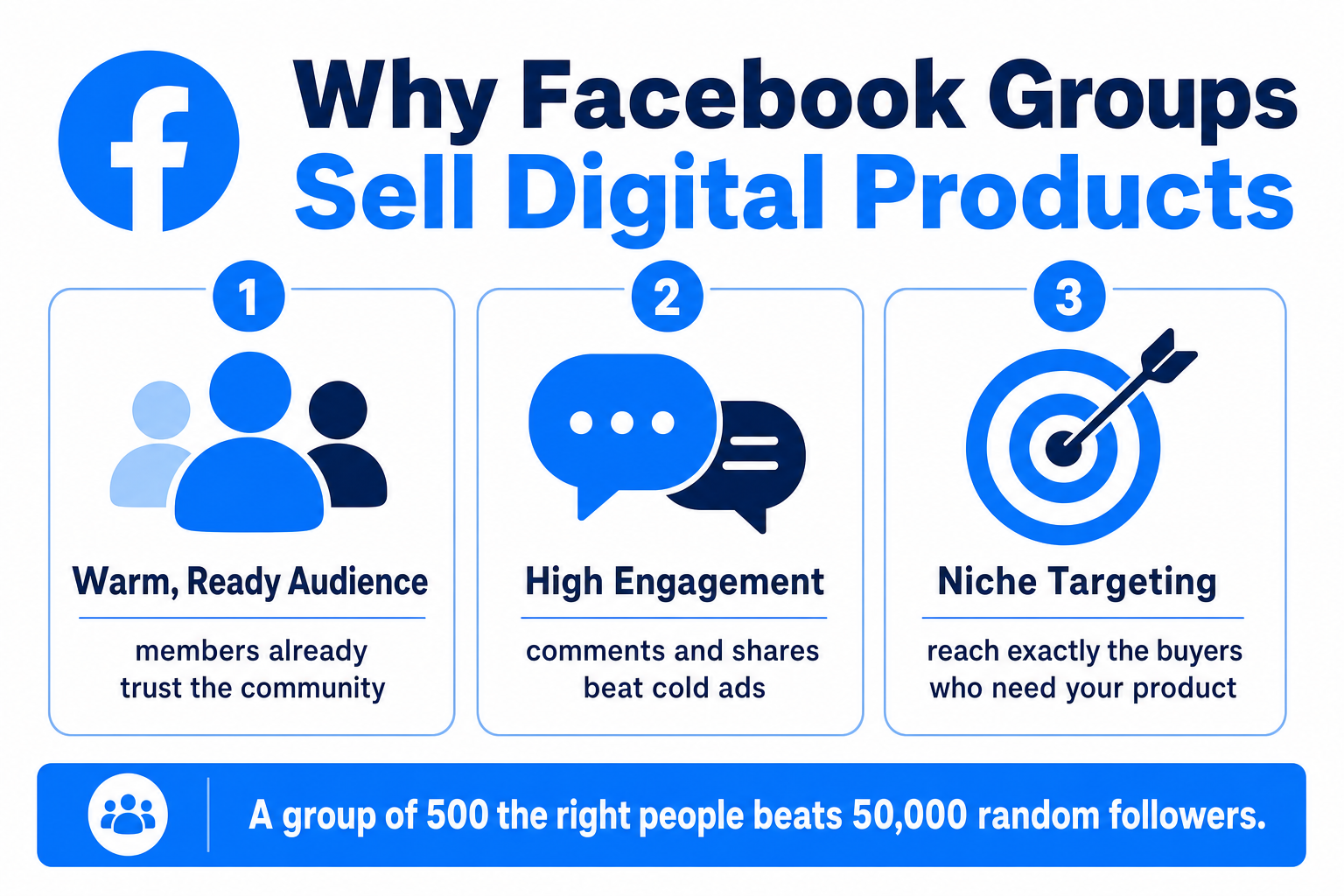 A group of 500 the right people beats 50,000 random followers.
Warm, ready audience — members already trust the community they joined.
High engagement — comments, replies, and shares happen far more in groups than on pages.
Niche targeting built in — a "KCSE revision tips" group is already full of people who need exactly what you sell.
This is especially powerful for people who already have niche expertise to package — teachers and students often have the most naturally engaged, ready-made groups to work with.
Both strategies work, and the best sellers eventually use both.
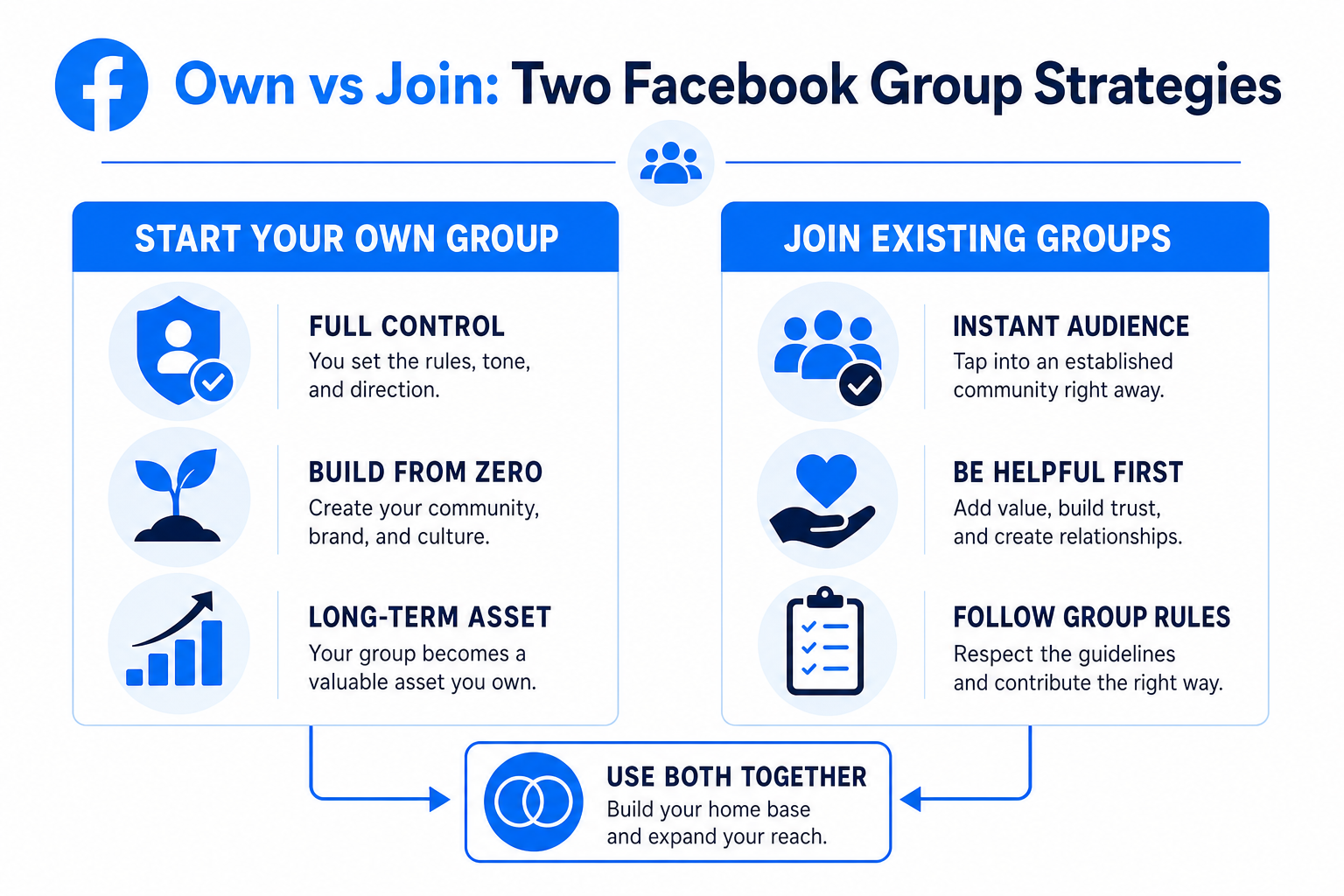 Own a group for control; join groups for instant reach — use both.
Starting your own group gives you full control, a long-term owned asset, and no rules to work around — but it takes time to grow. Joining existing groups gives you instant access to an audience that already exists, as long as you show up as genuinely helpful first and follow each group's rules. If you're new to this entirely, turning simple app knowledge into a digital product is a fast way to have something worth talking about in either type of group.
Search Facebook for your topic plus "group" — parenting, exam revision, side hustles, coaching, network marketing, and hundreds of other niches all have active communities. Look for groups with real conversation (not just link-dropping), a reasonable size, and clear rules you can actually follow. If your product targets a specific outcome — like income growth — groups built around that exact promise convert best; see the roadmap for scaling digital-product income fast for the kind of goal-driven audience that gathers in these communities.
The single rule that keeps you welcome in any group: give far more than you ask.
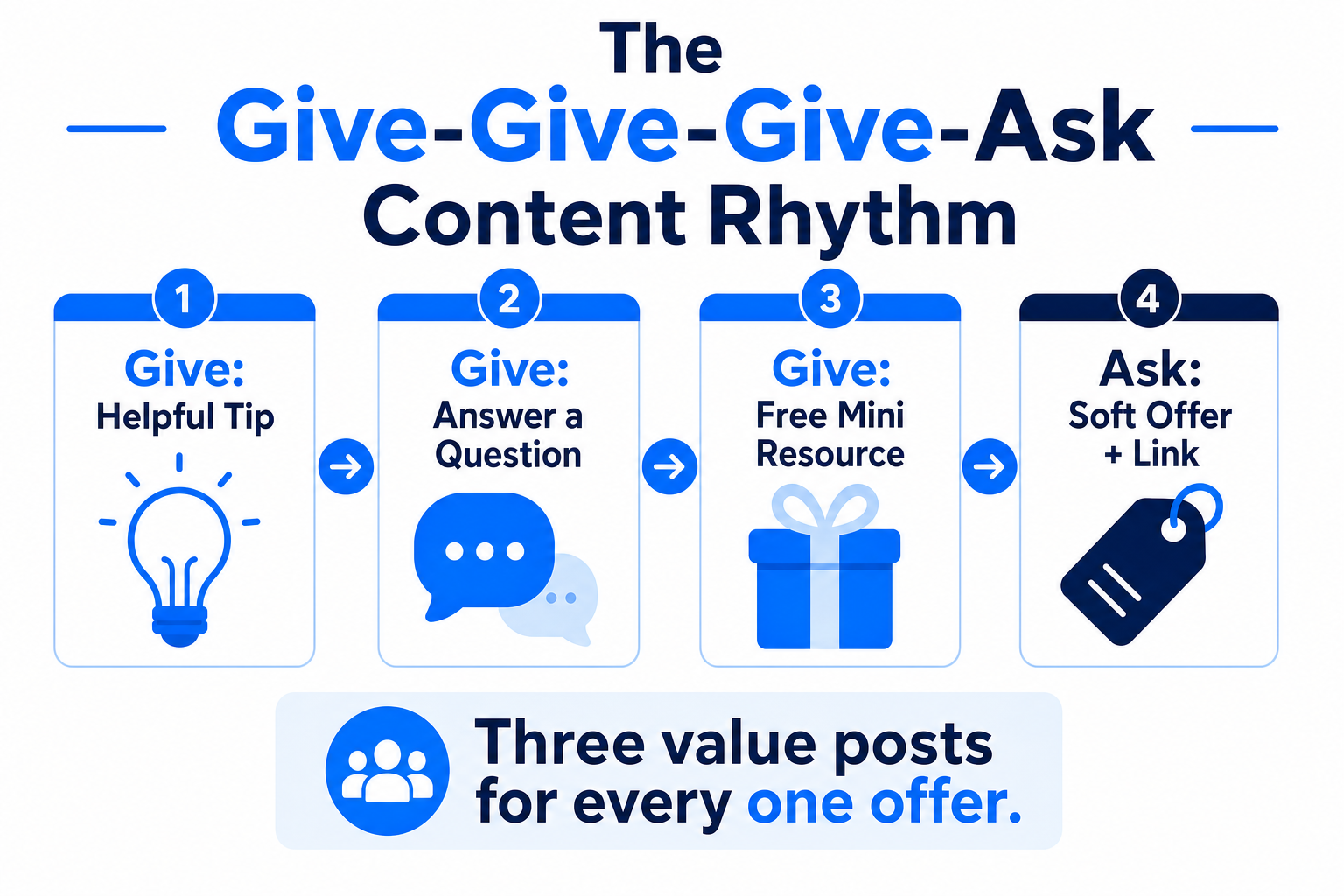 Three value posts for every one offer — the ratio that keeps you welcome.
Answer questions properly, share a genuinely useful tip, occasionally drop a small free resource, and only then make a soft offer with a link. Members remember who helped them before they ever pitched anything — that's the trust your offer rides on.
Most groups ban blatant self-promotion, and for good reason — nobody joins a group to be sold to constantly. The workaround is subtlety and context: answer a real question, then mention your product as the natural solution ("I actually put together a full guide on this — happy to share if useful"). Pin helpful posts in your own group, and in others, let people ask for the link rather than dropping it unprompted.
Educational niches convert fastest: Groups built around exams, courses, or skills are full of buyers actively searching for exactly this kind of resource — see the 35 high-demand educational digital products selling well in Kenya for proven angles.
Selling in a group is a short, repeatable path — not a random pitch.
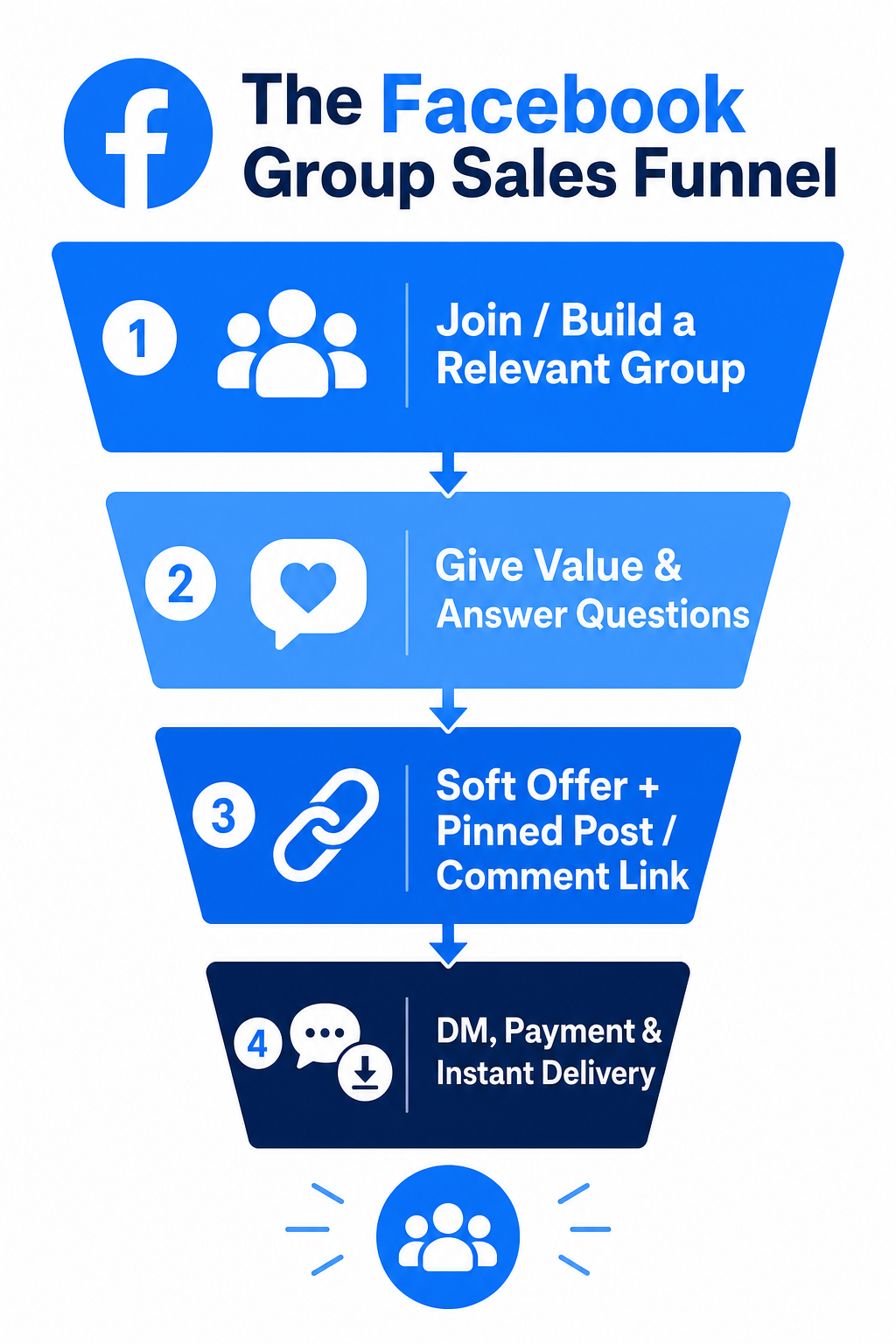 Value earns trust; trust earns the click; the click earns the sale.
Join or build a group in your niche, show up consistently with value, place your offer where interested members naturally find it, then move the conversation to DM for payment and instant delivery. Route buyers to a product page hosted on Vezill so checkout is effortless and professional.
Your reputation in a group is your most valuable asset — protect it. Read the rules of every group before posting, never spam multiple groups with identical pitches back-to-back, and always deliver exactly what you promise. Trust and quality are what convert browsers into buyers — see why buyers choose Vezill for the trust signals worth mirroring in how you present yourself inside a group.
Posting your link on day one — build presence and trust first.
Ignoring group rules — a ban ends your access to that entire audience.
Copy-pasting the same pitch everywhere — it reads as spam and gets removed fast.
Never engaging with others' posts — visibility is earned through participation, not just posting.
Overpromising in a pitch — a disappointed buyer damages your name inside a tight-knit community fast.
These same principles work whether you sell your own product or resell one from someone else's catalogue with Master Resell Rights — the community-first approach is what actually converts.
Trust in a group only pays off if there's a real offer behind it. Vezill lets you host and sell your digital product for free, with instant delivery, built-in reviews, and Master Resell Rights so buyers can resell it too.
Start selling on Vezill — free →
Facebook Groups reward the same thing every good marketing channel does: genuine value, consistency, and respect for the community you're speaking to. Choose your groups deliberately, give more than you ask, place your offer where it naturally fits, and let trust do the selling for you. Because groups are built on relationships rather than reach, the trust you build this month keeps paying off long after the algorithm has moved on.
Join or start one relevant group today, and post something genuinely useful before you post anything that sells.
Yes, as long as you follow each group's rules on self-promotion. The most effective approach is giving genuine value consistently, then making soft, well-placed offers rather than posting direct sales pitches repeatedly.
Both work well together. Starting your own group gives you full control and a long-term owned asset, while joining existing groups gives you instant access to an audience that's already active — many sellers use both strategies at once.
Read and follow each group's specific rules on promotion, avoid posting identical pitches across multiple groups, and focus on being genuinely helpful before ever mentioning your product. Groups typically ban accounts that ignore rules or spam links repeatedly.
It's a content rhythm where you share three pieces of genuine value — tips, answers, or free resources — for every one soft offer you make. This keeps your presence welcome in a community instead of feeling like constant advertising.
Products tied closely to the group's specific topic sell best — educational resources in study groups, business templates in entrepreneur groups, or coaching guides in niche skill communities. Relevance to the group's exact interest matters more than the product format.
Move interested members to a direct message, answer any remaining questions, then send them to a professional product page for payment and instant delivery. Hosting your product on a platform like Vezill makes this final step seamless and automatic.
Discover more articles you might be interested in
Learn how to sell digital products on Google without paid ads

By Super Admin
WhatsApp Marketing for Digital Products
By Davie
YouTube Marketing for Digital Products
By Davie
How to Get Your First 100 Customers for Your Digital Product
By Davie
Get the updates, on newly released, popular & fast-moving MRR digital products
Up to Top