
Everyone already has WhatsApp open. That's the entire advantage. While creators chase algorithms on other platforms, WhatsApp lets you reach real people directly, build trust in a private conversation, and close a sale without a single ad. If you sell ebooks, guides, templates, or resell-rights products, WhatsApp might already be your easiest sales channel — you just haven't structured it yet.
This post covers the core system. For the full framework — 12 chapters, ready-to-use scripts, and a 7-day action plan — see WhatsApp Marketing for Digital Products: Sell More With WhatsApp.
WhatsApp marketing for digital products means turning your WhatsApp Business profile, Status updates, and one-on-one chats into a simple sales system: (1) set up WhatsApp Business properly, (2) build an audience of contacts who actually want your updates, (3) post Status content that moves people from Attention to Action, (4) turn conversations into sales with scripts and honest objection-handling, and (5) follow up with value, not pressure.
You don't need a big following — WhatsApp rewards relevant attention and real conversations over audience size, which makes it one of the most accessible sales channels for beginners.
Deliver the product you sell on WhatsApp through Vezill for instant, professional checkout and delivery.
WhatsApp isn't just another app to post on — it's where trust already exists. Messages land privately and personally, conversations feel like talking to a real person rather than shouting into a feed, and you don't need a big following, just relevant attention. This makes WhatsApp especially powerful for people already earning informally: Uber and matatu drivers, motorbike riders, and small traders and hawkers already have hundreds of WhatsApp contacts who trust them — that's a ready-made audience for a digital product.
A few minutes of setup makes every message that follows look more credible.
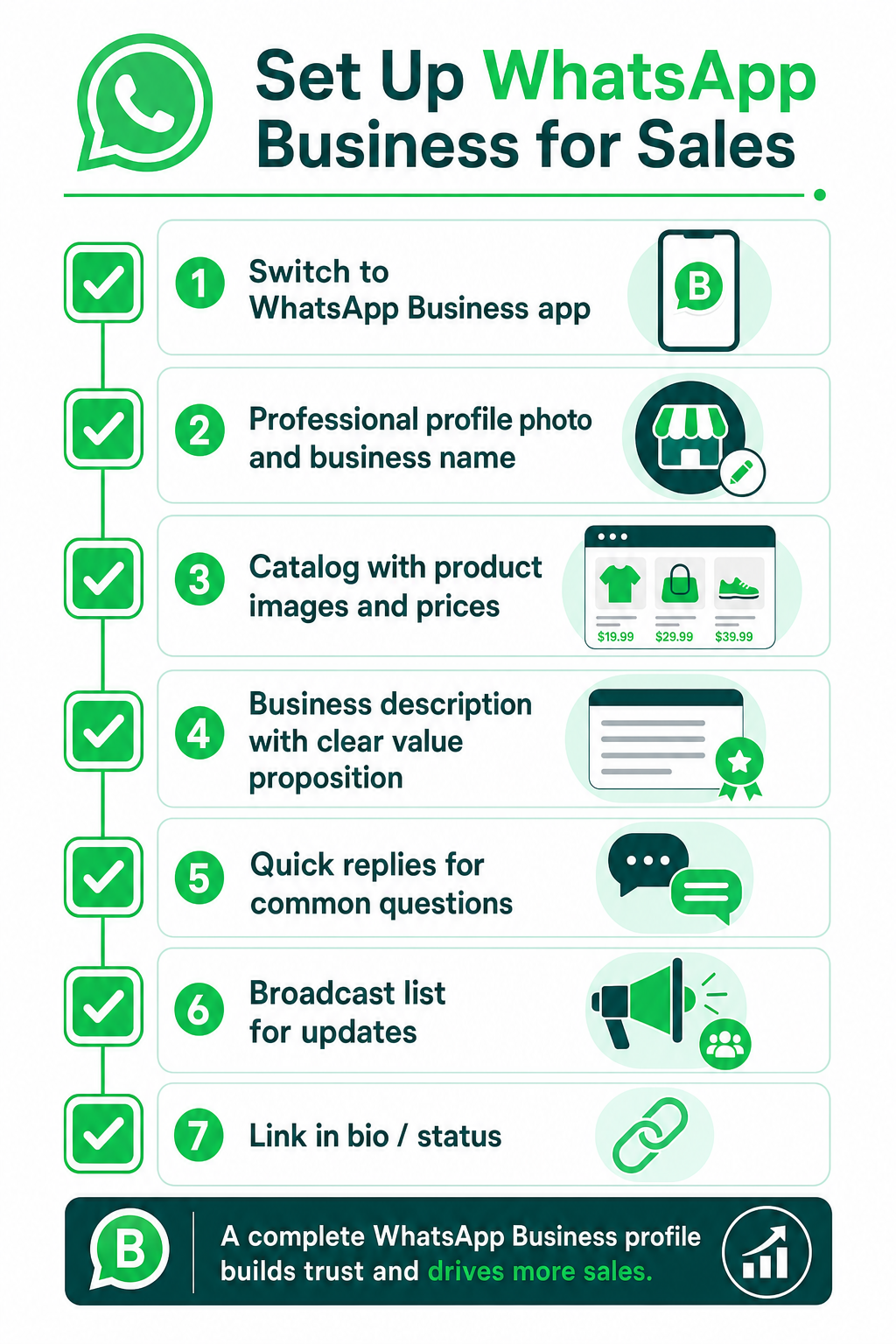 Seven quick setup steps before you send your first sales message.
Switch to the free WhatsApp Business app, add a professional photo and clear business name, build a catalog with your product image and price, write a description that states your value proposition, and set up quick replies for the questions you'll get repeatedly.
You don't need a huge list — you need the right one. Start with your existing contacts who have a real reason to care about your product, grow it through your other channels (share your Status link everywhere), and always ask permission before adding someone to a broadcast list. If you're just starting from nothing, starting an online business from home with zero capital pairs well with this — WhatsApp is often the very first channel people use.
WhatsApp Status is your free, 24-hour billboard — and most sellers waste it on random ads. Structure every update instead around a proven framework:
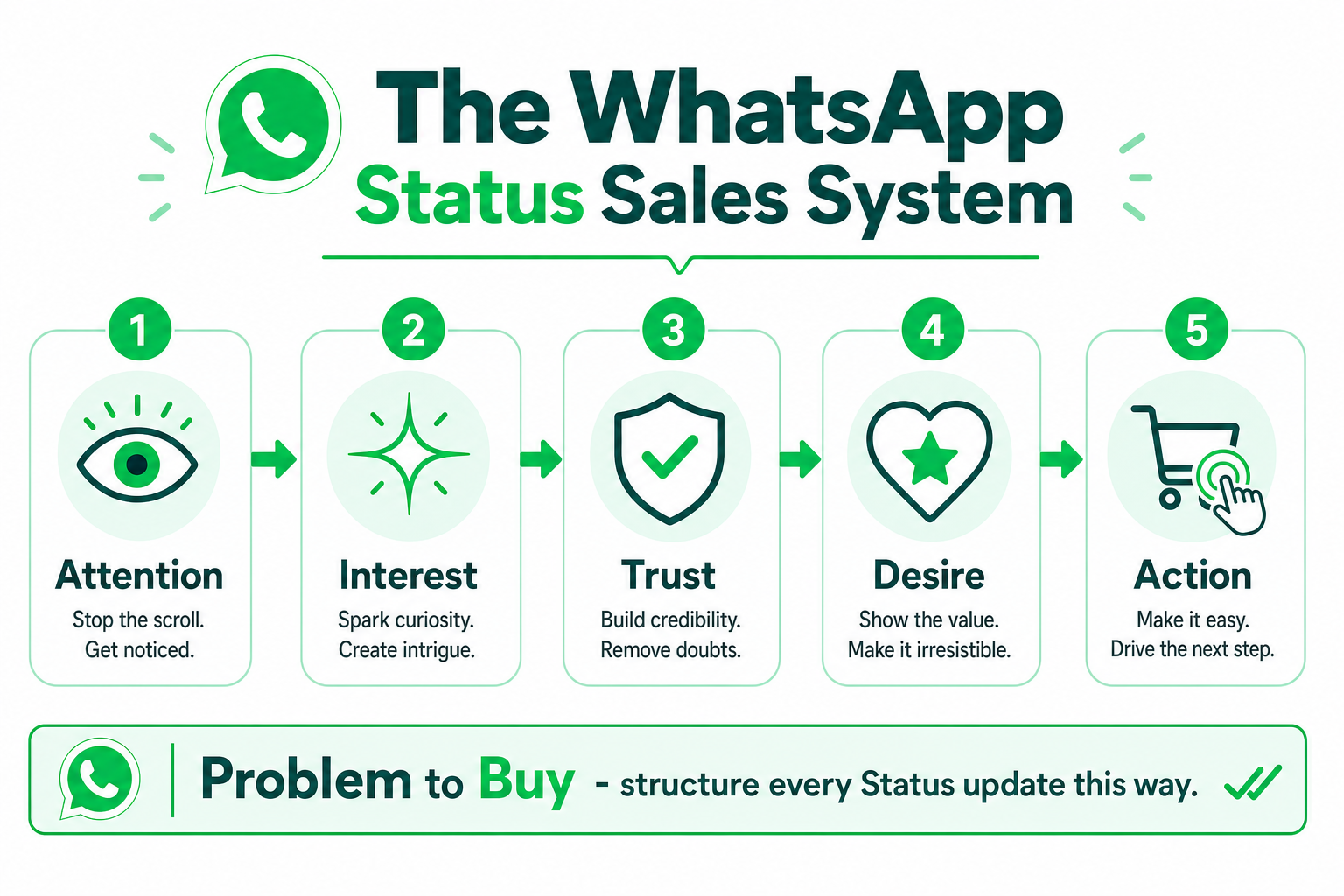 Attention → Interest → Trust → Desire → Action — structure every Status this way.
In practice: post a relatable problem (Attention), teach something useful about it (Interest), show proof it works (Trust), paint the transformation your product delivers (Desire), and end with a simple, clear call to action (Action). Never post the same "buy now" message twice in a row.
Selling on WhatsApp isn't complicated once you see it as a short, repeatable path rather than a random chat.
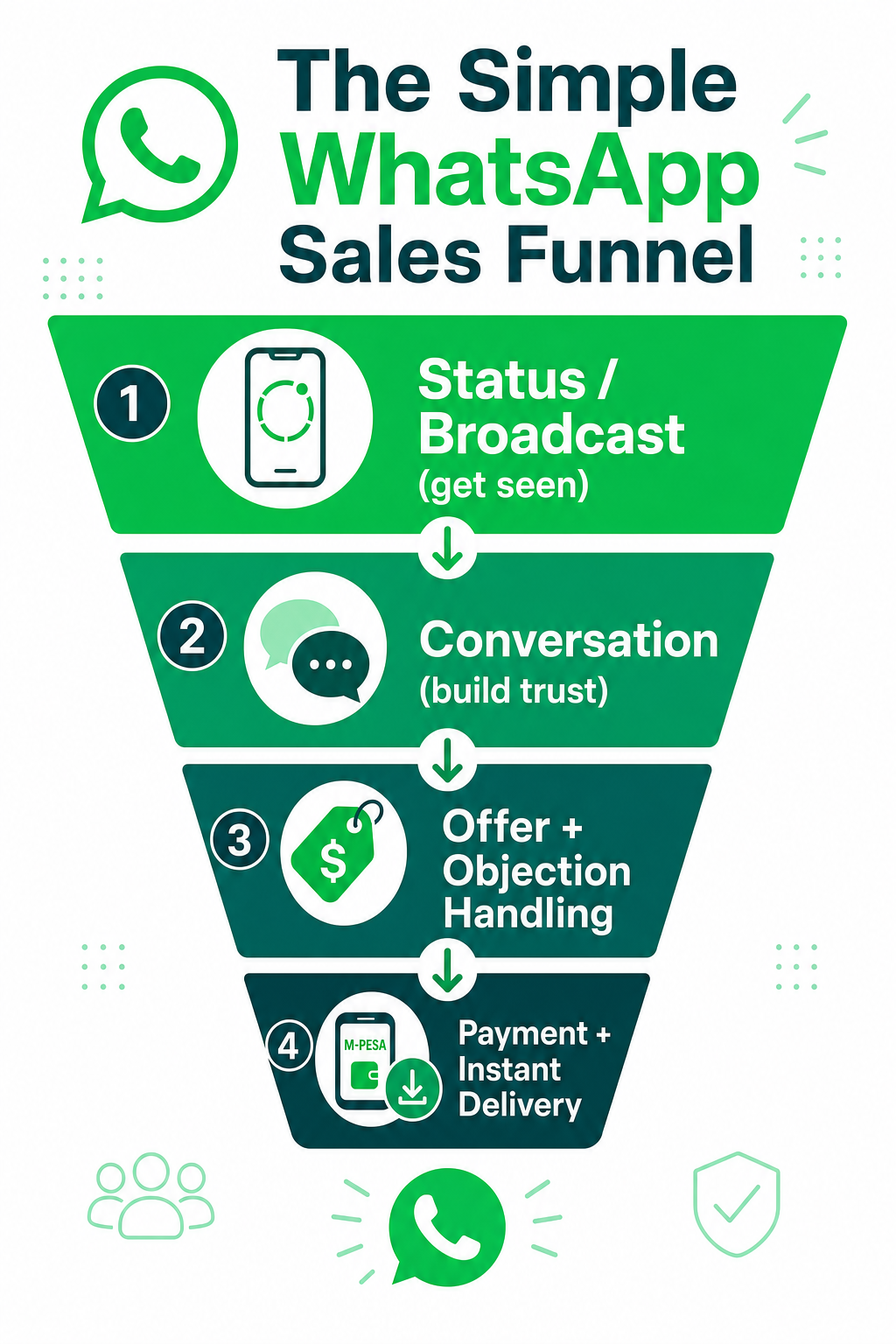 Status gets you seen; conversation builds trust; the offer closes the sale.
Someone notices your Status or broadcast, replies or asks a question, you have a real conversation that surfaces their need, you present your offer and handle any hesitation honestly, then you take payment and deliver instantly. No landing pages, no complicated automation — just a clear sequence you repeat.
Scripts save you time: Having ready-to-adapt responses for pricing questions, objections, and product introductions means you never freeze up mid-conversation. The complete swipe file of scripts is included in the full WhatsApp Marketing guide.
Most sales happen after the first "no thanks" — but only if you follow up with value, not pressure.
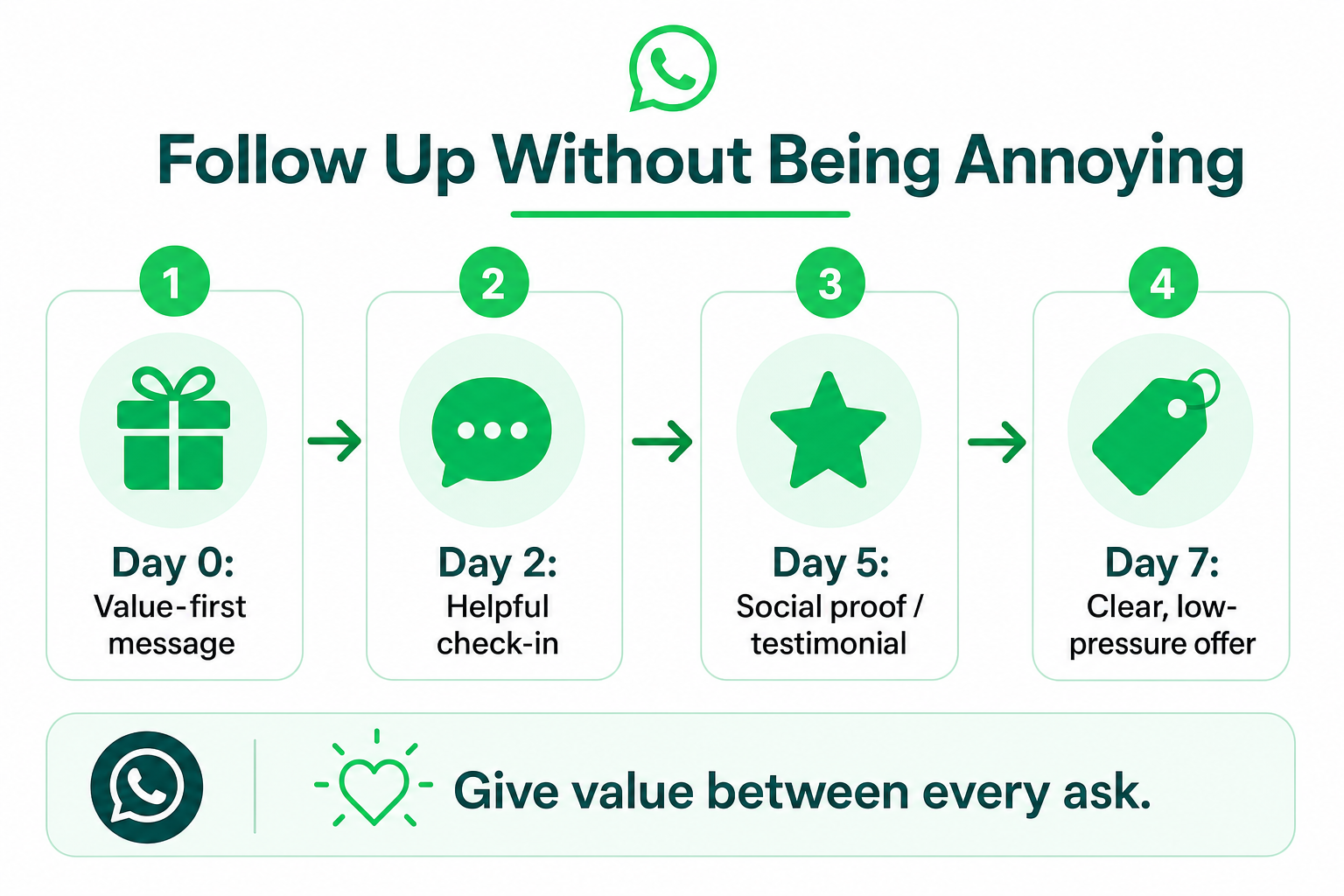 Give value between every ask — that's what separates follow-up from spam.
Space your messages out, lead with something useful each time, and only make the direct ask once trust has been re-established. This is especially effective for anyone selling to a community they already interact with daily — mitumba vendors and market traders already have this rhythm of conversation built in.
The moment someone says yes, friction kills momentum — so make paying and receiving the product as fast as possible. Accepting payment via M-Pesa works well for direct WhatsApp sales, but for a professional, automated experience, send buyers to a product page hosted on Vezill — checkout and delivery happen instantly, and you can add resell rights so buyers become sellers too.
Only posting ads on Status — mix value with offers, or people mute you.
Adding people without permission — always ask before broadcasting to someone.
No clear catalog or pricing — confusion kills quick decisions.
Ignoring objections — answer hesitation honestly instead of repeating the pitch.
One-and-done follow-up — most sales need 2–3 gentle touches, not zero or ten.
Manual, slow delivery — a buyer who has to wait can change their mind. Automate it.
WhatsApp selling works especially well alongside other income ideas — see how it fits for new ways women are making money online with digital products, or go all-in with becoming a digital products trader. Chasing a bigger daily target? How to make 10K daily in Kenya shows where WhatsApp fits into a bigger income system.
You don't need a website, a big following, or paid ads to sell digital products — you need a phone, WhatsApp, and a structured way to turn everyday conversations into sales. Set up your profile properly, post Status updates with a purpose, follow a real funnel, and follow up with value instead of pressure. The trust you already have with your contacts is the most valuable marketing asset most creators overlook.
Post one purposeful Status update today, using the Attention → Action framework — and if you want the complete system, scripts, and a 7-day plan to execute it, grab the full guide here.
Create your free Vezill account, upload your product, and start sharing your link in every WhatsApp chat and Status. Your next sale could be one message away.
Create your Vezill store now →
Yes. WhatsApp works well for communicating with prospects, presenting a digital-product offer, answering questions, arranging payment, and delivering the product — either directly or by sending buyers to a hosted product page for instant checkout.
No. WhatsApp marketing focuses on getting relevant attention and having genuine conversations rather than reaching a huge audience. A smaller list of engaged contacts often converts better than a large, cold one.
It's a simple framework — Attention, Interest, Trust, Desire, Action — used to structure WhatsApp Status content so it educates and builds interest instead of just repeating advertisements. Each update moves a viewer one step closer to buying.
Space follow-up messages out over several days, lead with something useful or a helpful check-in each time, and only make a direct, low-pressure offer once you've re-established value. Avoid repeating the same pitch back-to-back.
You can accept payment directly through mobile money and send the file, or send buyers to a professional product page hosted on a platform like Vezill, which handles checkout and delivers the product instantly and automatically.
Ebooks, PDFs, templates, courses, prompt packs, guides, checklists, and other digital products all work well, since WhatsApp marketing focuses on the conversation and offer rather than the specific product format.
Discover more articles you might be interested in

Affiliate Marketing for Digital Products
By Davie

Digital Product Bundling: 3x Your Average Order Value
By Davie

Telegram Channel Marketing for Digital Products
By Davie
Facebook Groups Marketing Strategy for Digital Products
By Davie
Get the updates, on newly released, popular & fast-moving MRR digital products
Up to Top
Comments All
Getrude
@getrude
WhatsApp is something almost everyone already uses, so I like how the article shows how it can be turned into a simple marketing tool for digital products. The tips are practical and easy to understand, especially for someone who wants to promote their products without making things feel too complicated.
September 08,2026 At 09:21 PM