
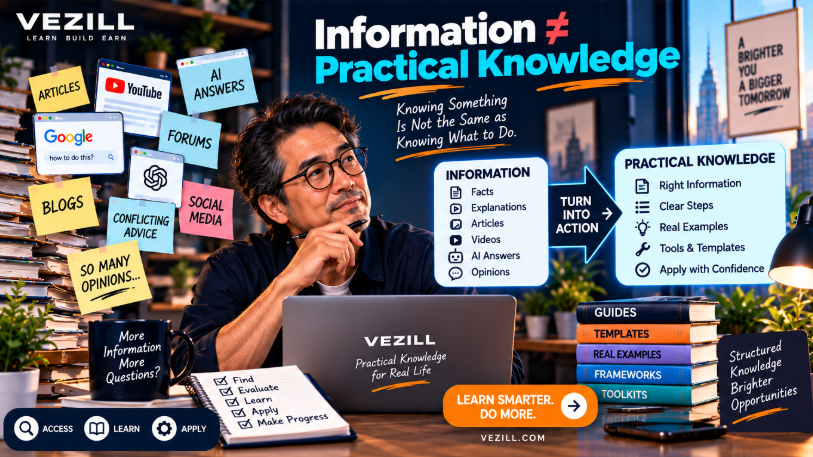
Why unlimited access to information can still leave you asking one frustrating question: “Okay… what do I actually do?”
Imagine someone gives you four facts about cooking chicken: seasoning affects flavour, high heat can create browning, resting can affect the final result, and chicken needs to be cooked safely. All of those statements may be useful information.
But imagine you have never cooked chicken before. You still need to decide which cut to use, how much seasoning to add, how hot the pan should be, when to turn the chicken, how to check whether it is cooked and what to do if the outside is browning too quickly.
Now compare those disconnected facts with a resource that shows you how to prepare the chicken, season it, heat the pan, cook it, check it, recognize the expected result and correct a common problem. The facts have not disappeared. They have been organized around an outcome.
Information gave you facts about cooking. Practical knowledge gave those facts a job.That simple difference is the heart of this article. Practical knowledge is not the opposite of information. It is what happens when relevant information is connected to context, decisions, action and feedback.
Information is facts, explanations or content that tell you about something. Practical knowledge is information and understanding organized around a real situation so you can use it to perform a task, solve a problem or make a decision. Information can be part of practical knowledge, but access to information alone does not guarantee understanding, judgment or ability.
INFORMATION ANSWERS “WHAT?” — PRACTICAL KNOWLEDGE HELPS YOU DECIDE “WHAT DO I DO?” IN THIS GUIDE Information vs practical knowledgeDo not create a false binaryThe Practical Knowledge LadderThe Application GapThe Practical Knowledge FormulaInformation overloadThe Knowledge Assembly ProblemPractical knowledge is not only step-by-stepDeclarative, procedural, explicit and tacit knowledgeInformation vs knowledge vs skillInformation vs advice and instructionsInformation vs experienceAI changed the information layerWorked examplesTemplates, checklists and frameworksKnowledge productsWhy pay when information is free?The VEZILL Knowledge PackageACCESS → LEARN → APPLYWhere practical knowledge stopsWhen information is enough30 practical examplesHow to turn information into practical knowledgeFAQ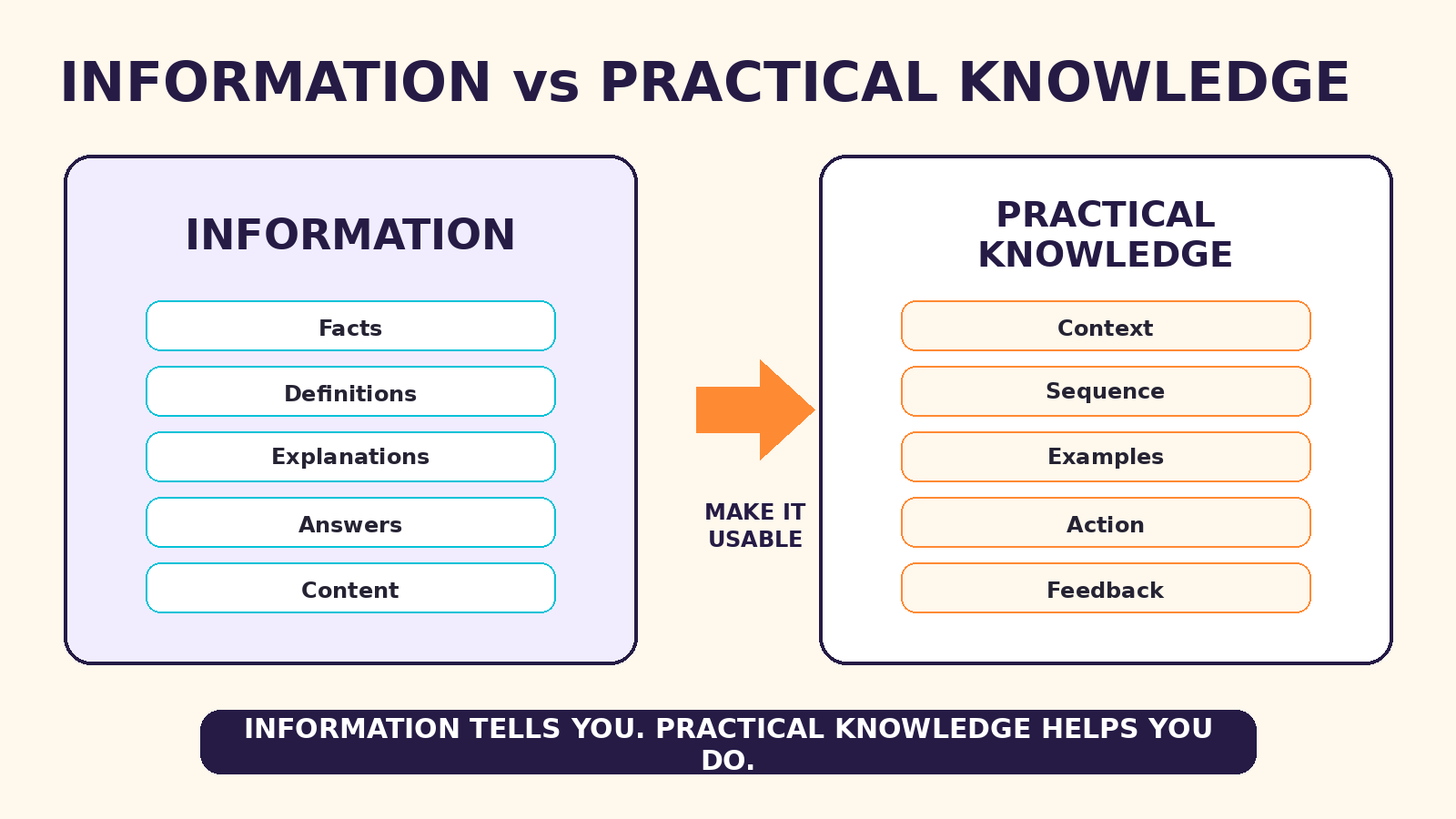 Information can be useful on its own, but practical knowledge organizes what matters around use.
Information can be a fact, definition, measurement, explanation, warning, statistic, description or answer. It can be highly valuable without telling you what to do next. Practical knowledge becomes more action-oriented: it connects what is known to a task, situation, decision or desired result.
This is why a person can know a lot about a topic yet struggle to perform a related task. Someone can explain what a PivotTable is but still not know how to build the one needed for a sales report. Someone can know what a domain name is but still not know how to connect it to a website. Someone can know that good presentations need visual hierarchy but still struggle to design one.
The distinction is not simply grammatical. Information can absolutely contain instructions. Practical knowledge is broader: it is about usable application in context.
That would be wrong. Practical knowledge depends on good information. If the underlying facts are inaccurate, the process built on top of them can be confidently wrong. Information is often the raw material from which useful knowledge is constructed.
INFORMATION IS INPUT. PRACTICAL KNOWLEDGE IS INFORMATION MADE USABLE IN CONTEXT.Experience and judgment also matter. Some knowledge is learned by doing, noticing patterns, making mistakes and receiving feedback. That means practical knowledge is not always reducible to written information. A resource can shorten the path, but the learner still has to engage with the real task.
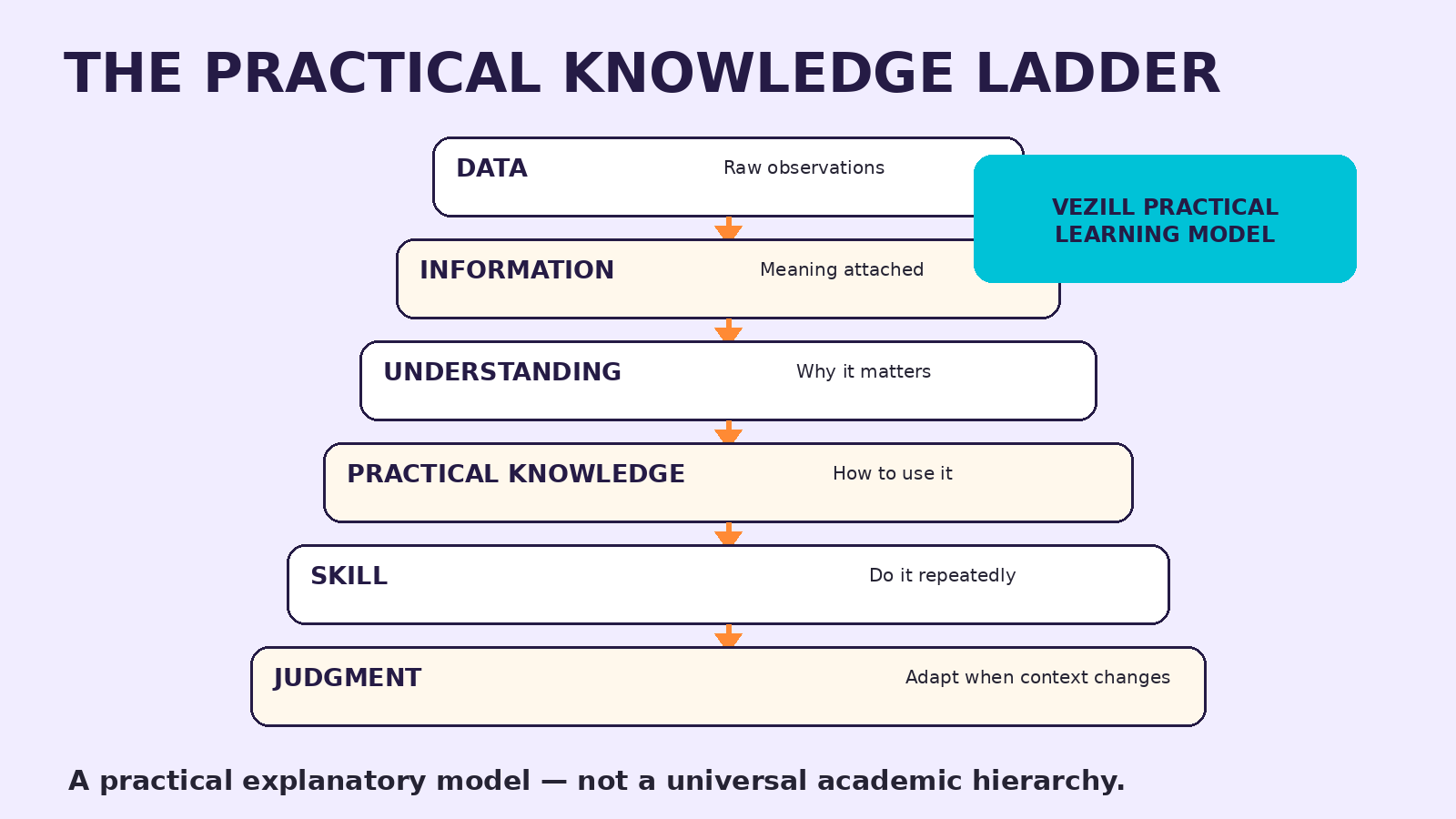 This is a VEZILL explanatory model, not a universal academic hierarchy.
Various data–information–knowledge hierarchies have appeared in information science and management, and they have also been criticized. Martin Frické, for example, argues that the familiar DIKW hierarchy should not be treated as a simple universal truth. That matters here because we should not pretend that every piece of data automatically “turns into” knowledge by moving through fixed levels.
VEZILL’s ladder is therefore a practical learning model, not an academic law. It asks a simpler question: what changes as a learner moves from seeing something to being able to use it repeatedly and adapt when conditions change?
DATA Raw observations or values. Example: 43, 51, 67, 71. INFORMATION Meaning has been attached. Example: website visits increased across four months. UNDERSTANDING You can explain what the change may mean and why it matters. PRACTICAL KNOWLEDGE You know how to use that understanding in a task: identify what drove the increase and decide what to test next. SKILL You can perform the analysis repeatedly without rebuilding the method from scratch. JUDGMENT You can adapt when the normal method is misleading, incomplete or inappropriate.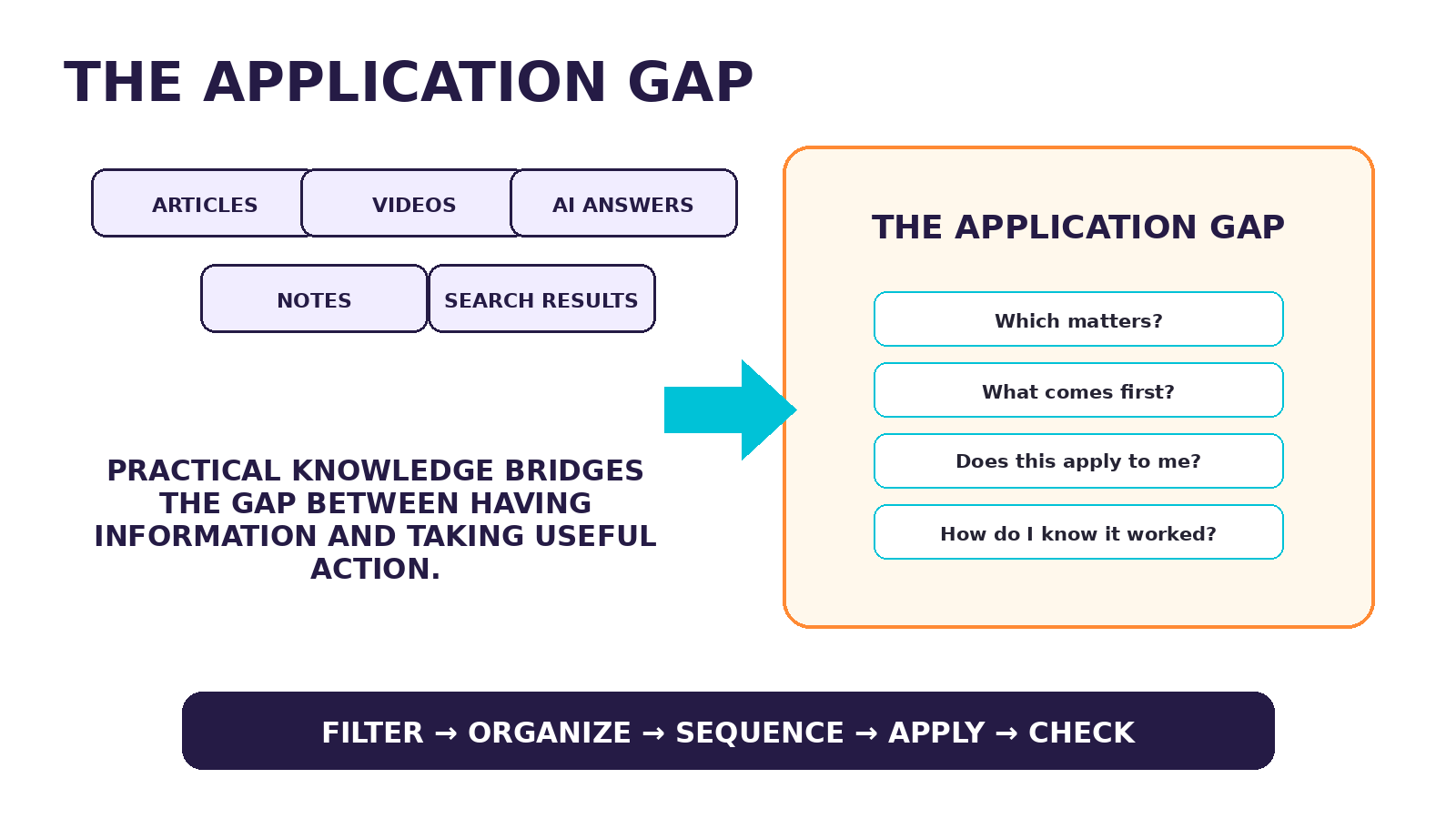 The internet can provide abundant information while leaving the learner to perform the assembly work.
Ask someone, “How do I make my website faster?” They may quickly find explanations of caching, CDNs, image compression, JavaScript, lazy loading, Core Web Vitals and server response time. All of that can be correct. The person can still end the research session with: “Okay… what should I do first?”
That is the application gap: the distance between having information and knowing how to use the right part of it in the current situation. The missing layer often includes prioritization, context, sequence, examples, tools, checkpoints and feedback.
MORE INFORMATION CAN CREATE MORE DECISIONS BEFORE IT CREATES MORE CLARITY.A useful VEZILL explanatory framework is:
INFORMATION + CONTEXT + SEQUENCE + EXAMPLE + ACTION + FEEDBACK = PRACTICAL KNOWLEDGEThis is not a scientific equation. It is a design test for turning content into something more usable. Information tells you what matters. Context tells you when it applies. Sequence tells you what comes first. An example makes the abstract concrete. Action gives the learner something to do. Feedback shows whether the attempt worked.
A resource does not need every element in equal quantity. A checklist may rely heavily on sequence and checkpoints. A formula may rely on a worked example. A troubleshooting guide may focus on context, decisions and feedback. The point is that practical knowledge is organized around use.
A generation ago, a common problem was access: where can I find an explanation? Today the internet can produce far more material than most people can evaluate in a single sitting. Search “how to start a newsletter” and you can encounter platform documentation, blogs, videos, social threads, AI answers, newsletters, courses, templates and communities.
The problem becomes less about finding any information and more about deciding which information matters for your exact outcome. That filtering work is not trivial. The learner has to choose what to ignore, what to trust, what applies, what comes first and when enough research is enough.
VEZILL’s article on finding practical knowledge online makes the same point from the search side: better learning often begins by defining the outcome before searching for the subject.
Traditional internet learning often looks like this: SEARCH → OPEN TABS → WATCH VIDEOS → ASK AI → COMPARE ANSWERS → SAVE NOTES → REMOVE DUPLICATES → PUT STEPS IN ORDER → TRY TO APPLY.
The learner is not merely consuming information. They are doing knowledge assembly. They are selecting, filtering, organizing, sequencing, contextualizing, verifying and applying. When that assembly has already been done well, the resource can save significant effort.
THE INFORMATION MAY BE FREE. THE ASSEMBLY WORK IS STILL WORK.A common mistake is to equate practical knowledge with tutorials. Step-by-step guides are one form, but practical knowledge can also live inside a checklist, decision tree, pricing formula, spreadsheet, prompt system, worked example, calculator, process map, troubleshooting guide, standard operating procedure or template.
A strong checklist can encode what experienced people know must not be forgotten. A spreadsheet can encode formulas and relationships. A decision tree can encode which option applies under which conditions. A template can embed questions, sequence and defaults.
PRACTICAL KNOWLEDGE IS KNOWLEDGE ORGANIZED FOR USE.Learning research often distinguishes declarative knowledge from procedural knowledge. The University of Oregon’s learning resource describes procedural knowledge as knowing how to do something and declarative knowledge as knowledge you can consciously explain. Chapman University also distinguishes procedural knowledge — knowing how to carry out a strategy or task — from declarative and conditional knowledge. These categories are useful, but they should not be treated as perfectly separate boxes. University of Oregon source · Chapman source.
For example, “a PivotTable summarizes data” is declarative information. “I can build the correct PivotTable for this sales dataset and use it to answer a question” is closer to procedural ability. Practical knowledge may include both, plus the context and judgment needed to know when the method applies.
Explicit knowledge can be documented relatively easily: manuals, formulas, checklists, guides, procedures and templates. It is the part of knowledge that can usually be written down, shared and stored.
Tacit knowledge is harder to fully articulate. An experienced barista may hear the grinder, feel the timing, see the texture and know something is off before a beginner can explain why. A designer may recognize that a layout feels unbalanced after years of comparison and practice.
NOT ALL KNOWLEDGE CAN BE COMPLETELY PACKAGED.That is an important boundary. A guide can transfer a process. A template can transfer structure. Neither can automatically transfer years of pattern recognition and judgment.
| Information | Practical Knowledge | Skill | |
|---|---|---|---|
| Main question | What is it? | How do I use it here? | Can I do it reliably? |
| Typical form | Facts/content | Organized usable guidance | Demonstrated ability |
| Requires action? | Not necessarily | Usually action-oriented | Yes |
| Context | May be general | Usually contextual | Adapted through practice |
| Example | “PivotTables summarize data.” | “Here is how to build the PivotTable you need.” | “I can independently analyze datasets with PivotTables.” |
These categories overlap. Practical knowledge can contribute to skill, but skill requires actual performance and repetition. Knowing a procedure is not identical to being able to execute it fluently under pressure or adapt it to unusual cases.
Information: “Instagram supports carousel posts.” Advice: “Use carousels because they will increase your reach.” Practical knowledge: “Here is when a carousel makes sense, how to structure one, how to create it and which metric to review afterward.”
Advice adds judgment. It can be useful, but the judgment may be poorly supported. Instructions add sequence: “Open Settings → Network → DNS → Custom.” Yet instructions can still lack context: what value belongs there, what changes, what can go wrong, how to reverse it and how to verify success.
INSTRUCTIONS ARE PART OF PRACTICAL KNOWLEDGE — NOT ALWAYS THE WHOLE OF IT.A resource can compress someone else’s experience into a useful starting point. It cannot do the task on your behalf. Practical knowledge becomes stronger when it is used.
LEARN → DO → CHECK → ADJUST → REPEATA learner may initially follow a process closely. After repeated use, they start recognizing exceptions, making faster decisions and adjusting without rereading every step. That is where skill and judgment begin to grow.
This is why VEZILL’s ACCESS → LEARN → APPLY model should not end at consumption. Application creates feedback, and feedback creates better judgment.
AI search and assistants have reduced the friction of getting an answer. ChatGPT Search can search the web and cite sources; OpenAI’s help guidance also warns that search results and citations can be incomplete or wrong and recommends opening sources and using authoritative material when accuracy matters. Google’s 2026 Search updates continue pushing AI Mode toward more complex, agentic and synthesized responses. Google Search 2026 update.
Before AI, the common flow was search → pages. Now it can be ask → synthesized answer. That is a huge reduction in retrieval friction. But retrieval is only one part of application.
AI REDUCES THE COST OF GETTING AN ANSWER. IT DOES NOT ELIMINATE THE NEED TO KNOW WHAT TO DO WITH THE ANSWER.A one-off answer may still lack a complete process, version-specific context, reusable tools, examples, checkpoints or tested boundaries. Structured knowledge and AI can work together: the resource provides the process, framework, template and guardrails; AI helps explain, adapt, personalize, compare and troubleshoot.
That is better than positioning structured knowledge against AI. The stronger model is complementary: structure supplies the durable map; AI makes the map interactive.
A familiar explanation can feel like knowledge because it is easy to recognize while you are reading or watching. But recognition is not the same as independent performance. Close the tab and the real test begins: can you recall the sequence, choose the correct option, notice an error and finish the task without being carried by the example?
UNDERSTAND WHILE WATCHING ≠ PERFORM WITHOUT HELPThis is one reason practical knowledge should include opportunities to act and check. A learner who only consumes may become familiar with the vocabulary without becoming capable.
Research on worked examples in educational psychology has repeatedly found that examples can be especially helpful for novices learning complex procedures because they reduce the search involved in figuring out every step from scratch. Reviews also emphasize that the benefit depends on the learner, task and instructional design. Educational Psychology Review on worked examples.
Take gross profit. Information: “Gross profit = revenue − cost of goods sold.” That is useful. A worked example makes it easier to apply: Revenue = KES 100,000; cost of goods sold = KES 60,000; gross profit = KES 40,000. Then the learner can calculate their own numbers.
FORMULA → EXAMPLE → APPLICATIONA client-onboarding template can encode what an experienced service provider knows to ask, when to ask it, what to document and what to confirm. The value is not just empty boxes. The structure itself can embody decisions.
A website-launch checklist compresses knowledge about what must be verified before going live. It may not teach the full theory of DNS, analytics, accessibility or backups, but it can protect against omission.
A pricing framework or troubleshooting tree can reduce a large decision space into repeatable questions. It does not become a universal law simply because it is neat. A good framework makes assumptions and boundaries visible.
KNOWLEDGE DOES NOT ONLY LIVE IN PARAGRAPHS. IT CAN LIVE INSIDE TOOLS.A knowledge product is a digital resource designed to package useful knowledge into a form someone can access, understand and apply. It might be a guide, spreadsheet, checklist, SOP, prompt system, calculator, framework, toolkit, mini-course, template or troubleshooting resource.
The value is not that words have been placed into a PDF. The value can come from selection, organization, context, sequence, examples, tools and application. A badly organized paid guide can be less useful than a free official help page. A well-designed free template can be extremely valuable.
SELECTION + ORGANIZATION + CONTEXT + APPLICATIONPeople often do not pay because information is impossible to find. They may pay because they do not want to perform all of the assembly work themselves. They may value curation, structure, specialization, examples, reusable templates, sequence, time saved or reduced uncertainty.
A simple analogy is water: the existence of water does not make filtering, packaging and delivery worthless. Knowledge is not literally water, but the analogy shows why access to raw material and value-added organization are different things.
THE VALUE IS OFTEN NOT ACCESS TO INFORMATION. IT IS REDUCING THE WORK REQUIRED TO TURN INFORMATION INTO ACTION.Free information can also be excellent. Official documentation, open-source manuals, strong YouTube tutorials, community guides and AI explanations can be outstanding. Paid knowledge can be generic, outdated or inaccurate.
PRICE IS NOT A RELIABILITY SIGNAL. PACKAGING IS VALUABLE ONLY WHEN THE PACKAGE IMPROVES USEFULNESS.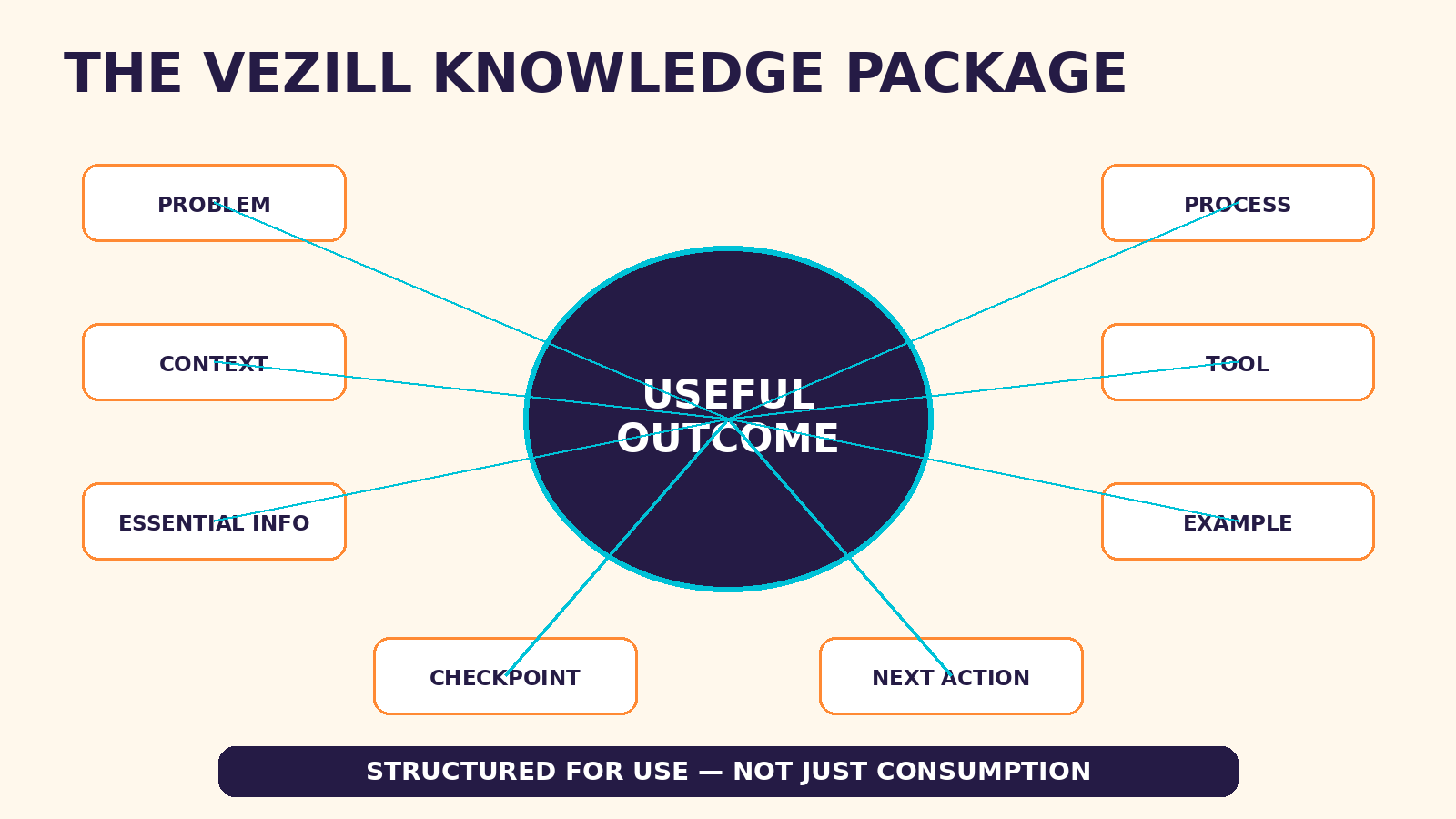 A VEZILL product-design framework for structuring practical knowledge around use.
A strong practical knowledge product can be designed around a clear outcome rather than around content volume. VEZILL’s Knowledge Package is a product-design framework, not an academic standard.
PROBLEM — What does this solve? CONTEXT — Who is this for and when does it apply? ESSENTIAL INFORMATION — What does the learner actually need to know? PROCESS — What should the learner do? TOOL — Is there a template, checklist, formula, prompt or worksheet that makes application easier? EXAMPLE — What does good application look like? CHECKPOINT — How does the learner know the process is working? NEXT ACTION — What should the learner do immediately after finishing?VEZILL is positioning itself around structured Quick Knowledge: useful knowledge packaged around tasks, problems and outcomes. VEZILL’s own About page describes Quick Knowledge as focused practical information designed to help someone accomplish a task, solve a problem or achieve a result without necessarily studying an entire subject.
The deeper meaning of ACCESS → LEARN → APPLY is straightforward. ACCESS reduces the search and assembly burden. LEARN means understanding the part that matters. APPLY means putting that knowledge against a real task.
ACCESS → LEARN → APPLY → FEEDBACK → IMPROVEThat is also why the distinction between a practical knowledge hub and a generic digital-product marketplace matters. Knowledge is the value. Digital products are the container. The marketplace is the delivery mechanism. You can browse VEZILL’s practical knowledge products as examples of that container layer.
A guide about writing a freelance proposal does not make someone an expert salesperson. A website-security checklist does not make someone a cybersecurity professional. A tax guide does not replace a qualified professional in a complex case. A medical explainer does not make the reader a clinician.
PACKAGED KNOWLEDGE CAN HELP WITH A BOUNDED OUTCOME. IT SHOULD NOT PRETEND TO PACKAGE AN ENTIRE PROFESSION.This connects directly to VEZILL’s article Quick Knowledge vs Online Courses: the right depth depends on the capability required. One task may need one focused resource. Repeated professional performance may need structured study, feedback, supervision and extensive practice.
Sometimes the right answer really is just information. What time does the store close? What keyboard shortcut opens search? What file type does this tool accept? What does an acronym mean? What is the maximum upload size? These are answer-sized problems.
ANSWER-SIZED PROBLEM → INFORMATIONA task-sized problem might be creating an invoice, formatting a CV, making a presentation, using a spreadsheet formula or setting up a simple landing page. When the task is bounded, relatively low-risk, observable and easy to verify, structured practical knowledge may be enough to begin useful application.
Capability-sized problems are different. Medicine, structural engineering, advanced cybersecurity, professional accounting, law, complex investment decisions and advanced technical architecture require deeper foundations, repeated practice and professional judgment. Quick Knowledge can support a piece of the journey; it should not pretend to replace the journey.
| Situation | Information | Practical Knowledge | Skill / Capability |
|---|---|---|---|
| Cooking chicken | Safe temperature, browning, seasoning facts | A method matched to cut, pan and heat with doneness checks | Cook chicken reliably |
| Excel PivotTable | PivotTables summarize data | Build the right PivotTable for a sales report | Analyze datasets independently |
| Canva | Canva supports templates | Choose and customize a layout for a specific presentation | Design consistently |
| WordPress | Plugins extend WordPress | Install, test and roll back a plugin safely | Manage a WordPress site |
| AI prompting | Models respond to instructions | Use a prompt pattern for a repeatable task | Design effective AI workflows |
| Coding | A loop repeats instructions | Use a loop correctly in this program | Program fluently |
| Email marketing | Open rate measures opens | Set up, send and evaluate a campaign | Run email marketing |
| Google Ads | Campaigns contain ad groups | Launch and monitor a simple campaign | Manage paid search |
| SEO | Title tags describe pages | Write and implement a title tag for this page | Optimize pages systematically |
| Ecommerce | A product page needs key details | Build a complete product page that converts clearly | Operate an online store |
| Budgeting | Expenses reduce available cash | Build a monthly budget and review variance | Manage personal finances |
| Freelancing | A proposal explains an offer | Write a proposal for this client brief | Sell services consistently |
| CV writing | A CV summarizes experience | Tailor a CV to a specific role | Present professional experience well |
| Job interview | STAR is an answer structure | Build and rehearse a STAR answer for one competency | Interview effectively |
| Presentation | Visual hierarchy directs attention | Turn notes into five clear slides | Present ideas clearly |
| Data analysis | Mean is an average | Choose the right summary for this dataset | Analyze data with judgment |
| Social media | Carousels contain multiple slides | Plan, structure and publish one useful carousel | Create social content strategically |
| Photography | Shutter speed affects motion | Set shutter speed for this moving subject | Control exposure creatively |
| Video editing | Cuts join clips | Edit a short sequence with pacing and audio | Edit videos fluently |
| Newsletter | A subject line influences opens | Create, send and review one newsletter | Operate a newsletter consistently |
| Website speed | Caching can reduce repeat work | Identify the biggest bottleneck and fix it safely | Optimize websites |
| DNS | DNS maps names to services | Add the correct record and verify propagation | Manage DNS confidently |
| Client onboarding | Onboarding gathers project inputs | Run a structured onboarding workflow | Manage clients professionally |
| Pricing | Profit needs revenue above costs | Use a pricing formula with real costs and margin | Price offers with judgment |
| Inventory | Stock levels change after sales | Build a basic stock-tracking workflow | Manage inventory |
| AI research | AI can synthesize sources | Ask, verify and document one research answer | Research with AI responsibly |
| Project planning | Projects have tasks and dependencies | Turn an outcome into milestones and tasks | Manage projects |
| Cooking rice | Rice absorbs water | Use the right ratio and heat for this rice | Cook rice consistently |
| Home Wi-Fi | Routers broadcast wireless networks | Change the Wi-Fi password on this router model | Manage a home network |
| Content calendar | A calendar schedules content | Build a one-month calendar around goals and formats | Plan content strategically |
Notice that the process ends with improvement rather than consumption. Practical knowledge becomes more valuable when the learner can test it against reality.
VEZILL’s About page frames the platform around focused, practical knowledge people can apply. Its FAQ similarly describes VEZILL as a digital knowledge marketplace connecting people who know how with people who need to know how.
That distinction is useful for product strategy: VEZILL should not merely accumulate files. The stronger proposition is to help people find knowledge that has been packaged around a problem, context, process and result.
If you are trying to find the right kind of practical resource, start with What Are You Trying to Do? How to Find Practical Knowledge Online. If you need a step-by-step resource, see Where Can I Find Step-by-Step Guides for Things I Want to Do?. If you are deciding whether one resource is enough or a full course is justified, use Quick Knowledge vs Online Courses.
Information tells you facts or explanations. Practical knowledge connects relevant information to context, action, examples and feedback so you can use it in a real situation.
Knowing that PivotTables summarize data is information. Knowing how to build the correct PivotTable for a sales report and interpret the result is practical knowledge.
Not exactly. Information can contribute to knowledge, but knowledge also involves understanding, connections, context and, in many cases, experience.
Procedural knowledge is knowledge of how to perform a task or process. It is often demonstrated through action rather than only through explanation.
Declarative knowledge is knowledge that can be consciously stated or explained, such as facts, concepts or rules.
Tacit knowledge is knowledge that is difficult to fully articulate and often develops through experience, observation, practice and judgment.
Knowledge can explain what to do and why. Skill is the demonstrated ability to perform reliably, usually developed through practice and feedback.
Yes. Information becomes more practically useful when it is selected, organized, contextualized, applied and tested against a real outcome.
More information can create more choices, contradictions and filtering work. The learner still has to decide what matters, what applies and what to do first.
AI can retrieve, explain and adapt information, but a useful answer is not automatically a complete, tested or reusable process. AI works well alongside structured knowledge.
They may be paying for curation, sequence, context, templates, examples, specialization, reduced uncertainty or time saved — not simply for access to facts.
VEZILL is building a practical knowledge hub where useful knowledge can be packaged into guides, templates, checklists, prompts, frameworks, spreadsheets and other digital resources.
Information gives you pieces. Practical knowledge helps you put the right pieces together for a real outcome. Neither replaces the other. The quality of practical knowledge depends on the quality of the information underneath it, while the usefulness of information often depends on whether someone can connect it to context and action.
THE GOAL IS NOT TO CONSUME MORE INFORMATION. THE GOAL IS TO KNOW ENOUGH OF THE RIGHT INFORMATION, IN THE RIGHT CONTEXT, TO DO SOMETHING USEFUL WITH IT.Sometimes one fact is enough. Sometimes you need a structured guide, checklist, example or template. Sometimes the task is large enough to require deeper study and repeated practice. Matching the knowledge format to the problem is the practical skill.
That is the deeper idea behind VEZILL: Knowledge is the value. Digital products are the container. The marketplace is the delivery mechanism. ACCESS → LEARN → APPLY.
Discover more articles you might be interested in
how to create your first knowledge product in one weekend
By Davie

how to build multiple digital products from one skill
By Davie

how to find problems people will pay you to solve
By Davie

How to turn a hobby into a digital product
By Davie
Get the updates, on newly released, popular & fast-moving MRR digital products
Up to Top
Comments All
Leon
@leon
There’s a real difference between simply knowing something and actually knowing how to use it. This made the idea of practical knowledge much clearer, especially when you’re trying to get something done.
September 17,2026 At 06:06 PM