
SEO has not disappeared. It has expanded from ten blue links into a wider discipline of organic discovery: search, maps, shopping surfaces, AI Overviews, AI Mode, Bing, Copilot and ChatGPT.
 Modern SEO connects search demand to measurable business action.
An SEO specialist can make money online through audits, keyword and search-intent research, on-page optimization, content strategy, local SEO, ecommerce SEO, technical SEO, Google Business Profile management, analytics, migration support, consulting, fractional leadership and AI-search visibility services. They can also work remotely, teach SEO, productize services and sell templates, checklists and other digital products.
The strongest offers do not sell rankings alone. They solve a specific visibility or customer-acquisition problem and connect the work to qualified traffic, enquiries, bookings, leads, customers or sales.
The old journey was simple: question → Google → result → website → action. The current journey may be question → search or AI system → answer plus sources → website or brand → action.
Google’s 2026 guidance says the SEO fundamentals used in traditional Search continue to matter for AI Overviews and AI Mode. Google does not require a secret AI file, special AI markup or an artificial “AI ranking” trick. Pages still need to be accessible, indexable, useful and eligible for Search. Microsoft’s Bing Webmaster Tools now adds AI Performance reporting, including cited URLs, citation trends and sampled grounding queries. OpenAI separately documents OAI-SearchBot as the crawler used to help surface public websites in ChatGPT search.
DISCOVERABLE → UNDERSTANDABLE → CREDIBLE → ACCESSIBLE → USEFUL → MEASURABLE
That is the commercial opportunity. Businesses pay SEO specialists to improve this chain.
Modern SEO can include customer research, search-intent analysis, page architecture, crawlability, indexation, internal linking, content briefs, structured information, local visibility, Search Console analysis, technical diagnosis, performance monitoring and conversion measurement.
Google’s Search Essentials emphasize helpful, reliable, people-first content and descriptive language in prominent locations such as titles, headings, alt text and links. SEO is therefore not “repeat the keyword 15 times.” It is the disciplined connection between what people need, what a page says and what a business can genuinely provide.
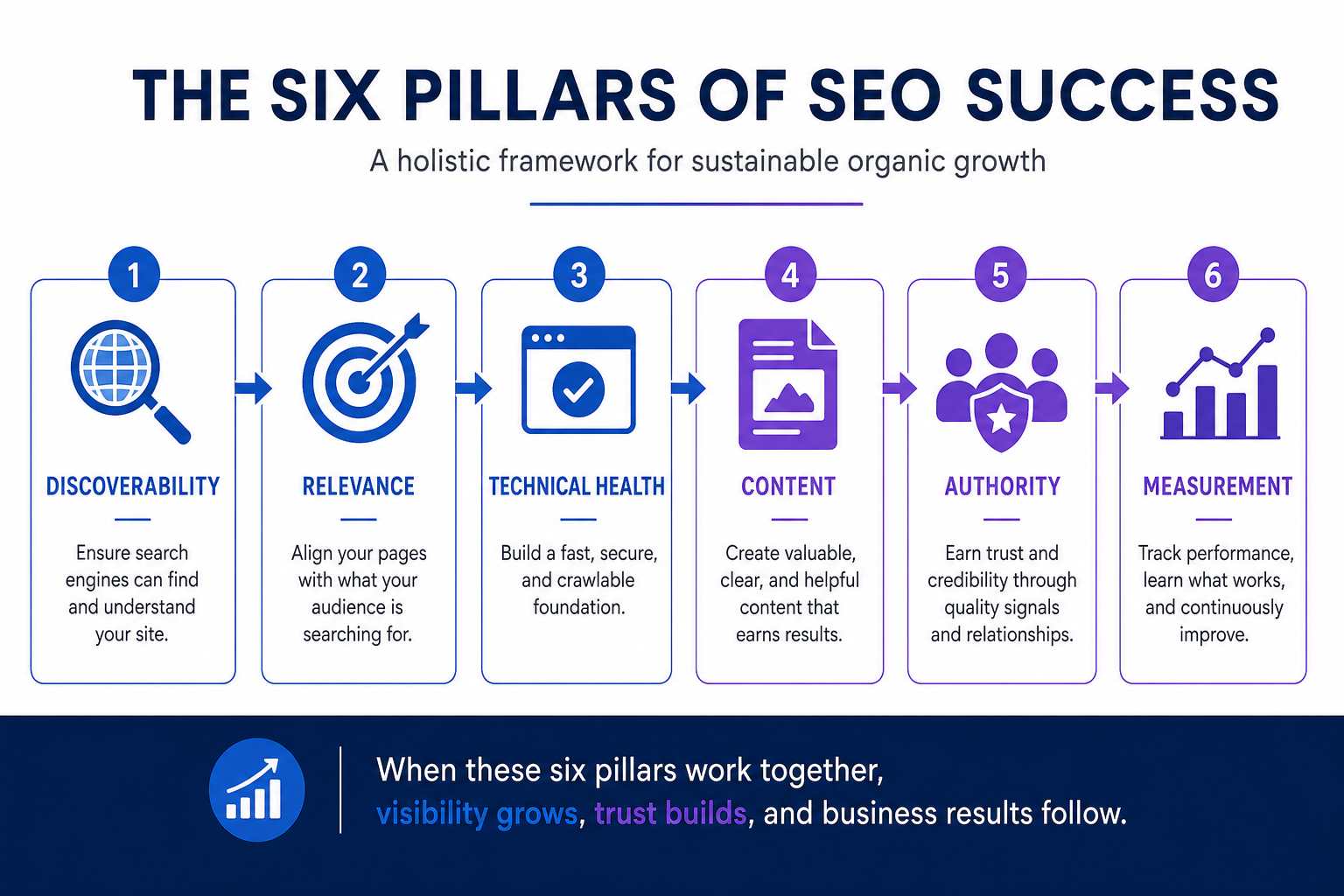 The six commercial outcomes behind professional SEO work.
Audit crawlability, indexing, redirects, canonicals, site architecture, internal links, titles, content gaps, structured data, performance and search intent. Do not export a pile of automated warnings. Deliver problem → evidence → impact → priority → recommendation. A strong audit can lead to implementation and then a retainer.
Businesses do not need 5,000 disconnected phrases. They need a search opportunity map that groups informational, commercial, local, comparison and product queries, then maps each group to the right page and business objective.
Improve existing pages through titles, headings, structure, clarity, internal links, metadata, image descriptions, structured information, intent alignment and calls to action. Package the work around a defined number of pages.
Replace random publishing with customer problem → search demand → content → internal link → commercial page → action. Deliver topic research, content gaps, clusters, briefs, calendars and refresh schedules.
Find pages that are outdated, cannibalized, thin, poorly linked or mismatched to intent. Decide whether to create, update, consolidate, redirect or remove. Existing content may already have history and links, making refresh work commercially attractive.
Serve dentists, hotels, restaurants, salons, lawyers, property companies and repair services. Offer Business Profile reviews, location pages, local search research, review processes and reporting. Never promise “number one on Maps”; Google says local visibility depends on factors such as relevance, distance and prominence, not a private payment route.
Work on robots directives, XML sitemaps, status codes, redirects, canonicals, JavaScript rendering, structured data, site architecture and Core Web Vitals. This can command stronger differentiation, but beginners should not casually take responsibility for high-risk migrations or enterprise systems.
Help Shopify, WooCommerce and other stores structure category and product pages, manage filters, duplicates, out-of-stock items, seasonal inventory, reviews, internal links and product information. Commercial architecture often matters more than publishing hundreds of generic blog posts.
Sell this as a focused recurring service: accurate details, categories, hours, photos, updates, review monitoring, customer questions and performance review. Do not create fake reviews, locations or business information.
Clients already have data; they need interpretation. Move from data → insight → recommendation → action. Explain which pages and queries changed, whether qualified traffic moved, what happened to enquiries and what should happen next.
Support domain, CMS, redesign and URL migrations with a before/during/launch/after process: crawl and benchmark, map URLs, review staging, QA redirects and canonicals, check robots and sitemaps, then monitor indexation and performance.
Consultants are paid for decisions: which content to prioritize, whether a migration is safe, which market to target and how SEO fits acquisition. The title is not the proof; reliable judgment comes from projects, analysis and business understanding.
Some companies need senior direction without a full-time hire. Provide strategy, roadmaps, team coordination, agency management, prioritization, editorial oversight, reporting and executive communication.
Remote roles include SEO analyst, content SEO specialist, ecommerce SEO specialist, technical SEO specialist, strategist and agency consultant. Employment can be the right model for someone who wants predictable income and exposure to established teams.
Offer a defensible AI Search Visibility Audit: crawlability, entity clarity, useful answers, supporting evidence, current pages, accessible text and consistency between visible content and structured data. Do not sell a secret ChatGPT ranking algorithm. Google says existing SEO fundamentals remain foundational.
Monitor brand mentions, supported AI referrals, citation visibility, important questions, cited competitors, content gaps and changes in how a brand is described. Bing’s AI Performance reporting makes this more measurable, but citation frequency is not the same as ranking, authority or revenue.
Help businesses choose markets, structure country and language pages, localize research, implement hreflang and coordinate translation workflows. Translation alone is not international SEO; language, terminology and buying behavior vary by market.
Earn legitimate mentions through original research, industry reports, expert commentary, useful tools, data studies and partnerships. Avoid link schemes and mass low-quality backlinks. A valuable link is usually a by-product of something genuinely worth referencing.
|
Model |
Best starting level |
Recurring potential |
Best fit |
|
Keyword research / on-page SEO |
Beginner–Intermediate |
Low–Medium |
New freelancers |
|
Audits / reporting |
Intermediate |
Medium–High |
Analytical specialists |
|
Local / ecommerce SEO |
Intermediate–Advanced |
High |
Freelancers and agencies |
|
Technical / migration SEO |
Advanced |
High |
Technical professionals |
|
Consulting / fractional leadership |
Advanced |
High–Very High |
Senior professionals |
|
Training / digital products |
Intermediate+ |
Variable |
Educators and product creators |
No row guarantees income. Your competence, niche, customer access, proof and ability to solve a real problem matter more than the label.
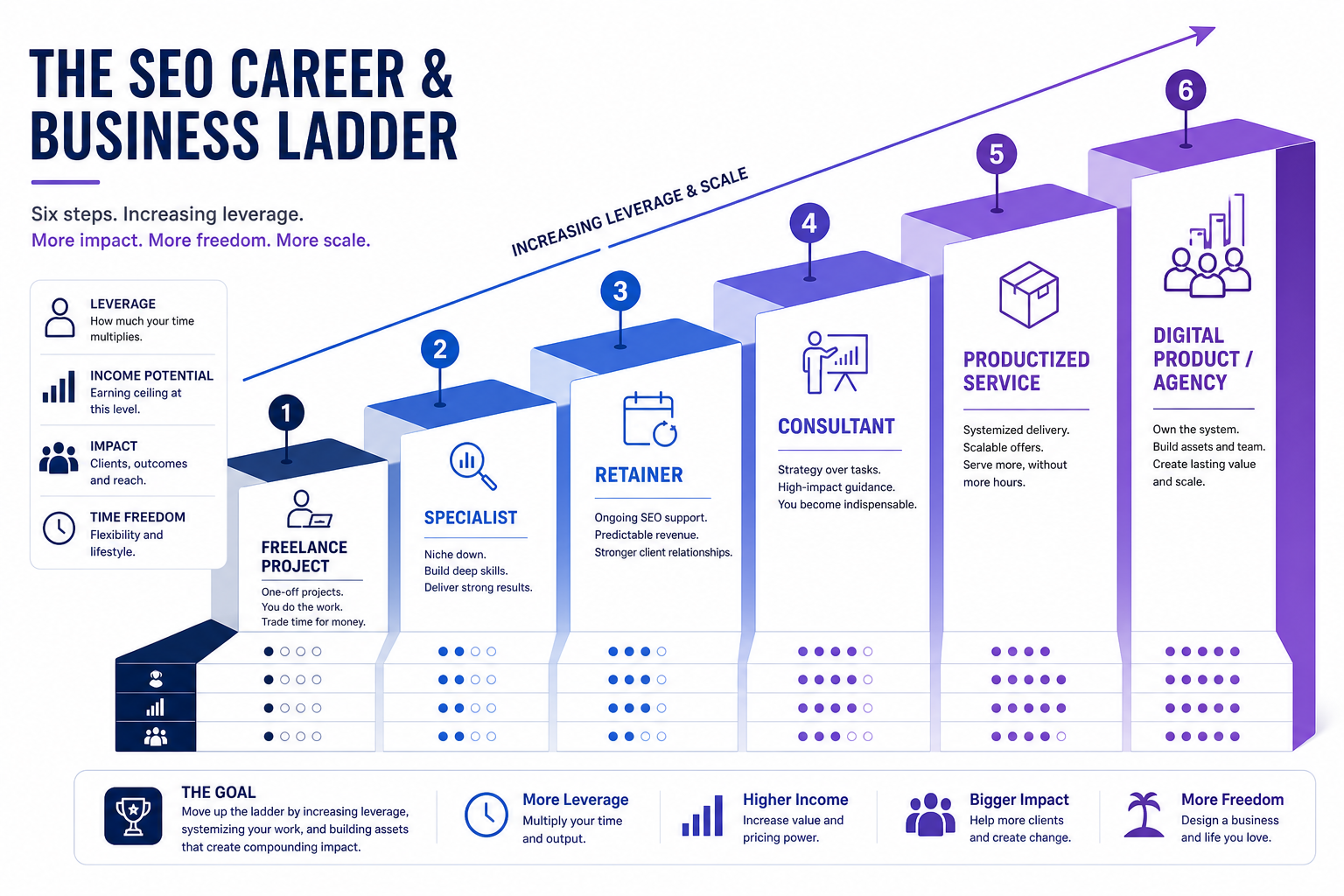 Leverage usually grows when repeatable expertise becomes a system.
Weak
I do keyword research.
Better
I identify the searches potential customers make before buying and turn them into a prioritized page and content plan.
Weak
I optimize Google Business Profiles.
Better
I help local service businesses improve how they appear when nearby customers search for the services they offer.
Weak
I do technical SEO.
Better
I identify the technical problems preventing important pages from being discovered, indexed or understood.
NICHE + SEARCH PROBLEM + SEO SOLUTION + BUSINESS OUTCOME
“I provide SEO services” is generic. “I help independent hotels capture non-paid demand around destinations, accommodation and booking-intent searches” is specific. Possible niches include SaaS, ecommerce, healthcare, hospitality, real estate, legal, fintech, B2B, education, local services and African-market SEO.
Domain knowledge compounds. A hospitality specialist learns about room pages, seasonality, booking engines, destinations and traveler behavior. That combination is harder to replace with a generic prompt.
Create a clearly labeled SEO audit demonstration.
Build a search opportunity map for a real business category.
Produce a 90-day content strategy.
Analyze a local business’s public search presence without pretending to access private data.
Use your own site or permitted environment for a technical SEO case study.
Use problem → data → analysis → recommendation → implementation → measurement. Never invent traffic, revenue, rankings, testimonials or conversion improvements.
Choose one niche. Find 30 suitable businesses. Study their public search presence. Identify one genuine opportunity. Prepare a short mini-audit or two-minute walkthrough. Contact the relevant decision-maker with a specific observation, relevant opportunity and easy next step.
For example: “Your hotel has detailed room pages, but I could not find a dedicated page for conference accommodation in your area. I mapped a few search opportunities and recorded a short walkthrough. Happy to send it if useful.” Start with a small paid project, deliver carefully, measure what can be measured, then offer ongoing work.
Service work is not the only monetization route. Package a repeatable shortcut, system or tool into an SEO audit workbook, keyword research template, content brief system, local SEO checklist, ecommerce toolkit, migration checklist, proposal kit, internal-link worksheet, reporting dashboard or AI-search visibility checklist.
Vezill supports digital products such as guides, templates, checklists, software and educational resources. Relevant examples include How to Optimise Products for AI Search, which covers product-page clarity and AI-search discoverability, and Sell Your First Digital Product, a beginner roadmap for creating, launching and selling a digital product.
If you want a broader marketing system, see YouTube Marketing for Digital Products and WhatsApp Marketing for Digital Products. For the commercial side of resell-rights products, review Solve Your Online Marketing Problem with MRR. Rights and licensing conditions always control what may be resold; MRR is not guaranteed passive income.
Continue learning through Vezill’s related blogs: How to Make Money Selling Digital Products Online, How to Turn YouTube Videos Into Digital Products and How to Become a Top Seller on Vezill. These links reinforce the same progression: learn a marketable skill, package the knowledge, attract the right audience and build a repeatable digital-product business.
Choose training based on the capability missing from your current offer, not on collecting certificates. Inceptor Institute’s Digital Marketing Course in Kenya covers SEO, search intent, on-page and technical fundamentals, local SEO, Google Search Console, audits, analytics, content, Google Ads and digital-product marketing.
If you need stronger data skills, explore Advanced Excel Training and the Inceptor course catalogue. For technical expansion, see Web & Software Development, Software Development with AI, Python Programming and Artificial Intelligence, AI Agents & Automation.
For SEO specialists who want to create and sell their own assets, Inceptor’s Digital Product Trading Masterclass with AI connects market research, AI-assisted creation, packaging, sales pages, organic marketing and launch systems.
AI can accelerate query classification, clustering, briefs, regex, spreadsheet formulas, data analysis, schema drafts, reporting and repetitive analysis. It cannot guarantee that the output is correct or that a page will rank. It may suggest the wrong canonical tag, invent facts or generate large amounts of low-value repetition. Professional SEO still requires verification, judgment and accountability.
Do not sell an “AI ranking secret.” Sell accessible content, clear entity information, useful answers, trustworthy evidence, clean technical foundations and transparent measurement. Google’s guidance specifically rejects the need for special AI markup, content chunking, AI-only rewrites and manufactured mentions. OpenAI says public websites can be eligible for ChatGPT search when OAI-SearchBot is not blocked; it does not promise placement.
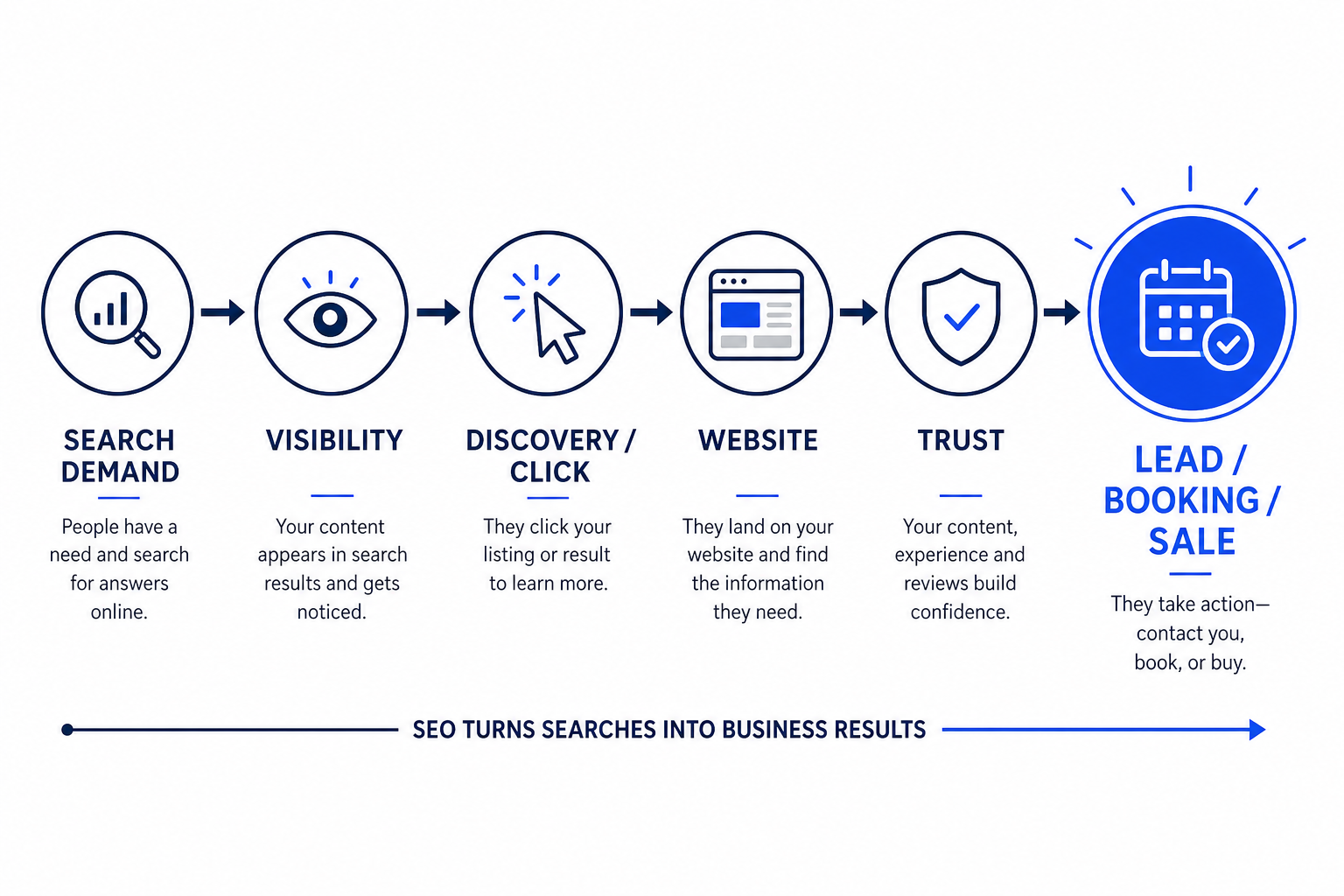 Rankings are not the final destination. Business action is.
Kenyan SEO specialists can combine local expertise with international delivery. Potential niches include hotels, safari operators, real estate, clinics, restaurants, ecommerce, schools, NGOs, SaaS businesses and SMEs. Understanding Nairobi neighborhoods, Kenyan customer language, tourism destinations, M-Pesa-driven buying behavior and local business structures can create an advantage that a generic overseas provider does not have.
Week 1: learn the fundamentals and choose one niche.
Week 2: build one strong demonstration project.
Week 3: package a clear offer, mini case study, template and outreach message.
Week 4: contact relevant businesses with specific observations and track replies, calls, proposals and projects.
Over 90 days, deliver carefully, identify repeated problems, productize the process and add monitoring or optimization where it creates genuine value.
Promising number-one rankings.
Selling tools instead of decisions and outcomes.
Having no niche.
Measuring nothing beyond rankings.
Keyword stuffing and buying spam links.
Publishing blind AI content.
Taking complex migration or enterprise work too early.
Creating fake reviews, fake locations or misleading structured data.
Filling retainers with meaningless activity.
Depending on one marketplace.
Yes. Common routes include freelance projects, audits, local and technical SEO, ecommerce, content strategy, reporting, consulting, fractional leadership, remote employment, training and digital products.
Start with one narrow service you can deliver competently, build demonstration projects and approach one customer type with specific observations rather than generic promises.
Yes, if you learn modern SEO: intent, useful content, technical access, measurement, local visibility, business outcomes and AI-assisted discovery.
Yes. Original checklists, workbooks, briefs, reporting systems and SOPs can become digital products. A practical shortcut usually has more value than generic information.
You can improve accessibility, clarity, usefulness, evidence and crawlability. You cannot legitimately guarantee “ranking number one in ChatGPT.”
There is no universal price. Scope, complexity, expertise, implementation responsibility, market, reporting and business value determine the appropriate model.
You do not make money online simply because you know what SEO means. You make money when you connect what people are searching for with a business capable of genuinely helping them—and build a reliable system that improves discoverability.
SEO SKILL → SEARCH PROBLEM → SOLUTION → PROOF → CLIENT → RESULT → RETAINER → SPECIALIZATION → SYSTEM → BUSINESS
Start with “I know SEO.” Move toward “I help independent hotels capture non-paid demand around destinations, accommodation and booking-intent searches.” Eventually, you may advise businesses on organic discovery across traditional and AI-driven search.
Google: New opportunities, control and insights for website owners
Microsoft Bing: Introducing AI Performance in Bing Webmaster Tools
Search platforms and course pages change. Verify current course details, product rights, prices and platform policies before publishing or making commercial claims.
Discover more articles you might be interested in

Discover 10 practical skills you can begin learning in 30 days, create proof of your ability and package into a realistic starter offer for earning online.
By Davie

Learn how small businesses can use AI for marketing, sales, customer service and automation—and turn real business experience into digital products to sell online.
By Davie

Learn how to build an AI-powered online business with practical ideas, tools, customer strategies, AI automation and a 30-day startup roadmap
By Davie

how web designers can make money online
By Davie
Get the updates, on newly released, popular & fast-moving MRR digital products
Up to Top
Comments All
Faith kamau
@faith_kamau
This was such an interesting read! I really liked how it shows that SEO can open up so many different ways to earn online, not just through one type of job. The different ideas are practical and motivating, especially for someone looking to build an online income. Definitely picked up a few ideas from this article! 👏
September 04,2026 At 11:19 PM