
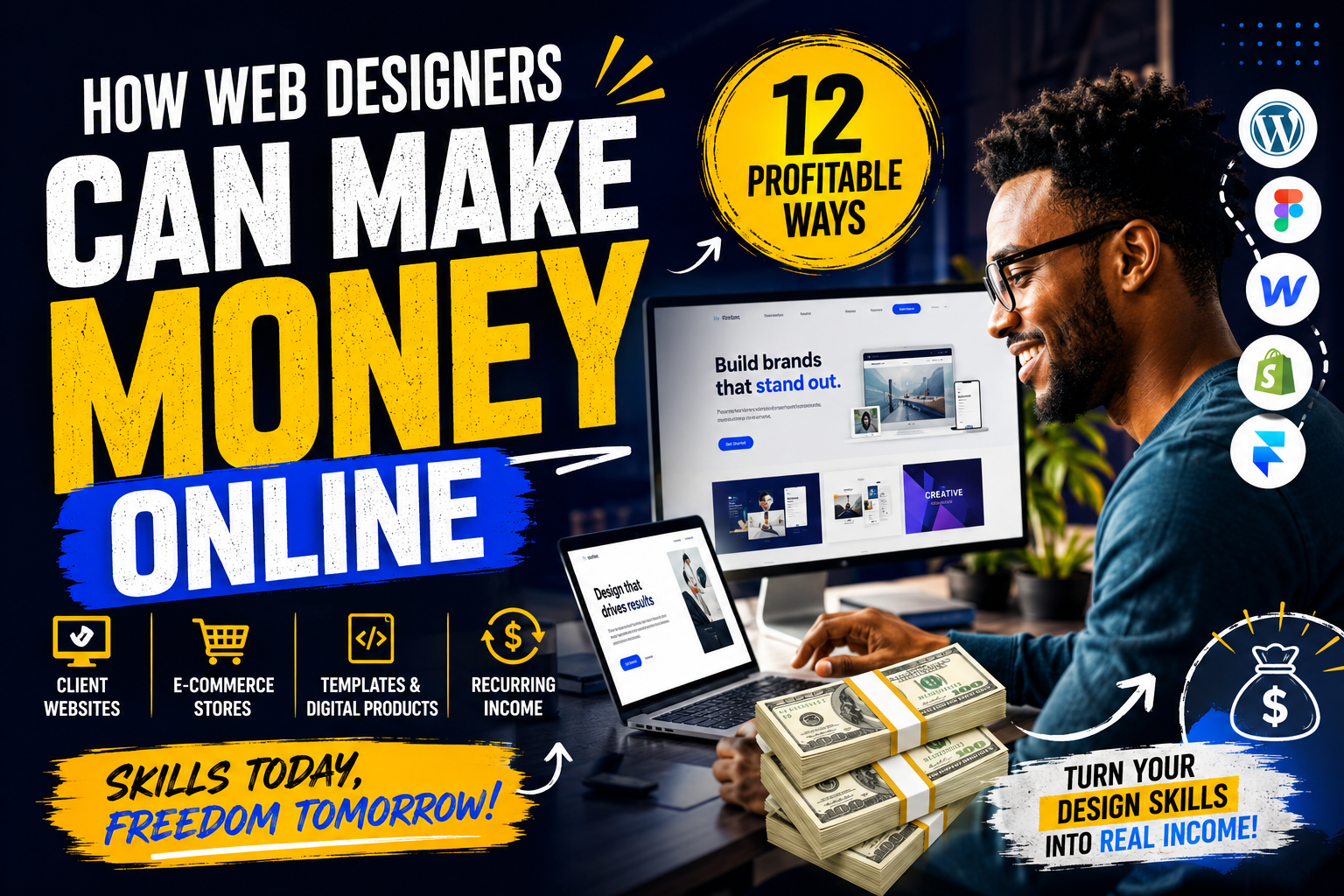
A web designer can earn from a single client project, turn that client into a monthly maintenance customer, build landing pages for other businesses, sell templates repeatedly, work behind the scenes for agencies, create digital products, or teach what they know.Knowing how to design a website is not just a technical skill. It can become the foundation of an entire online business.
And despite the rise of AI website builders, there is still measurable demand for people who can create and improve websites. The U.S. Bureau of Labor Statistics projects employment of web developers and digital designers to grow 7% between 2024 and 2034, compared with 3% across all occupations.
The important shift is that simply knowing how to "make a website" is becoming less valuable on its own.
Businesses pay for outcomes: more enquiries, more bookings, more sales, better credibility, faster websites, easier navigation, better conversion rates.
That is where the opportunity is.
This guide explains how web designers can make money online in 2026, what you can actually sell, who might buy it, where to find clients, how to package your services and how to turn one-off projects into recurring income.
Web designers can make money online by building websites for clients, creating landing pages, designing e-commerce stores, redesigning existing websites, selling website templates, offering monthly maintenance, working with agencies, selling digital design products and teaching web design. Designers can also use AI tools to speed up research, copy, prototyping and development, allowing them to handle projects more efficiently.
The most straightforward way to monetize web-design skills is still one of the best: build websites for other people and businesses.
You don't need to start an agency. You need a clearly defined service and someone with a problem you can solve.
Potential customers include consultants, restaurants, photographers, lawyers, creators, coaches, accountants, real-estate businesses, hotels, contractors, clinics, startups and small e-commerce brands.
Instead of selling "I do web design," turn your skill into a concrete offer.
Example Offer — Small Business Website Package
Now the customer understands what they are purchasing.
There isn't one universal web-design price. Current Upwork marketplace data gives a useful reference point: web designers on its marketplace commonly fall around $15–$30 per hour, while Upwork lists roughly $300–$1,500 for landing-page projects, $1,500–$5,000 for business website design, $3,000–$10,000 for e-commerce design and $1,000–$5,000 for website redesigns.
Those are marketplace reference ranges, not prices every beginner will immediately command. A designer's actual price depends on experience, portfolio quality, scope, market, complexity, copywriting, integrations, development work and the business value of the project. A beginner may intentionally start with smaller projects to build proof. The mistake is staying permanently cheap.
Try This Today: Create one service package rather than listing everything you know. For example: "Restaurant Website Starter — website + menu + WhatsApp + Google Maps + reservation CTA." That is much easier for a restaurant owner to understand than "professional web-design services."
One of the easiest places to find potential web-design opportunities is not necessarily a freelance marketplace. Look around your own city.
Search Google Maps for: restaurants, salons, dentists, gyms, lawyers, hotels, real-estate agents, contractors, cleaning companies, clinics, photographers, car dealers.
Then inspect their online presence. You are looking for a business problem, not simply an ugly website.
For example, a restaurant might have great Google reviews but its website has no menu. A salon might depend entirely on Instagram and have no booking page. A contractor's website might look reasonable on desktop but become almost unusable on a phone. A hotel may have beautiful rooms but make customers hunt for a telephone number instead of providing a clear reservation CTA.
Those are sellable problems.
Choose one industry and investigate 30–50 businesses. For every business, check: Does it have a website? Does the site work properly on mobile? Is the main offer immediately obvious? Is there a strong call to action? Is contacting or booking easy? Are pages obviously outdated? Are there broken links? Is the website painfully slow? Are important trust signals missing? Is there a clear opportunity you can actually improve?
Then contact only businesses where you found something meaningful.
Example Outreach
"Hi James, I found your restaurant while looking at businesses in Westlands. I noticed your Google profile gets customers to your website, but the menu is difficult to view on mobile. I redesigned that section as a quick concept to show how the menu and WhatsApp reservation button could work. Happy to send it over if useful."
Notice what is missing: "Hello Sir/Madam, I am a professional web designer offering affordable website development services..." Personalized outreach demonstrates that you looked at the business before asking for money.
Being in Kenya does not limit you to Kenyan customers. You can build websites for a Nairobi restaurant today and pitch a UK accounting firm tomorrow. But local businesses can be particularly useful for getting started because you understand the market, can sometimes meet decision-makers directly and can build local referrals.
Your first goal is not necessarily to find the highest-paying company on Earth. Your first goal is to build proof that businesses will pay you to solve website problems.
Compare these two statements: "I build websites." and: "I design lead-generation websites for independent real-estate agencies." The second tells a potential customer immediately: what you do, who you do it for, why it matters.
Specialization can make selling easier because you begin solving similar problems repeatedly. A restaurant website usually needs menus, maps, reservations and opening hours. A real-estate website may need property listings, enquiry forms, agent profiles and lead capture. A SaaS website may need product explanations, demos, pricing, integrations and signup CTAs. An e-commerce store needs product discovery, trust, strong product pages and an efficient buying journey.
Potential niches include: real estate, law firms, clinics, restaurants, SaaS, coaches, e-commerce, hotels, construction, creators, online education, professional services.
Beginner Mistake: Don't interpret "choose a niche" as "you can never work outside this niche." Your positioning can be narrow while your actual client base remains broader. The niche simply makes it easier for someone to understand why they should hire you.
You don't have to build entire websites. Companies routinely need individual pages for advertising campaigns, new products, SaaS launches, apps, waitlists, lead magnets, webinars, courses, events, email campaigns and product launches. This creates a separate business opportunity: landing-page design.
A landing page has a specific job. Instead of helping visitors explore an entire company, it normally tries to move them toward one action: book a demo, buy the product, join the waitlist, request a quote, download the guide, register for the webinar.
That makes landing-page work commercially interesting because your design is closely connected to a measurable business outcome. Upwork currently lists landing-page design at roughly $300–$1,500 per project for entry-to-intermediate work on its marketplace. Experienced specialists working directly with high-value businesses may price differently.
Example Offer — SaaS Landing Page Sprint
You could later upsell: A/B testing + ongoing conversion improvements. Now a single landing page has created an opportunity for recurring work.
Client work has an obvious limitation: you build something once and usually get paid once. Templates change that model. A well-designed template can potentially be sold repeatedly.
You might create: restaurant website templates, agency templates, portfolio templates, SaaS templates, real-estate templates, course sales pages, creator websites, e-commerce templates, personal-brand sites.
Platforms such as Framer Marketplace and Webflow Templates provide established ecosystems for this. Framer currently says Marketplace creators keep 100% of their Marketplace earnings and can also earn referral commissions. Webflow currently advertises a 95% payout on template sales, retaining 5% for payment processing, and allows approved designers to use fulfillment links to sell templates outside the marketplace as well.
And people do pay meaningful amounts for templates. For example, current Framer Marketplace listings include templates priced at $79 and $109.
That doesn't mean uploading one template guarantees sales. You still need: a useful niche, excellent design, responsive behavior, clear documentation, strong previews, good naming, SEO-friendly marketplace descriptions, customer support, regular updates where necessary.
 The Web Designer Income Stack — client websites, landing pages, e-commerce, maintenance, templates, digital products, and teaching.
Imagine creating a polished Framer template for dental clinics. Instead of designing a completely new clinic website from scratch every time, the same underlying design expertise can create two revenue streams: template sales (a lower-priced scalable product) and a customization service (a higher-priced client service). That is a much stronger model than treating templates and freelancing as completely separate businesses.
E-commerce web design can command higher project values because the website is directly involved in generating revenue. The work may include: store setup, homepage design, theme customization, product pages, collection pages, navigation, mobile optimization, product filtering, app integration, cart experience, conversion improvements, store redesign.
Upwork's current marketplace guide places e-commerce website design at approximately $3,000–$10,000 per project for intermediate-to-expert work. Again, this is a marketplace benchmark — not a promise of what a new designer will earn.
You can also participate in the broader Shopify Partner ecosystem. Shopify notes that Partner earnings depend on the contribution made to its ecosystem and that referral earnings are tied to qualifying merchant subscriptions.
But the more interesting long-term opportunity may be what happens after launch. An online store constantly changes — new products, promotions, landing pages, collections, seasonal campaigns, graphics, apps, tests. That creates recurring work.
This may be one of the most overlooked ways web designers can increase income. Suppose you charge $1,000 to build a website — you get paid once. Now suppose the customer also pays $100 per month for ongoing website management. Over two years: website project = $1,000, maintenance = $100 × 24 = $2,400, total customer revenue = $3,400. This is only an illustration, not a recommended universal price, but it shows why recurring revenue matters.
Depending on the platform and your skills: software/plugin updates, backups, security checks, performance checks, content changes, broken-link checks, analytics reporting, form testing, small design changes, product updates, technical support.
You can create tiers — Essential: basic updates, backups and monitoring. Growth: everything above plus content changes, analytics and monthly improvements. Premium: everything above plus landing pages, conversion work and priority support.
Pro Tip: Offer maintenance during the original sales conversation, not six months after launch. Say: "After launch, you can manage everything internally, or I have an optional monthly care plan where I handle updates, backups and minor changes for you. No pressure." But now the customer knows the option exists. This is how a freelancer gradually begins building predictable monthly revenue.
There are millions of businesses that already have websites. That means you don't always need to convince someone they need a website. You can sell a better version of what they already have.
Look for: poor mobile layouts, confusing navigation, weak calls to action, outdated branding, slow pages, poor forms, weak product pages, clutter, poor readability, missing trust signals.
Instead of saying "Your website looks old," connect the problem to the business. For example: "Your mobile homepage makes customers scroll through almost two screens before seeing how to request a quote." That is much more compelling.
Upwork's current marketplace reference for website redesign is roughly $1,000–$5,000 per project for intermediate-to-expert work.
Don't sell "Website Redesign — $X." Sell "Lead-Generation Website Redesign." Now you can include: UX audit, conversion analysis, navigation redesign, mobile optimization, CTA improvements, forms, performance improvements, analytics. You're moving from decorator to business problem-solver.
Finding clients is a separate skill from designing websites. If you love the design work but hate prospecting, consider working with companies that already have clients — SEO agencies, marketing agencies, branding studios, social-media agencies, development companies, PR agencies.
Imagine an SEO agency with 40 clients. A customer asks them for a new website. The agency doesn't employ a full-time designer. They hire you. The website may be delivered under the agency's brand — hence white-label web design.
You sacrifice some upside because the agency needs margin. But in exchange, you may get less prospecting, repeat work, better briefs, existing client relationships, more predictable projects. One strong agency relationship can potentially be worth more than constantly chasing individual $200 jobs.
Example Pitch
Don't send agencies "Do you need a web designer?" Send something more specific: "I build Webflow landing pages and 5–10 page marketing sites for agencies that need overflow design/development capacity. I can work fully white-label and follow your existing design systems. Here are three relevant builds." That sounds like a business relationship rather than a job application.
Templates are only one digital product. Web designers create reusable assets constantly. For example: Figma UI kits, wireframes, website sections, icon packs, design systems, client questionnaires, proposal templates, website audit checklists, project-management systems, Notion templates, SEO checklists, website launch checklists, web-design guides, prompt packs.
Suppose you have completed 20 client projects. You probably already have a process for: Discovery → Proposal → Content → Wireframe → Design → Development → Testing → Launch. That process itself can become a product.
A Web Designer Client Onboarding Kit, for example, could contain: client questionnaire, content collection sheet, scope template, revision tracker, launch checklist, handover checklist. You create the system once and can sell copies repeatedly. This is fundamentally different from freelancing because your revenue is no longer directly tied to building a new asset for every buyer.
Inceptor's Digital Product Trading Masterclass with AI is a useful next step if you want to turn your web-design knowledge or assets into products.
Important Distinction: Digital products are often described as "passive income." A better description is scalable income. You may still need to market, answer questions, improve products, update files, create content, handle customers. The advantage is that creating a second sale usually doesn't require recreating the entire product.
Once you've developed genuine expertise, another business becomes available: teaching. You could create YouTube tutorials, paid courses, workshops, ebooks, bootcamps, coaching, mentorship, live classes, paid communities.
But don't rush into teaching before you have anything useful to teach. Completing real projects gives you examples such as: how I structure a restaurant website, how I price landing-page projects, how I hand over a Webflow site, my client onboarding workflow. Those are far more valuable than repeating basic information available everywhere.
Teaching can also generate clients. Someone discovers your tutorial while searching "How to redesign a Shopify product page." They watch it and realize they would rather pay an expert to do the work. Your educational content has become marketing.
AI has changed web design significantly. It has not eliminated the commercial need for good websites. Instead, it has dramatically reduced the time required for some parts of the workflow.
Current tools can help with: research, sitemap ideas, wireframes, copy drafts, code, debugging, prototyping, SEO, image ideation, content structure, proposals, documentation.
For example, Webflow AI can currently generate websites, pages, copy, CMS content and code components, while its AI site builder can create editable multi-page sites. Framer AI can generate editable pages, sections, copy and visuals directly inside a project.
This changes what customers should be paying you for. A customer doesn't ultimately care whether the first wireframe took you five hours or AI helped you produce a useful starting point in 30 minutes. They care whether the final website solves their problem.
 AI assists research, wireframes, copy, and code — human judgment stays essential for design, QA, and launch.
| Stage | Traditional Workflow | AI-Assisted Workflow |
|---|---|---|
| Research | Manual research | AI-assisted synthesis + human verification |
| Sitemap | Created manually | AI drafts options |
| Copy | Writer starts from blank page | AI drafts + human editing |
| Wireframe | Manual | AI-generated starting point |
| Development | Manual implementation | AI/code assistance |
| Debugging | Manual investigation | AI-assisted troubleshooting |
| SEO | Manual review | AI-assisted audits + human review |
| QA | Human testing | Human testing remains essential |
The biggest mistake would be using AI to produce generic websites faster. The opportunity is to use AI to remove repetitive work so that more time goes toward strategy, taste, user experience, customer research, conversion, communication, quality assurance.
Imagine a project previously required 30 hours. If better tools reduce repetitive work and bring it to 20 hours while maintaining or improving quality, you have created 10 hours of capacity. You could increase margins, serve another customer, spend longer on strategy, offer faster delivery, improve quality. That is the business advantage. Not: "AI builds websites, therefore easy money."
There is no responsible way to promise a particular income. But current marketplace benchmarks help show how different services compare.
| Income Method | Indicative Market Reference | Recurring Potential | Difficulty | Best For |
|---|---|---|---|---|
| Landing pages | $300–$1,500/project | Medium | Beginner–Intermediate | Conversion-focused designers |
| Business websites | $1,500–$5,000/project | High with maintenance | Intermediate | General freelancers |
| E-commerce design | $3,000–$10,000/project | High | Intermediate–Expert | Shopify/e-commerce specialists |
| Website redesign | $1,000–$5,000/project | Medium | Intermediate | UX/design specialists |
| Maintenance | Individually packaged | Very High | Beginner–Intermediate | Existing client bases |
| Templates | Product-priced | Scalable | Intermediate | Framer/Webflow designers |
| White-label work | Contract/project-based | High | Intermediate | Designers who dislike sales |
| Digital products | Product-priced | Scalable | Varies | Designers with reusable assets |
The first four ranges above use current Upwork marketplace references and should not be interpreted as guaranteed freelance earnings. Your actual revenue will depend on your skills, location, portfolio, specialization, customer acquisition ability, positioning and the businesses you serve.
Also remember: revenue is not profit. A $5,000 website is not $5,000 profit if you paid developers, copywriters, software subscriptions, contractors or advertising to deliver it.
You now know what you can sell. The harder question is: who is going to buy it? There is no single best acquisition channel.
 Choose Niche → Find Businesses → Audit Website → Personalized Outreach → Discovery Call → Proposal → Build → Maintenance.
Platforms such as Upwork can give beginners access to businesses already looking for designers. The downside is competition. Don't apply to everything. A Shopify designer with three relevant e-commerce examples will usually present a clearer proposition than someone whose profile says "Web designer | graphic designer | video editor | social media manager | virtual assistant | SEO expert."
Pick an industry. Search for founders, marketing managers and business owners. Then inspect their websites. Don't immediately pitch. Find a legitimate opportunity first. Your process: choose niche → find company → review site → identify issue → find decision-maker → personalized message → offer useful next step.
This works particularly well for local services. Search "dentist Nairobi" or "roofing company Manchester" or "restaurant Toronto." Then examine the businesses appearing in the results. You are essentially using Google as your prospect database.
Create a small portfolio specifically for agencies and pitch yourself as overflow capacity.
After a successful project, ask: "Do you know another business owner who might need something similar?" One happy restaurant owner probably knows other restaurant owners. One SaaS founder knows other founders. Niches create referral networks.
Publish useful content showing what you know. For example, "5 mistakes costing restaurant websites reservations" is more strategically useful than "Here is another website I designed." The first attracts people who potentially have the problem you solve.
Let's turn everything above into a simple plan. This is an example roadmap, not a guarantee.
Eventually, don't think about your business as a single income stream. Think:
Layer 1 — Cash Flow: Client websites.
Layer 2 — Recurring Revenue: Maintenance and optimization.
Layer 3 — Scalable Products: Templates, UI kits and digital products.
Layer 4 — Authority: Content and teaching.
Layer 5 — Partnerships: Agencies and referrals.
A mature web-design business might therefore look like: Client Projects + Maintenance Retainers + Templates/Digital Products + Specialized Services. That is much more resilient than depending entirely on finding a brand-new freelance client every month.
Inceptor Institute offers hands-on, project-based training in web design and coding, AI, and digital marketing — the practical skill layer underneath every opportunity in this guide.
Explore all courses at Inceptor →
Yes. Web designers can earn through freelance projects, employment, landing pages, e-commerce design, maintenance retainers, templates, digital products, agency subcontracting and teaching. Current labor-market data also continues to project growth for web developers and digital designers.
It can be. AI has reduced the difficulty of producing basic websites, but businesses still need strategy, customization, UX, conversion optimization, integrations, maintenance and professional execution. The strongest designers sell business outcomes rather than simply access to website-building tools.
There is no guaranteed beginner income. Pricing depends heavily on skill, portfolio, market, specialization and sales ability. Current Upwork data places typical web-designer hourly rates on its marketplace around $15–$30, with project rates varying substantially by complexity.
Choose one customer type, create 2–3 strong portfolio examples, package one clear service, find businesses with genuine website problems and send personalized outreach showing that you understand the problem.
Yes. Tools such as Webflow, Framer, WordPress and Shopify allow substantial website creation without traditional hand-coding. Coding knowledge can nevertheless expand the kinds of customization and problems you can handle.
AI can already automate parts of website creation. Webflow and Framer, for example, can generate editable website structures and content from prompts. But professional projects still require judgment around brand, strategy, UX, conversion, accuracy, accessibility, QA and customer requirements.
There isn't one universally highest-paying category. Complex e-commerce, SaaS, conversion-focused landing pages and specialized business websites can command higher rates because they are closely connected to business revenue, but expertise and customer value matter more than simply choosing a category.
Designers can sell templates through ecosystems including Framer and Webflow, as well as through their own websites and other compatible marketplaces. Always check each platform's current submission, licensing and payout rules before selling.
Website maintenance, hosting management, analytics, conversion optimization, content updates, landing-page production and ongoing design support can turn one-time customers into recurring relationships.
Yes. A designer can start with small websites or landing pages alongside work or study, then expand once there is consistent demand. Keep project scope realistic so deadlines don't exceed the time you actually have available.
Web design becomes far more valuable when you stop thinking of it simply as "I know how to make websites." Think instead: what expensive problem can this skill solve?
A restaurant needs more reservations. A consultant needs qualified leads. An e-commerce company needs more sales. A SaaS startup needs more demos. A creator needs to sell a course. A local company needs credibility. A marketing agency needs someone reliable to build websites for its customers.
Those are businesses. Your website is the tool.
If you're starting today, don't spend the next month trying to launch 12 different income streams. Choose: one niche, one offer, one platform. Build two or three excellent examples and start talking to potential customers. Once client work begins generating cash flow, add maintenance. Once you've repeated the same processes enough times, turn them into templates or digital products.
That's how a web-design skill can gradually become a web-design business.
And if you want to turn your templates, checklists, design systems or web-design knowledge into products that can be sold repeatedly, explore Inceptor's Digital Product Trading Masterclass with AI. You can also browse Inceptor's full course catalog for related practical training.
Visit Inceptor Institute to explore practical, project-based training in web design and coding, AI, and digital marketing.
Discover more articles you might be interested in

Discover 10 practical skills you can begin learning in 30 days, create proof of your ability and package into a realistic starter offer for earning online.
By Davie

How to Make Money Online as an SEO Specialist: 18 Realistic Income Opportunities
By Davie

Learn how small businesses can use AI for marketing, sales, customer service and automation—and turn real business experience into digital products to sell online.
By Davie

Learn how to build an AI-powered online business with practical ideas, tools, customer strategies, AI automation and a 30-day startup roadmap
By Davie
Get the updates, on newly released, popular & fast-moving MRR digital products
Up to Top
Comments All
James wafula
@james_wafula
Wow! It’s nice to see how web design skills can be turned into different income opportunities online, instead of relying on just one source of income. The ideas are practical and easy to understand, especially for someone looking to get started. Definitely a helpful read! 👏
September 05,2026 At 10:50 PM