
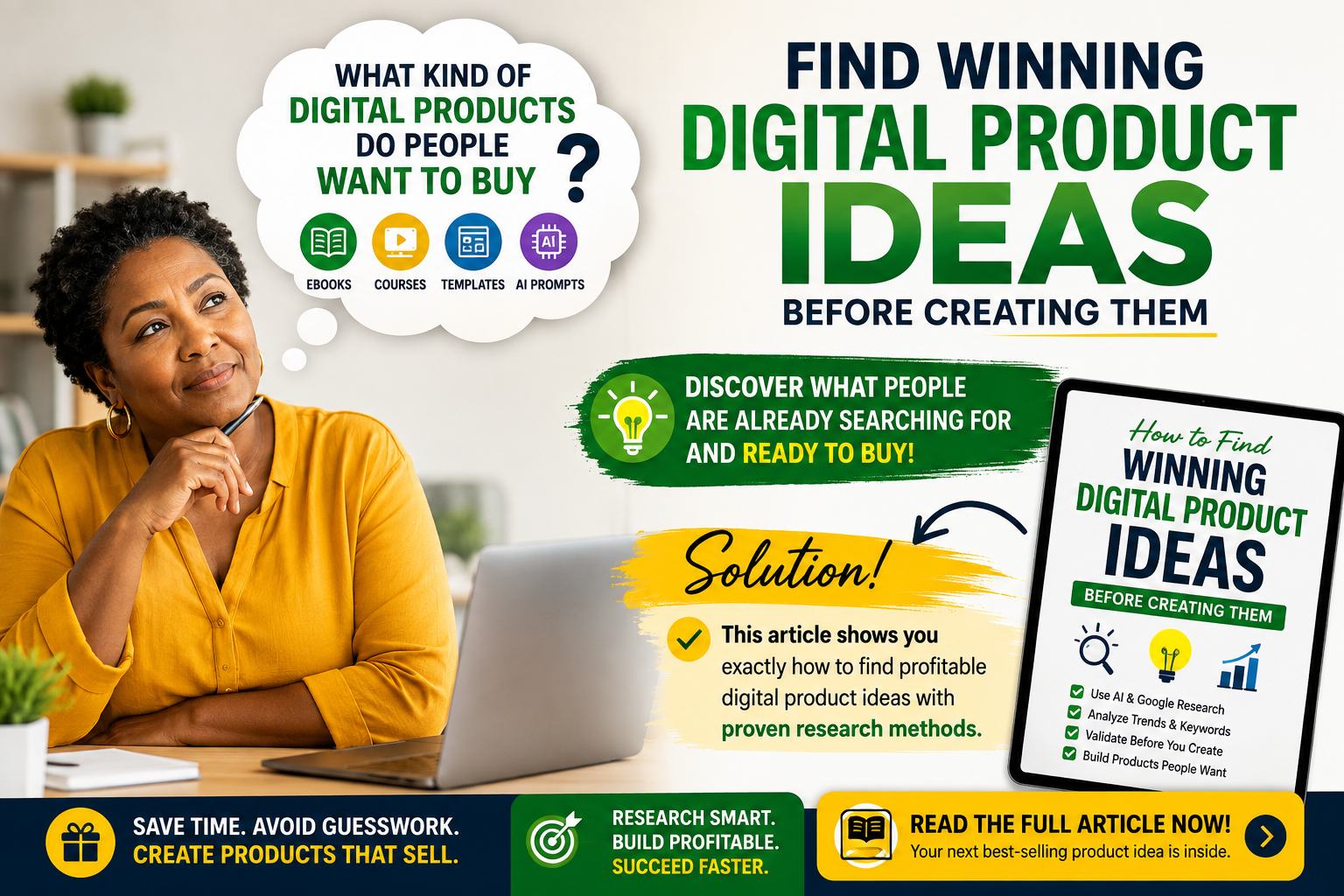
How to Find Winning Digital Product Ideas Before Creating Them
Many creators spend weeks or even months building digital products that never sell.
Not because the product is poor.
But because nobody was looking for it.
One of the biggest mistakes beginners make is creating first and researching later.
Successful digital entrepreneurs do the opposite.
They first discover what people desperately need, what they are actively searching for, and what they are already buying- then they create a solution.
Whether you're planning to sell eBooks, AI prompt packs, templates, online courses, design assets, spreadsheets, or software, this guide will show you exactly how to discover winning digital product ideas before investing your time.
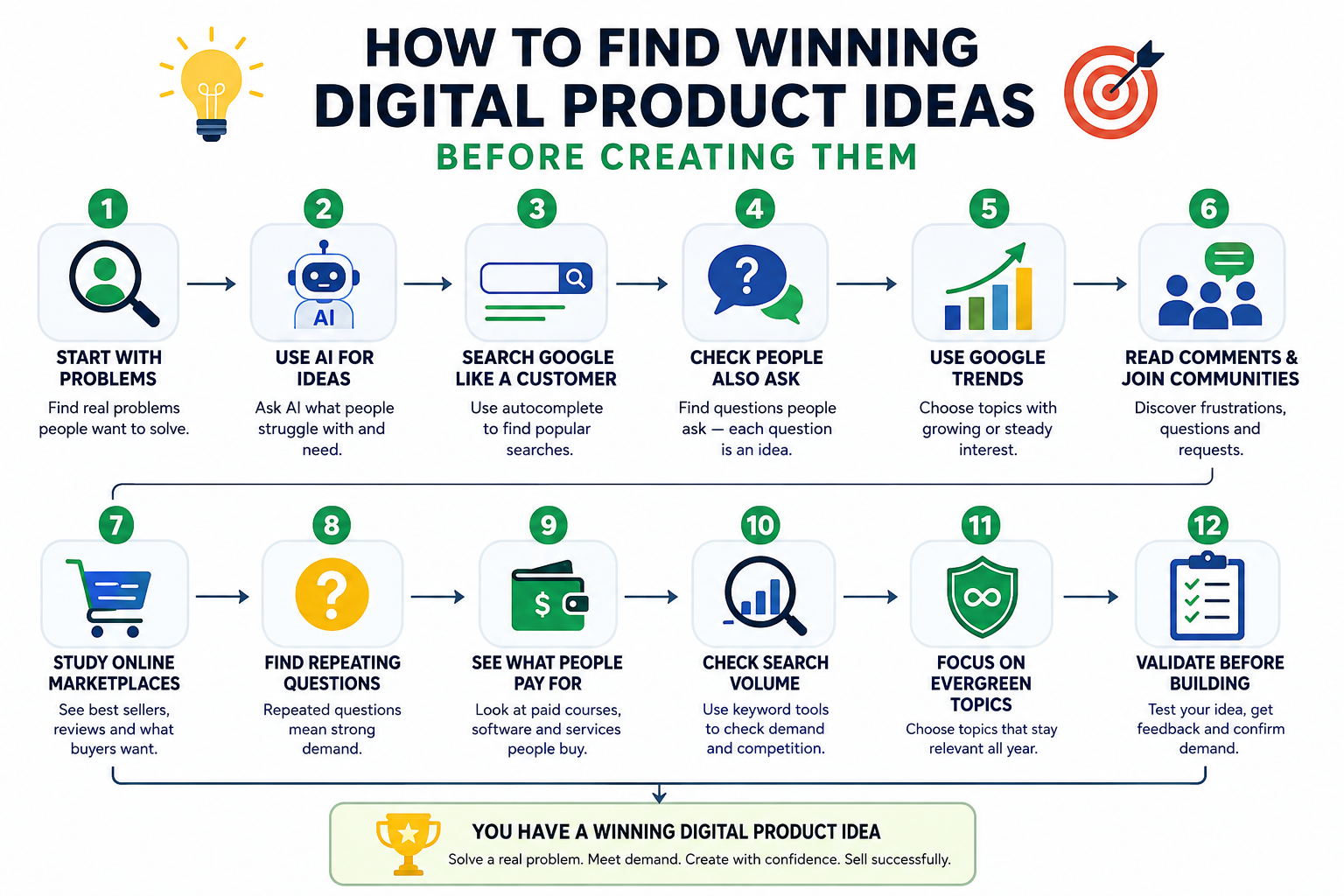
Why Most Digital Products Fail
Thousands of digital products are launched every day.
Only a small percentage become profitable.
The common reasons include:
The internet leaves clues everywhere.
Your job is learning how to read them.
What Makes a Winning Digital Product?
A winning digital product usually has these characteristics:
✅ Solves a real problem
✅ Saves time
✅ Helps make money
✅ Reduces stress
✅ Improves skills
✅ Has growing search demand
✅ Has buyers already spending money
If people are searching every day, chances are there is already a market.
Step 1: Start With Problems -Not Products
Don't begin by asking:
"What should I create?"
Instead ask:
"What problems are people trying to solve?"
People don't buy PDFs.
They buy:
Focus on outcomes.
Step 2: Use AI to Discover What People Are Asking
Artificial intelligence has become one of the best market research assistants available.
Ask AI questions like:
Go even deeper:
What questions are people asking every day about passive income?
or
What frustrations do beginner photographers have?
Within minutes you'll uncover hundreds of potential products.
Step 3: Search Google Like Your Customer
Google tells you what millions of people search for every day.
Start typing:
How to...
Best...
Why...
Can I...
Template...
Checklist...
Guide...
Google Autocomplete will suggest popular searches.
Example:
How to make money...
How to make money online
How to make money with AI
How to make money selling ebooks
How to make money without coding
Every autocomplete suggestion represents demand.
Step 4: Study Google's "People Also Ask"
One of the richest research tools is Google's People Also Ask section.
Example:
Search:
Sell ebooks
You may discover questions like:
Each question can become:
One search can generate dozens of products.
Step 5: Use Google Trends
Google Trends helps you identify whether interest in a topic is:
Look for topics with steady or increasing interest over time.
For example:
Growing trends often create opportunities before markets become crowded.
Step 6: Read Comments Instead of Articles
Comments reveal what articles often miss.
Read discussions on:
People openly share:
Every complaint is a potential product idea.
Step 7: Look Inside Online Marketplaces
Successful marketplaces already reveal what buyers want.
Study products on marketplaces that sell:
Pay attention to:
Do not copy existing products.
Instead, identify opportunities to create something more useful, more current, or tailored to a specific audience.
Step 8: Find Repeating Questions
When the same question appears repeatedly, it indicates strong demand.
For example:
"How do I start an online business?"
This could become:
One question often supports multiple digital products.
Step 9: Research What People Already Pay For
People spend money solving problems.
Look at:
If customers willingly pay, there is an opportunity to package part of that value into a digital product.
Step 10: Check Search Volume
Keyword research tools reveal how frequently people search for specific topics.
Aim for keywords that have:
Good keyword examples include:
Target long-tail keywords such as "AI prompts for teachers" or "Excel budget template for small businesses", which often convert better because they match a specific need.
Step 11: Identify Evergreen Markets
Some industries continue attracting buyers year after year.
Examples include:
Education
Business
Artificial Intelligence
Personal Finance
Health & Wellness
Career Development
Evergreen products generate demand long after launch.
Step 12: Evaluate Competition the Right Way
Competition is not always a bad sign.
If several businesses already sell similar products, it usually confirms there is demand.
Ask yourself:
Your goal is differentiation, not duplication.
Step 13: Validate Before Building
Before creating the full product:
Early validation helps ensure you're building something people actually want.
The Best AI Prompts for Product Research
Try prompts such as:
Prompt 1
List 100 problems faced by beginner entrepreneurs that can be solved with digital products.
Prompt 2
What are the fastest-growing AI search queries related to online business?
Prompt 3
Suggest 50 digital products teachers would pay for.
Prompt 4
What questions do university students ask most about making money online?
Prompt 5
Generate 100 profitable digital product ideas for the health industry.
The more specific your prompts, the more actionable your research becomes.
Mistakes to Avoid
Avoid these common pitfalls:
Where to Sell Your Winning Digital Products
Once you've validated your idea, choose a marketplace that helps you reach customers efficiently.
When evaluating platforms, look for features such as:
If you're creating products with resell rights, a digital product marketplace that supports MRR can help both creators and buyers expand their income opportunities legally and efficiently.
Final Thoughts
Finding a profitable digital product is not about guessing- it's about researching.
The most successful creators spend more time understanding customer needs than producing content. By combining AI-assisted research, Google search insights, keyword analysis, customer feedback, and trend monitoring, you can identify opportunities with genuine market demand before you create anything.
The best digital products solve real problems for real people. When you validate your ideas first, you reduce risk, improve your chances of making sales, and build products that continue generating value over time.
Instead of asking, "What should I create?", start asking, "What problem can I solve that people are already searching for?"
That shift in mindset is often the difference between creating another forgotten digital download and building a successful digital product business.
Frequently Asked Questions (FAQ)
How do I know if a digital product idea will sell?
Research search demand, analyse customer questions, review competing products, and validate the concept with a small audience before investing in full development.
What are the best tools for finding digital product ideas?
AI assistants, chatGPT, Google Search, Google Trends, keyword research tools, online communities, and digital marketplaces are among the most effective resources.
Should I create a product before validating it?
No. Validating demand first helps reduce wasted effort and increases the likelihood of creating something customers are willing to buy.
What types of digital products are easiest to validate?
Templates, eBooks, prompt packs, checklists, worksheets, online courses, planners, and business resources can often be validated quickly through audience feedback and search demand.
Can beginners find profitable digital product ideas?
Yes. With the right research process, beginners can identify underserved problems, validate demand, and build products that meet real customer needs without relying on guesswork.
Discover more articles you might be interested in

Learn How to Make Money Online Selling What You Know as a Digital Product

By Super Admin

How to Get Clients Online Without Paid Ads (2027)
By Davie

LinkedIn Marketing for Digital Products
By Davie
Pinterest Marketing for Digital Products
By Davie
Get the updates, on newly released, popular & fast-moving MRR digital products
Up to Top
Comments All
Kristine
@kristine
I really liked this one! I think finding a good digital product idea before spending time creating it is such a smart move. The tips here are simple and practical.
September 10,2026 At 10:27 PM
Hillary
@hillary
The focus on solving a specific problem stood out to me. A simple product that solves a real problem is probably more valuable than a complicated one that nobody is actively looking for.
September 05,2026 At 02:18 PM
Rosalie
@rosalie
This is a useful reminder to validate an idea before spending hours creating the product. Checking whether people are actually looking for a solution first can save a lot of wasted effort.
September 01,2026 At 03:18 PM