
Most creators sleep on Pinterest because they think it’s just recipes and wedding boards. Big mistake. Pinterest is where hundreds of millions of people actively search for solutions, templates, guides, and products — with their wallets ready. For digital-product sellers, it’s one of the highest-intent, longest-lasting, completely free traffic sources on the internet.
This guide shows you exactly how to use Pinterest to drive evergreen traffic and sales to your digital products. If you’re still choosing what to sell, start with the best digital products in high demand to sell online.
Pinterest marketing for digital products works because Pinterest is a visual search engine, not a social feed — users go there actively looking for ideas and products to buy, and each pin keeps driving traffic for months or years. To sell digital products on Pinterest: (1) set up a free business account, (2) do keyword research, (3) design vertical, scroll-stopping pins in Canva, (4) link each pin to your product or email opt-in, and (5) pin consistently to keyword-rich boards.
It’s the best free, evergreen traffic source for creators who don’t want to show their face or dance on camera — just great visuals and smart keywords.
Send that traffic to a product hosted on Vezill for instant checkout, delivery, and resell rights.
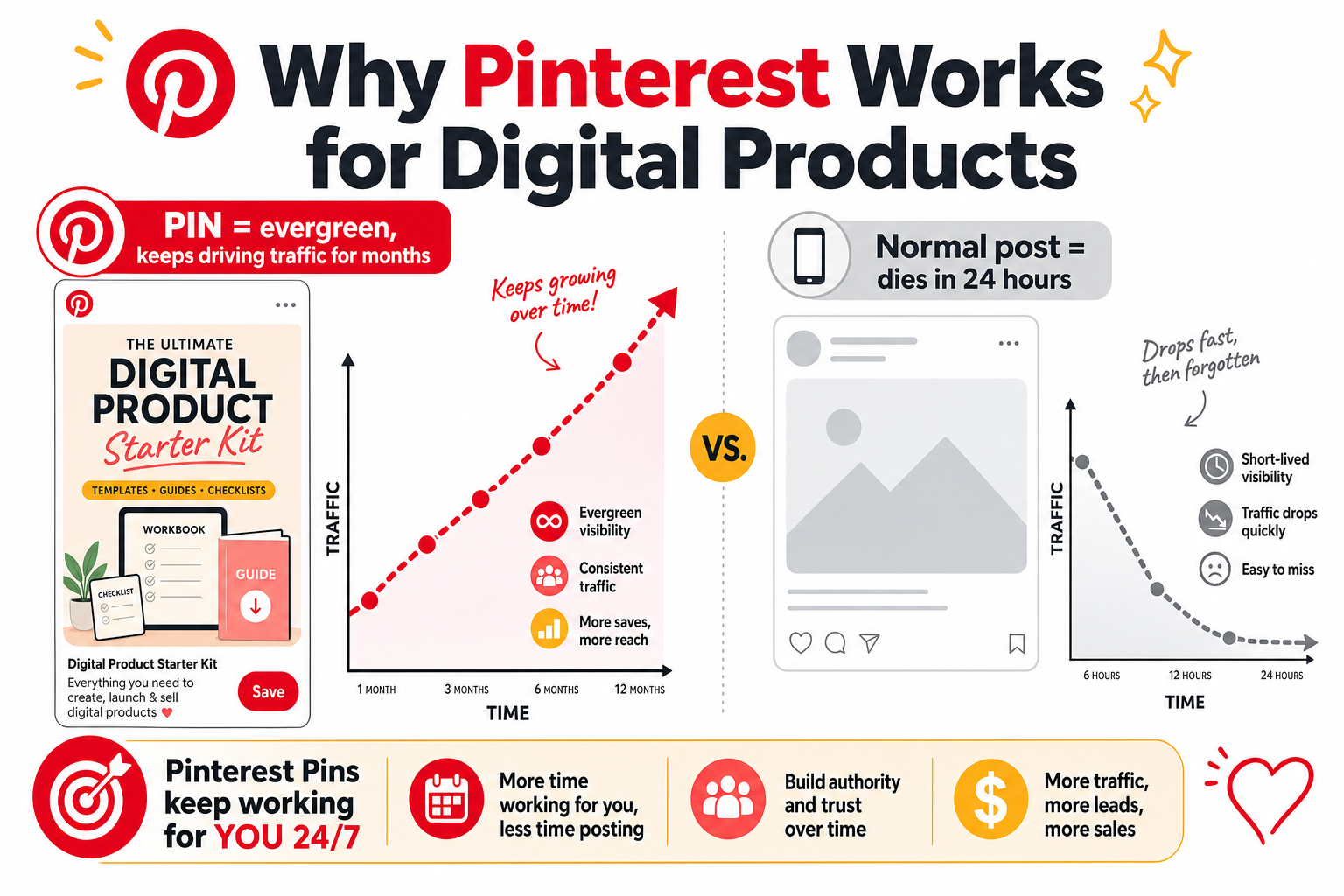 One pin can drive traffic for months — a social post is gone in a day.
Three things make Pinterest special for selling digital products:
Buyer intent — people come to Pinterest to find and plan purchases, not to argue in comments. That mindset converts.
Evergreen reach — unlike a TikTok or Instagram post that dies in a day, a good pin keeps getting discovered for months or even years.
Visual-first & faceless-friendly — you sell with graphics and keywords, so you never have to appear on camera. If that’s your style, pair this with selling digital products without showing your face.
It’s also a genuine long-term asset — one of the best passive-income ideas for digital creators, because your pins keep working while you sleep.
The single biggest mindset shift: Pinterest is a search engine, not a social network. People type queries ("digital planner," "study templates," "AI prompts for business") and Pinterest shows the most relevant pins. That means your success depends on keywords and visuals, not followers. A brand-new account with zero followers can get thousands of views if the pins match what people search.
Start with a free Pinterest Business account (it unlocks analytics and rich pins). Optimise your profile name and bio with the keywords your buyers search, and make sure you have somewhere for traffic to land — a product page or an email opt-in.
Have your product ready to receive buyers: if you haven’t set up a storefront yet, learn how to create and sell digital products online, and make sure your offer is one people actually want.
Because Pinterest is a search engine, keywords are everything. Find them in seconds:
Type a seed word in the Pinterest search bar and note the autocomplete suggestions — those are real searches.
Check the coloured keyword tiles that appear under the search bar.
Study the top-ranking pins for your term and mirror their language.
Weave these keywords into your pin titles, descriptions, board names, and even the text on the pin image.
Your pin has one second to stop the scroll. Winning pins are vertical (1000×1500px, a 2:3 ratio), bright, and carry a bold text hook. You don’t need design skills — Canva has free Pinterest templates you can restyle in minutes.
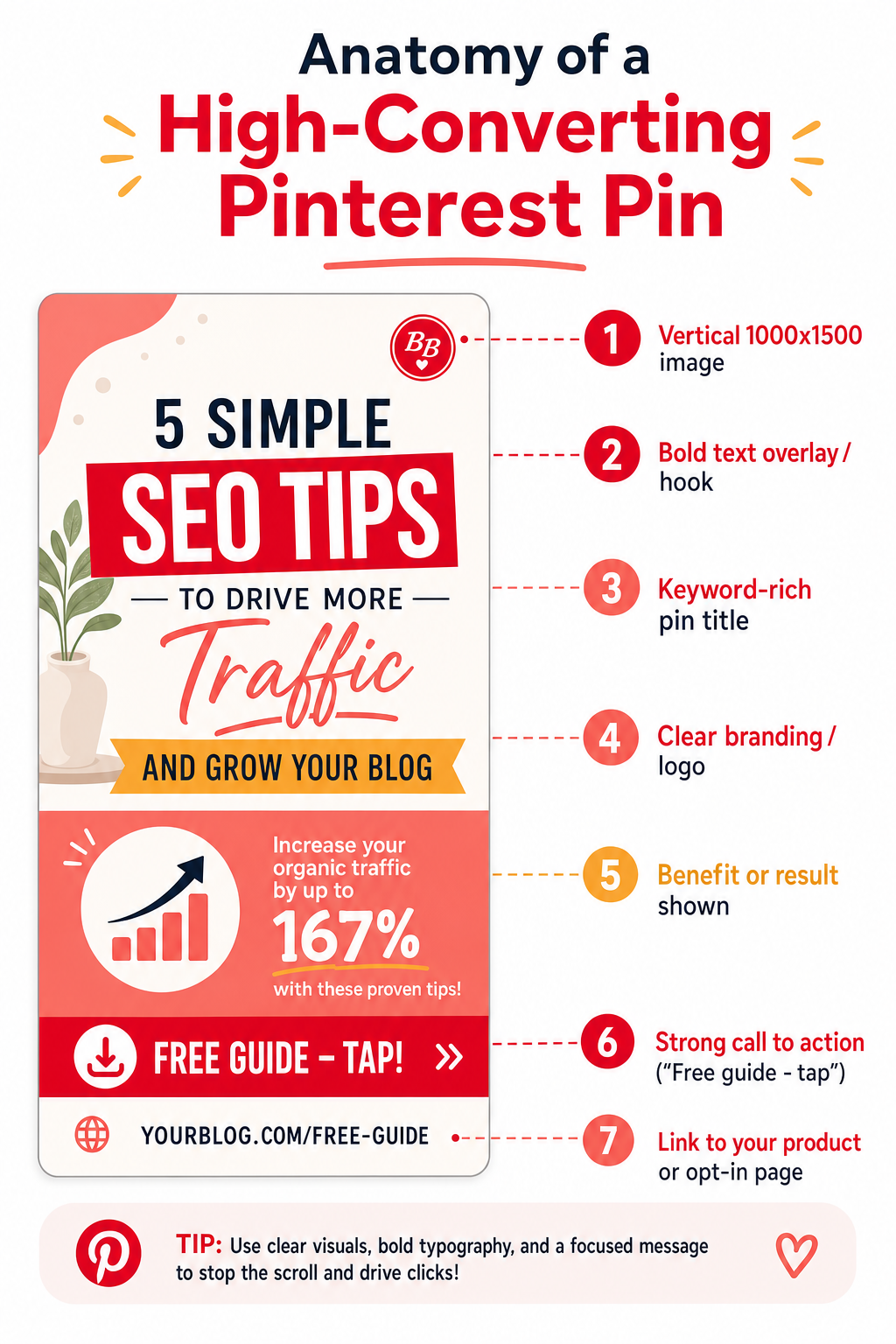 Anatomy of a pin that gets clicks: vertical, bold hook, clear CTA, link.
Batch tip: Design 5–10 different pin styles for the same product. Pinterest rewards fresh pins, so multiple designs pointing to one product multiply your chances of a hit — with almost no extra work.
Mix promotional pins with value pins so you stay discoverable:
Product pins — showcase your ebook, template, or planner with a benefit-led hook.
Value pins — tips, checklists, and how-tos that lead back to your offer.
Repurposed content — turn videos and posts into pins. If you make videos, YouTube Video Mastery pairs perfectly, and you can cross-promote with TikTok promotion without ads.
Popular, visual digital products do especially well as pins — think photo packs, AI prompt packs, and online courses.
Pins don’t sell on their own — they start a journey. Send every pin somewhere that converts.
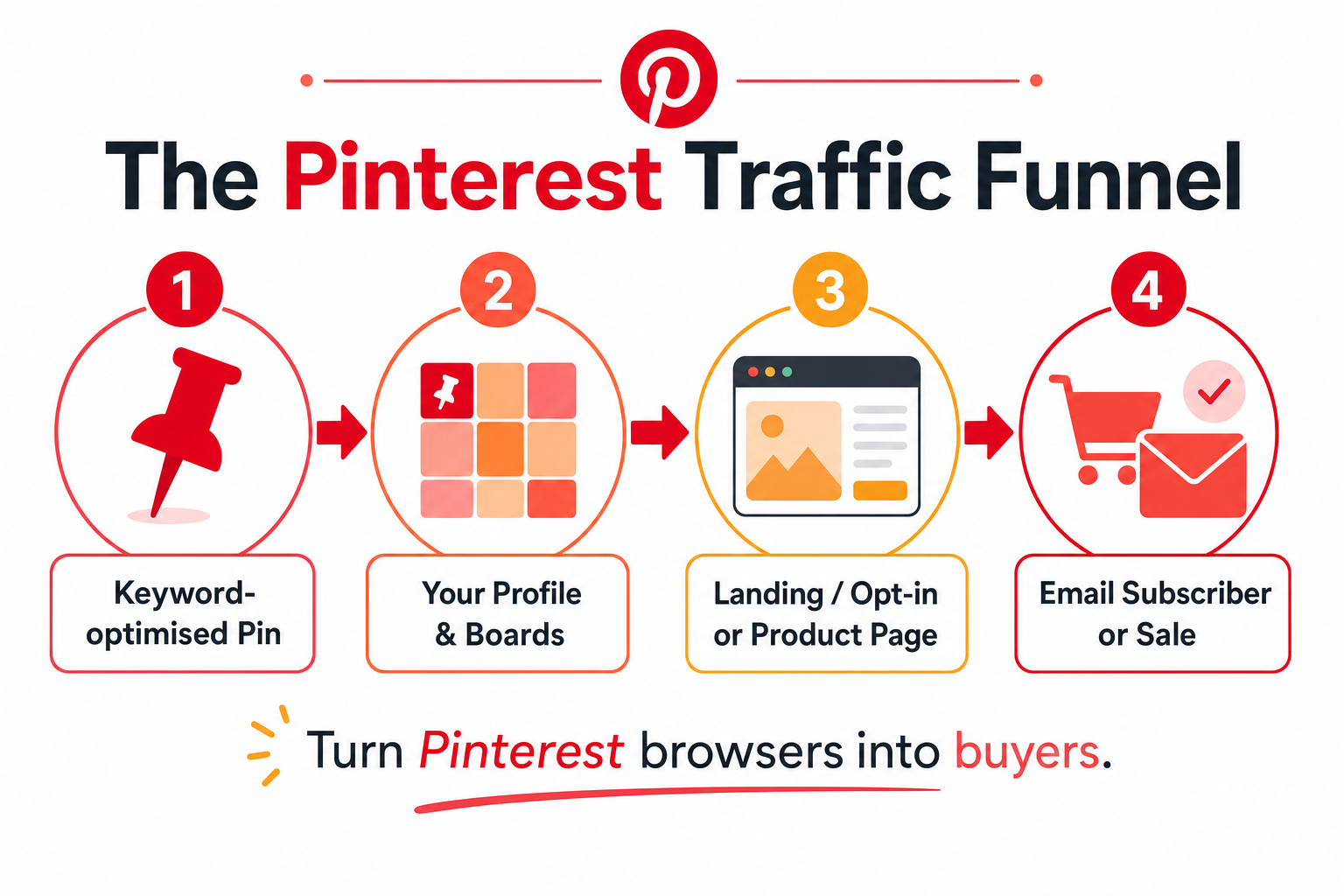 From pin to profit: give every pin a destination that converts.
The smartest play is to send pins to an email opt-in first, so you capture the visitor before selling — follow building an email list from zero. When you do link straight to a product, make sure the page converts using the high-converting sales page guide. Pinterest traffic is a fast route to your first 100 customers.
Consistency beats bursts. A simple, repeatable rhythm wins on Pinterest.
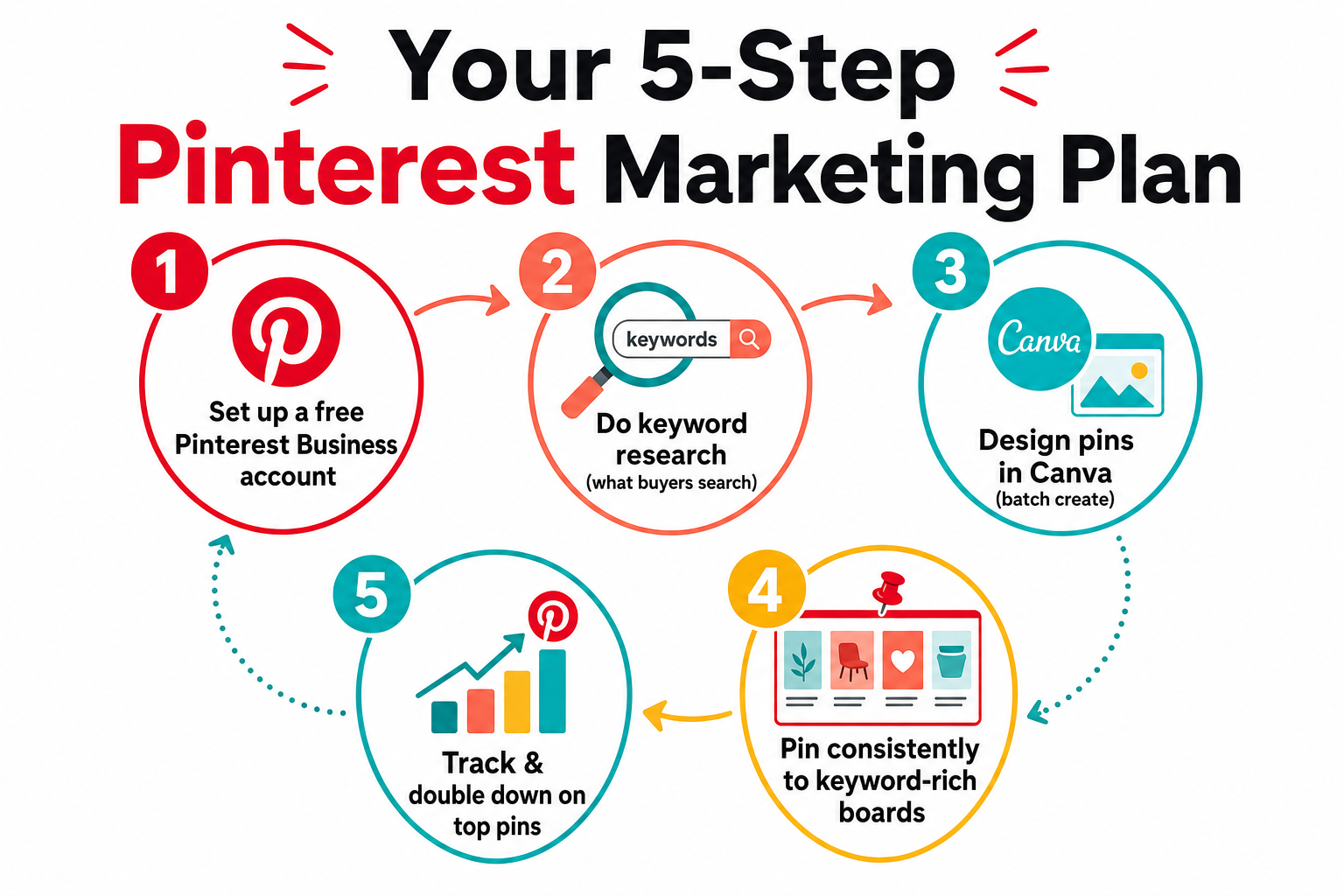 A repeatable 5-step system you can run in a couple of hours a week.
Pin daily if you can (even 3–5 fresh pins a day), always to keyword-rich boards, then check analytics weekly and make more of whatever is working. Digital products famously stack into resell-rights income, so every pin that lands can keep paying off.
Treating it like Instagram — it’s search; lead with keywords, not hashtags.
Horizontal or tiny images — always go vertical 2:3 with bold text.
One pin per product — make many designs per product.
No clear destination — every pin needs a link to an opt-in or product.
Giving up in week two — Pinterest is a slow burn that compounds; results build over months.
Ignoring analytics — double down on your top pins.
Pinterest rewards patience and good visuals more than follower counts or luck. Set up a business account, research the keywords your buyers actually type, design bright vertical pins, and point every one at an opt-in or product page. Then keep pinning. Because pins are evergreen, the traffic you build this month keeps compounding for months to come.
Create five pins for your best product today, and let Pinterest start working for you around the clock.
Yes — it’s one of the best. Pinterest is a visual search engine full of users actively looking for ideas and products to buy, and pins keep driving traffic for months. Digital products like ebooks, templates, planners, printables, and courses perform especially well because they’re visual and solve clear problems.
No. Because Pinterest ranks pins by keyword relevance rather than follower count, a brand-new account can reach thousands of people if the pins match what users search. Focus on keywords and great visuals, not follower numbers.
Consistency matters more than volume, but many successful sellers pin 3–5 fresh pins per day to keyword-rich boards. Creating several different pin designs for the same product increases your chances of one taking off.
Vertical pins at 1000×1500 pixels (a 2:3 ratio) perform best. Use bold, readable text overlays and bright visuals so your pin stops the scroll. Free Canva templates make this easy.
Link each pin to a destination that converts — ideally an email opt-in so you capture the visitor first, or a high-converting product page. Nurture subscribers, then send them to your product hosted on a platform like Vezill for instant checkout.
Pinterest is a slow burn that compounds. Some pins gain traction within weeks, but the real momentum usually builds over two to three months as pins get indexed and re-surfaced. Consistency early pays off later.
Discover more articles you might be interested in
Learn How to Make Money Online Selling What You Know as a Digital Product

By Super Admin
How to Get Clients Online Without Paid Ads (2027)
By Davie
LinkedIn Marketing for Digital Products
By Davie
How to Build an Email List From Zero (and Sell Your Digital Products)
By Davie
Get the updates, on newly released, popular & fast-moving MRR digital products
Up to Top
Comments All
Gerald
@gerald
This was such a helpful read! I like how it explains Pinterest in a simple way and shows how it can be used to get more eyes on digital products without making marketing feel complicated. The practical tips on creating useful pins and staying consistent were especially helpful. Definitely a great guide for anyone trying to grow their digital products organically.
September 08,2026 At 09:28 PM
Jesse
@jesse
I honestly hadn’t considered Pinterest as a serious way to promote digital products before reading this. The idea of creating content that can keep bringing people in over time makes it pretty interesting. Definitely something I’d like to experiment with.
August 26,2026 At 11:36 PM