

Learning a skill takes time. The expensive mistake is choosing one because it looks popular, studying it for months, and only then discovering that you cannot explain who needs it or why they would pay. A better approach begins with a customer problem and works backwards to the smallest useful skill that can solve it.
Quick Answer: To find a skill people are willing to pay for, identify a specific group, study a problem that costs them time, money, opportunity or peace of mind, and look for proof that they already pay for solutions. Then choose one narrow capability, create a sample, and offer a small test service. Job advertisements, paid competitors, customer interviews and real purchase attempts are stronger evidence than likes, trends or a long list of “profitable skills.”
This article gives you a practical way to make that decision without pretending that any skill guarantees income. Your result will still depend on competence, positioning, proof, pricing, customer access, competition and execution.
A commercially useful skill helps a recognisable customer reach an outcome they value. It is not valuable merely because it is interesting, fashionable or technically difficult.
Consider four different descriptions:
The fourth description connects a customer, a problem and a deliverable. That makes it easier for a buyer to judge the value. A salon owner does not buy “Canva knowledge”; she may buy a price-list poster and ten promotional graphics because inconsistent visuals are costing her time and making the business look less credible.
The same distinction applies elsewhere. “I know spreadsheets” is vague. “I clean a shop’s weekly sales records and turn them into a simple dashboard” describes an outcome. “I know AI” is vague. “I build a reviewed FAQ workflow that helps a small team draft consistent customer responses” is testable.
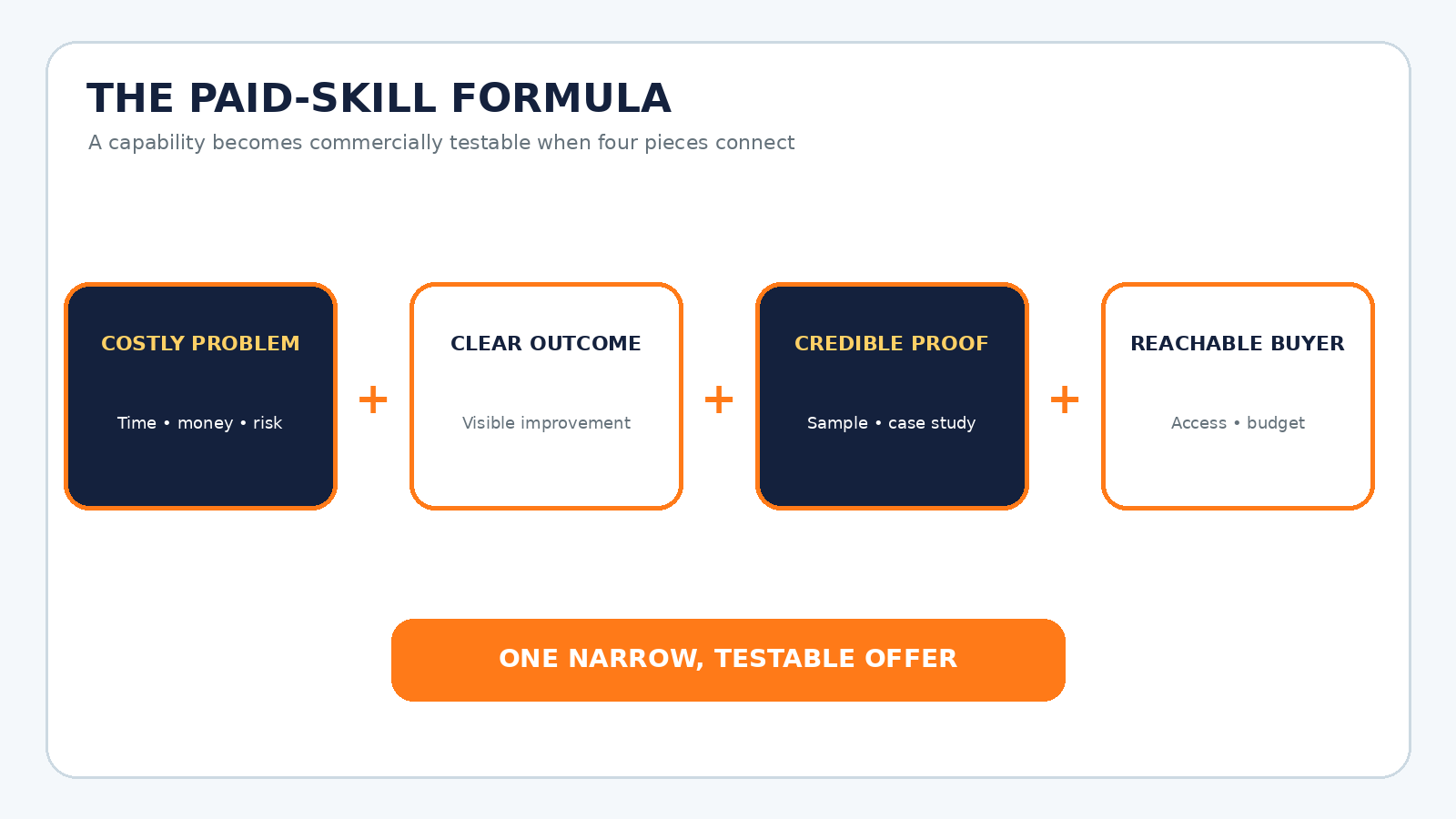 The paid-skill formula: a useful skill combines a costly customer problem, a clear outcome, proof and access to a buyer.
A marketable skill is a capability connected to a problem, proof and a reachable buyer.
People tend to pay when the result is important and doing nothing has a visible cost. The cost may be lost sales, wasted hours, confusion, risk, poor presentation or a missed opportunity.
Common paid problem categories include:
Urgency, frequency and consequences matter. A one-time inconvenience with a free workaround may attract attention but little spending. A problem that recurs weekly, delays staff or affects revenue is more commercially promising.
In Kenya, you can observe these needs close to you. A restaurant may struggle to publish menus consistently. A church or community organisation may need event graphics. A small retailer may have disorganised sales records. A tutor may repeatedly explain the same difficult topic. These are not automatically businesses, but they are useful starting points for investigation.
If you are exploring digital work more broadly, Inceptor’s overview of marketable IT and computer courses in Kenya shows how areas such as digital marketing, web development, design and data analysis connect to practical work. Treat course categories as possibilities—not proof that a customer will hire you.
Start with a customer problem when possible. A trending-skill list tells you what people are discussing; a problem tells you why a buyer might act.
Use this sequence:
Customer → Problem → Desired outcome → Required skill → Testable offer
Example 1: A Nairobi restaurant. The owner has daily offers but inconsistent graphics and no time to design. The desired outcome is a reliable weekly set of branded posts. The required beginner capability could be template-based Canva design and basic copy editing. A testable offer is five branded promotional posts delivered in three days.
Example 2: A private tutor. Parents keep asking for revision exercises between lessons. The desired outcome is structured practice. The required capabilities are curriculum knowledge, clear writing and simple document design. The tutor could first offer a paid revision pack to a small group, then improve it from feedback. VEZILL’s article on why many digital products never sell is useful here because it reinforces the difference between creating a file and solving a wanted problem.
You can also begin with an ability you already have, but run it through the same sequence. Ask: Who has this problem? What result do they buy? Which part of my ability produces that result? If you cannot answer, the skill is not yet an offer.
Good research combines several independent signals. One job advertisement or viral post is not enough. Look for a repeated pattern across buyers, platforms and conversations.
Search for the outcome, not only the skill name. Try phrases such as “monthly social media graphics,” “clean Excel data,” “edit short videos,” or “WordPress landing page.” Record how often the need appears, the expected deliverables, tools, experience requirements and buyer language.
Repeated paid listings are useful evidence. Be cautious with expired posts, extremely low budgets, copied adverts and listings that combine five professions into one role.
Search local agencies, independent professionals and marketplace sellers. Look for clear packages, credible reviews, repeat clients and specialisation. Competition is not automatically bad; paid competition can show that buyers exist.
Do not copy another person’s portfolio, pricing or wording. Your purpose is to learn which outcomes buyers understand and which proof reduces uncertainty.
Customer language is valuable. Reviews and community discussions reveal frustrations such as missed deadlines, confusing reports, generic designs or slow communication. A complaint can show both the problem and how current solutions disappoint.
Separate frustration from willingness to pay. Someone asking for a free shortcut is weaker evidence than a business describing the cost of an unresolved operational problem.
Talk to shop owners, creators, teachers, professionals, community groups or colleagues. Ask about repeated tasks, delays and work they avoid. Do not begin by asking, “Would you pay me?” People often answer hypothetical questions politely. Ask what they currently do, what it costs, what they have tried and what happens when the problem remains.
Look at what buyers purchase to save time or learn an outcome: templates, spreadsheets, revision resources, short courses, checklists and prompt packs. Reviews and visible sales signals can help, but do not assume every listing succeeds. You can explore digital products created with AI to understand possible formats, then return to the more important question: which format solves your audience’s specific problem?
Repeated tasks are clues. Perhaps coworkers ask you to format reports, troubleshoot devices, explain a process, prepare presentations or organise files. Write down tasks people trust you with and the consequences of doing them poorly. Your profession may already contain the seed of a service, template or training product.
For every opportunity, record the customer, problem, current solution, evidence of spending, common deliverable, urgency and where buyers gather. Ten similar observations are more useful than one exciting trend.
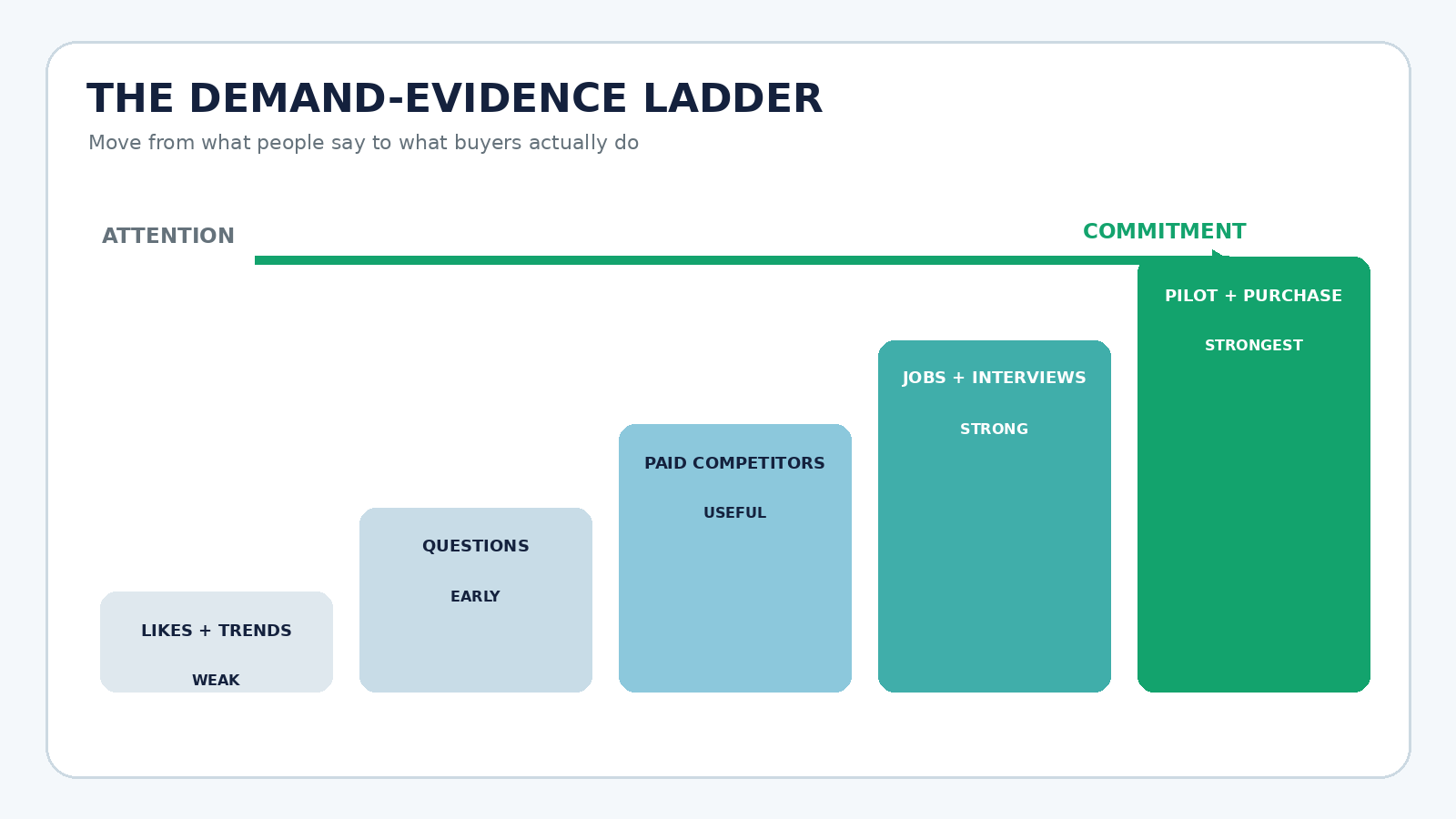 Demand evidence ladder showing weak signals such as likes and trends rising toward paid competitors, recurring jobs, customer interviews and real test purchases.
Move upward from attention signals to behaviour that shows real spending or commitment.
You cannot know with certainty before making an offer, but you can reduce uncertainty. Strong demand evidence involves real behaviour; weak evidence involves opinions or attention.
| Signal | Strength | What it may tell you |
|---|---|---|
| Likes, views or a trending hashtag | Weak | People notice the topic, but may not buy |
| Friends say the idea is good | Weak | Encouragement, not purchasing behaviour |
| People repeatedly ask how to solve it | Moderate | The problem exists; budget is still unclear |
| Several credible providers sell the solution | Moderate–strong | A market probably exists; differentiation matters |
| Businesses advertise paid roles for it | Strong | Organisations allocate budget to the capability |
| Buyers already pay for alternatives | Strong | The problem has economic value |
| A prospect gives time, data or a deposit for a pilot | Very strong | The buyer has made a real commitment |
| A customer purchases and refers another buyer | Strongest | Your offer, proof and delivery worked for that segment |
A promising skill usually passes several checks: the problem is repeated, the outcome is easy to recognise, the customer has a budget, you can reach the customer, and you can produce credible proof without causing unacceptable risk.
Avoid testing a beginner offer in regulated or high-stakes areas where unqualified work can harm people. Legal, medical, financial, structural and advanced security work may require credentials, supervision or professional standards.
The best choice sits at the intersection of market evidence and personal feasibility. Score each candidate from 1 (poor) to 5 (strong), then investigate your top two rather than treating the total as scientific truth.
| Decision factor | Question to ask |
|---|---|
| Demand | Can I find repeated evidence that a defined buyer pays? |
| Existing advantage | What knowledge, access or credibility do I already have? |
| Time to usefulness | Can I produce a small, safe outcome soon? |
| Startup cost | Can I practise with equipment and tools I can afford? |
| Customer access | Can I name and reach 20 plausible prospects? |
| Proof potential | Can I create an honest sample without a client? |
| Repeatability | Does the need recur or lead to adjacent work? |
| Product potential | Could repeated work become a template, checklist or lesson? |
| Automation exposure | Is basic production becoming a commodity? |
| Human advantage | Does success require judgment, trust, context or communication? |
For example, video editing may show good demand but score poorly if your current phone cannot handle reliable delivery. Spreadsheet organisation may appear less exciting but score strongly if you already understand business records and can reach local retailers. Inceptor’s explanation of ways to acquire practical tech skills can help you compare learning routes after you have narrowed the outcome.
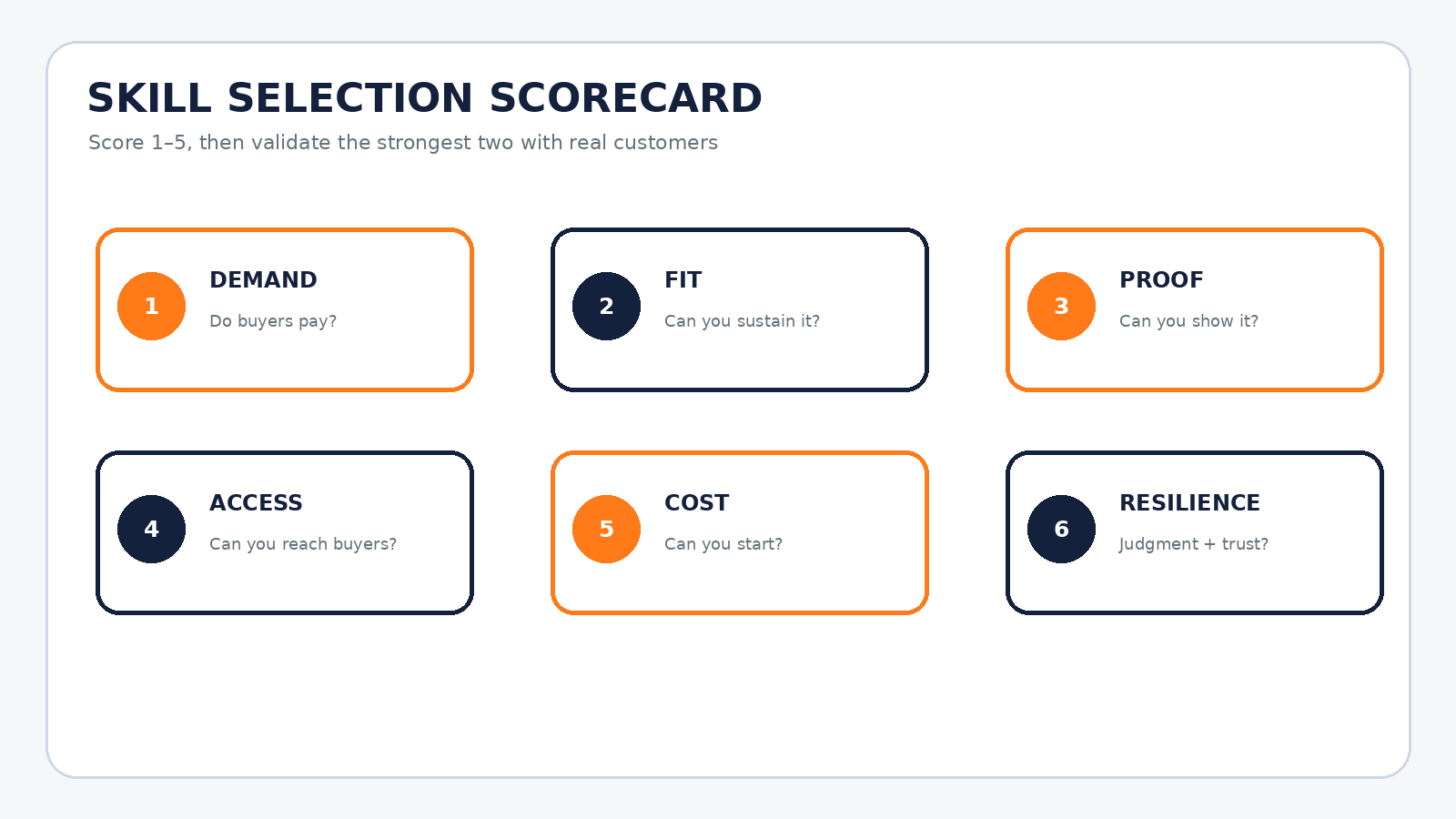 Skill selection scorecard comparing market demand, personal fit, proof potential, customer access, startup cost and automation resilience.
Use a scorecard to shortlist opportunities; use market conversations to make the final decision.
Buyers pay for many skills, but demand varies by industry, location, level and timing. Think in problem categories rather than searching for one universally “best” skill.
Sales support, lead research, SEO, digital advertising, email writing and social-media management can support customer acquisition. A beginner should narrow the offer: keyword research for local service pages is clearer than “I do marketing.” Inceptor’s discussion of digital marketing as a career outlines some of the tools and analytical thinking involved.
Graphic design, presentation design, copy editing and short-form video editing help businesses and creators communicate. A beginner could offer five branded posters, one polished pitch deck or three captioned short clips. Proof must show readable design, brand consistency and dependable delivery—not merely familiarity with software.
Virtual assistance, spreadsheet cleanup, bookkeeping support, data reporting and project coordination reduce administrative burden. An office administrator might turn an existing strength into a defined offer: clean one month of sales records, standardise categories and produce a one-page weekly dashboard.
Web design, no-code automation, software development and cybersecurity support can solve higher-complexity problems. Beginners should stay within safe competence boundaries. A simple landing page is a more honest first offer than “complete digital transformation.” Learners comparing structured options can consult Inceptor’s current catalogue of technology courses and verify the syllabus, delivery mode and prerequisites directly.
Tutoring, curriculum support, workplace training and technical explanation convert subject knowledge into guided progress. A teacher may begin with a small live revision session, then create exercises from recurring questions. Students considering digital creation can also see how learners turn knowledge into digital resources—without assuming uploads automatically create sales.
Templates, checklists, workbooks, guides and micro-courses can help multiple buyers solve the same bounded problem. A marketer who repeatedly builds content calendars might create a small planning template. VEZILL’s beginner guide to selling digital products explains the broader model, while demand validation should come before extensive creation.
AI is reducing the cost of basic production while increasing the importance of problem selection, context, verification and accountability. It can help a beginner generate exercises, explore alternatives and draft work, but it does not automatically understand a customer’s business or guarantee accurate output.
The stronger combination is usually domain skill + responsible AI use:
As generic output becomes easier to produce, buyers may value the person who asks good questions, protects sensitive information, checks facts, applies brand context and takes responsibility for delivery. If you are new to the technology, start with a sound explanation of what artificial intelligence is and where it is used before offering AI-enabled work.
Tools can shorten production, but they should follow the problem. VEZILL’s overview of AI tools for creating digital products is useful after you have decided what the customer actually needs.
This seven-day test will not guarantee a customer. Its purpose is to replace guesses with better evidence before you make a large investment.
What: Select one specific group, such as independent restaurants, tutors or small online shops. How: List 20 real examples you could ethically contact or observe. Why: “Everyone” produces vague research. Expected outcome: One customer definition you can describe in a sentence.
What: Find a task that wastes time, creates risk or blocks a wanted result. How: Read discussions and speak with at least three people using neutral questions. Why: Real workflows reveal more than idea lists. Expected outcome: One problem statement in the customer’s language.
What: Confirm that similar buyers pay employees, freelancers, agencies, software or products to solve it. How: Check several independent sources and record prices only as market observations. Why: Complaints alone do not prove a budget. Expected outcome: An evidence log with at least three credible spending signals.
What: Reduce the problem to a small deliverable you can safely produce. How: Specify quantity, scope, deadline and exclusions. Why: A bounded promise is easier to learn, price and assess. Expected outcome: A one-sentence outcome, such as “five branded offer graphics delivered in three days.”
What: Demonstrate the relevant result. How: Use a fictional brief or your own project and label it clearly as sample work. Why: Evidence reduces a buyer’s risk. Expected outcome: One polished before-and-after example or mini case study.
What: Invite relevant prospects to discuss a pilot. How: Send a short, personalised message naming the observed problem, sample and bounded deliverable. Why: A real offer tests more than a survey. Expected outcome: Responses, questions, objections or a pilot—not necessarily an immediate sale.
What: Continue, adjust or reject the idea. How: Review response quality, buyer urgency, delivery feasibility and objections. Why: Persistence is useful only when paired with learning. Expected outcome: A decision to deepen the skill, change the customer or test another problem.
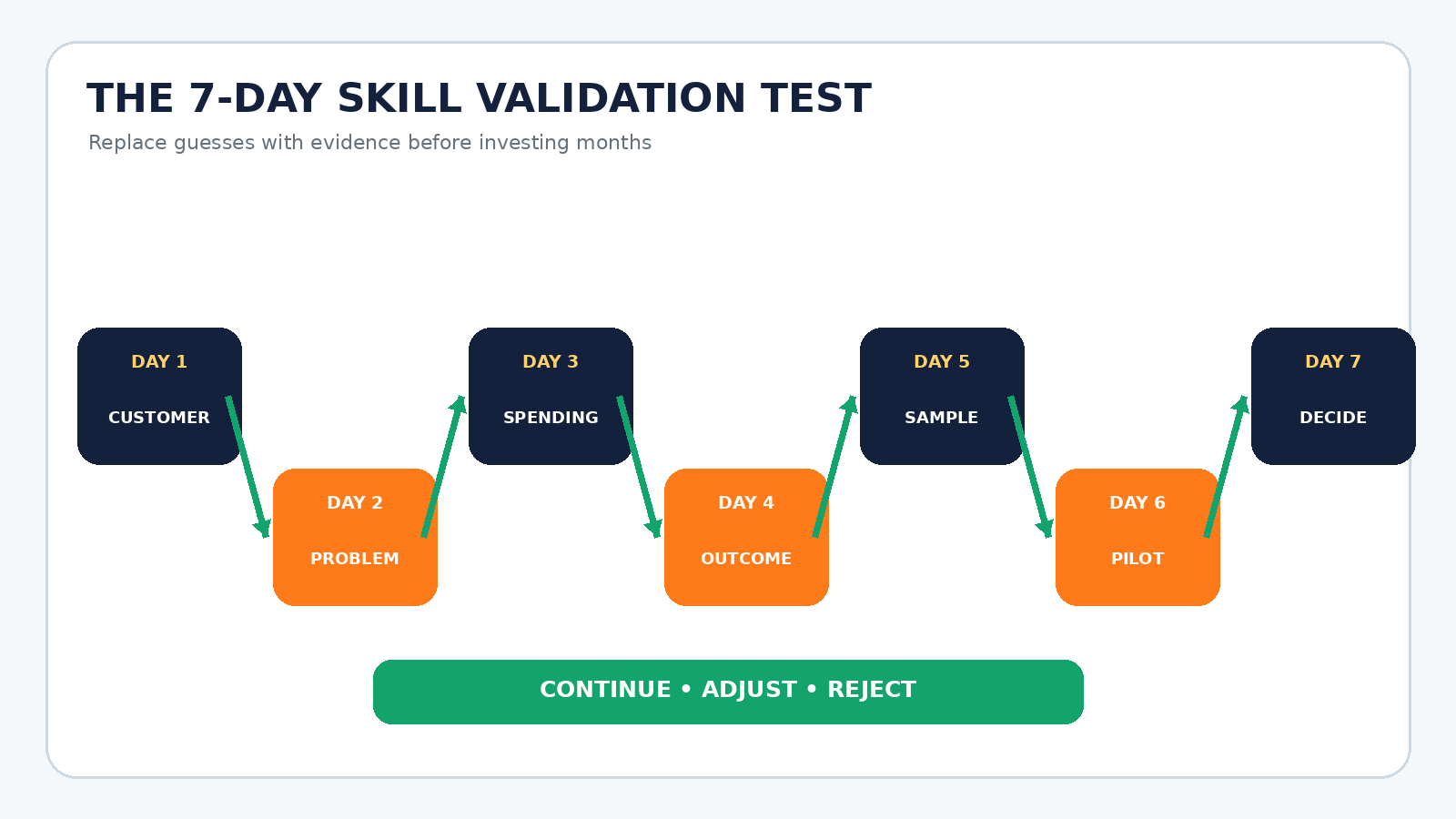 Seven-day skill validation roadmap from choosing a customer and confirming a paid problem to creating proof, presenting a pilot and deciding from evidence.
The purpose of validation is a better decision—not false certainty.
An offer translates a capability into a result a buyer can evaluate. Use this formula:
I help [specific customer] achieve [specific outcome] by providing [specific deliverable] within [time or scope].
Compare “I do graphic design” with “I create ten branded Instagram graphics each month for neighbourhood restaurants.” Compare “I am a data analyst” with “I clean a retailer’s weekly sales data and deliver a one-page performance dashboard.”
Your first offer should define what is included, what is excluded, the delivery time, revision limit, information required from the client and price. Never promise a business result you do not control, such as a guaranteed number of sales.
A service gives fast feedback because you work closely with one buyer. Repeated requests may later become a product. A teacher’s custom exercises could become a revision workbook; an administrator’s repeated process could become a spreadsheet template. If that pattern emerges, follow a disciplined AI-assisted digital-product workflow while checking every generated claim and respecting privacy and copyright.
Yes, some beginners can earn from a narrow, low-risk skill before having paid-client history, but they still need credible proof and honest positioning. “No experience” must not become “pretend experience.”
Build proof through:
Label fictional briefs as concept or sample work. Get permission before displaying client or volunteer work. Do not expose private data. For a portfolio, show the problem, constraints, process, finished output and what you learned.
The first customer may be easier to reach through an existing relationship than a global marketplace. Reliability, clear communication and following instructions can matter as much as technical polish at beginner level.
Do not treat passion and demand as opposites. Look for an overlap among a valued problem, work you can become competent at, customers you can reach and an outcome you can prove.
Passion without demand may remain a fulfilling hobby. Demand without any tolerance for the work can become difficult to sustain. You do not need a lifelong calling before starting; curiosity and willingness to practise may be enough for a small test.
A useful decision question is: Would I be willing to solve this type of problem repeatedly while becoming better at it? If yes, and buyers show real behaviour, the opportunity deserves further testing.
Creating a product too early is another common error. Before producing a large guide or course, test the smallest useful version. The lessons in how to market a digital product are most effective when the underlying problem and audience are already clear.
Learn only the part needed to produce your first narrow outcome. Practise it repeatedly, create honest proof, share it with the right audience, present a small offer and improve from feedback.
That follows the VEZILL path:
LEARN → DO → CREATE → SHARE → SELL → GROW
If your selected outcome is suitable for a focused sprint, use this practical article on what you can learn in 30 days to begin earning online. It shows how to narrow a skill, practise, build proof and test an offer without claiming mastery in one month.
Your next actions are simple:
Once repeated service work reveals a reusable solution, you may choose to create and sell a template, checklist, workbook or tutorial. A 30-day digital-product business plan can help organise that later stage. Creation comes after problem clarity—not before it.
Look for repeated paid demand, buyers with budgets, credible competitors, an understandable outcome and customers you can reach. Profit is not guaranteed; it also depends on your costs, pricing, delivery quality and marketing.
People pay for skills that help them make or protect money, save time, reduce risk, communicate clearly, organise information or learn difficult subjects. Examples include sales support, design, marketing, data reporting, administration, web work and tutoring.
Choose a customer, document a repeated problem, find evidence of existing spending, create a small sample and present a narrow pilot offer. Real conversations and commitments are stronger evidence than social-media popularity.
You can offer a small, low-risk service when you can deliver it competently and show honest sample work. Never invent clients, mislabel concept projects or accept work beyond your ability.
Choose the overlap between market demand, your capacity to become competent, customer access and work you can sustain. Passion alone does not prove demand, while income potential alone does not ensure long-term fit.
The answer depends on your starting knowledge, equipment and market. Narrow tasks in design, content support, administration, spreadsheets, video editing or tutoring may be testable relatively quickly, but competence and demand still need verification.
Start where your chosen customers already gather: local business networks, professional groups, referrals, job boards, marketplaces and industry communities. Personalise outreach around an observed problem rather than sending a generic service list.
No. A skill may support employment, consulting, productised services, teaching, licensing or digital products. The best model depends on the problem, buyer, proof required and how repeatable the solution is.
AI may automate parts of many skills, especially generic production. Skills remain more defensible when they combine domain knowledge, judgment, customer context, verification, communication and responsibility.
There is no universal timeline. A narrow, low-risk deliverable may become commercially testable sooner than a complex profession. Charge only when you can produce the promised outcome reliably and represent your level honestly.
Do not begin by asking which skill is most popular. Ask which customer you can reach, which costly problem they repeatedly face, what outcome they value and what evidence shows they already spend money on solutions. Then learn the smallest useful capability, create proof and test a bounded offer.
The goal is not to predict the perfect career from a list. It is to make one evidence-based decision, test it cheaply and improve from what real buyers do.
Discover more articles you might be interested in

Learn where to find reliable step-by-step guides online, how to choose the right tutorial for your task, check whether it is current and follow instructions safely.
By Davie

Stop searching broad topics and start finding the exact knowledge you need. Learn how to define your problem, search smarter, choose reliable sources, verify answers and take action.
By Davie

Quick Knowledge or an online course? Learn when a focused answer is enough, when structured learning is better, and how to choose the right learning depth for your goal.
By Davie

Learn how to turn one useful digital product into multiple income streams through premium versions, bundles, courses, licensing, services, subscriptions, B2B sales and complementary products.
By Davie
Get the updates, on newly released, popular & fast-moving MRR digital products
Up to Top
Comments All
Thomas
@thomas
This is a really useful topic. Sometimes you have a skill but don’t know if people would actually pay for it. I like how this breaks down what to look for before putting your time into something.
September 11,2026 At 10:35 PM