
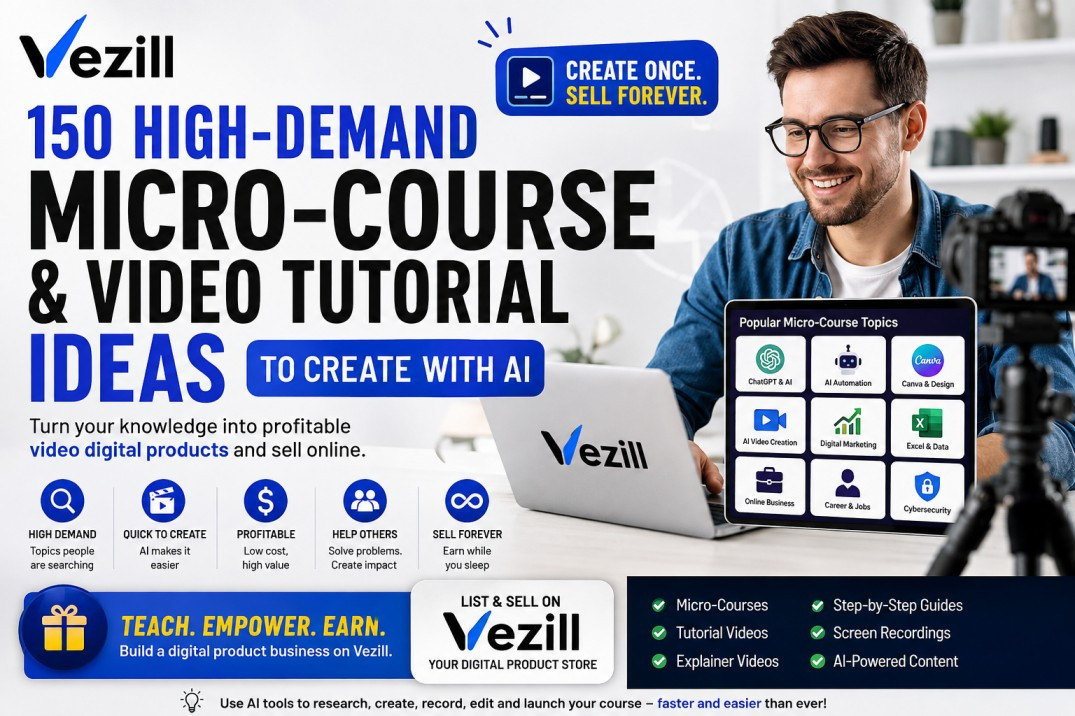
One of the biggest opportunities in the digital-product economy is surprisingly simple:
Teach someone how to do one useful thing through a short video.
People search Google, YouTube and AI assistants every day with questions such as:
How do I use ChatGPT?
How do I create videos with AI?
How do I make money with AI?
How do I automate my work?
How do I use Excel formulas?
How do I create an ebook?
How do I write a CV using AI?
How do I start freelancing?
How do I create a website?
How do I use Canva?
How do I rank on Google?
How can I get my business recommended by ChatGPT?
Every question represents a potential micro-course, tutorial or explainer video digital product.
And you don't necessarily need a studio, expensive cameras or a large production team.
Modern AI tools can help creators research a topic, structure lessons, generate scripts, design slides, create graphics, produce voiceovers, generate demonstrations, edit videos, create subtitles and package educational content to ultimately create a complete micro-course.
This makes it an excellent time to explore AI-assisted video digital products.
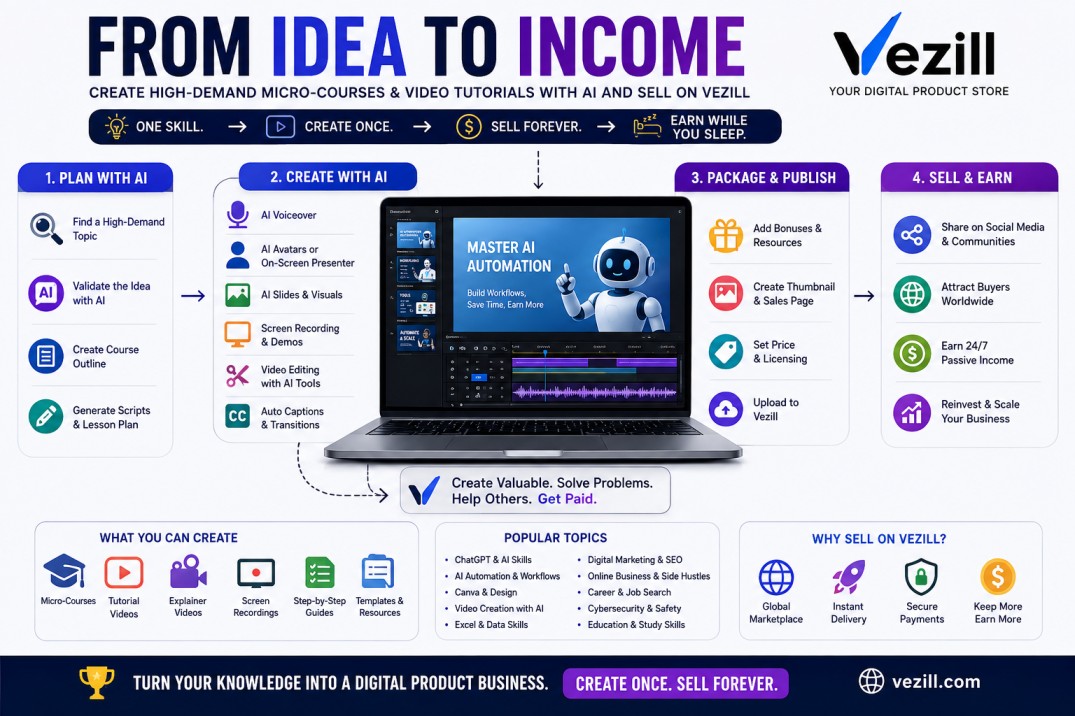
A video digital product is educational or informational video content created once and distributed digitally.
Examples include:
Micro-courses
Short training programs teaching one specific skill.
Video tutorials
Step-by-step demonstrations showing viewers how to complete a task.
Explainer videos
Videos simplifying a concept or process.
Screen-recorded training
Practical demonstrations of software, websites or digital tools.
Mini masterclasses
Focused lessons taught by someone with experience in a particular subject.
Video guides
Structured guidance helping someone accomplish a specific outcome.
Unlike a large 20-hour online course, a micro-course might take only 20 minutes to two hours to complete - and this is very ideal to be sold as digital products on the Vezill platform.
That is part of its appeal.
Someone searching:
“How do I create an ATS-friendly CV with ChatGPT?”
may not want an entire course about artificial intelligence.
They want to solve that problem.
A focused 45-minute video course can potentially provide exactly what they need.
Demand for practical digital and AI skills is substantial.
Coursera reported 191 million global learners and 41.8 million enrollments in 2025. Generative AI alone generated 5.4 million enrollments, almost twice the previous year's total, with approximately 14 GenAI enrollments every minute.
Coursera's 2026 Job Skills Report similarly describes generative AI as the most in-demand skill in its history. Importantly, learners aren't studying AI in isolation. They're combining AI capabilities with foundational skills such as SQL, web applications and other job-specific competencies.
This suggests a powerful opportunity for digital creators:
Teach people how to use AI to accomplish something they already need to do.
For example:
Generic: Introduction to Artificial Intelligence
Better: ChatGPT for Teachers
Even better: Create Lesson Plans, Quizzes and Revision Notes With ChatGPT
That shift from topic-based learning to outcome-based learning is particularly suited to micro-courses.
Yes.
AI can dramatically reduce the work involved in producing short educational videos.
A creator can use AI to assist with:
Research → Course outline → Script → Slides → Images → Voiceover → Screen demonstrations → Editing → Captions → Thumbnail → Course description → Marketing content
The important distinction is that AI should assist the creator rather than replace subject-matter verification.
Creators should check factual claims, demonstrate tools accurately, use properly licensed material and add their own expertise or practical examples.
The result can be a useful digital product created considerably faster than traditional video-course production.
The following opportunities are organized around areas showing strong learning, search, career or commercial intent.
Generative AI should be one of the first categories creators investigate. Coursera reports a 234% year-over-year increase in GenAI enrollments among its enterprise learners.
ChatGPT for Complete Beginners
How to Write Better ChatGPT Prompts
Prompt Engineering for Beginners
ChatGPT for Work
How to Use ChatGPT to Learn Faster
How to Research With ChatGPT
ChatGPT for Students
ChatGPT for Teachers
ChatGPT for Small Businesses
ChatGPT for Entrepreneurs
ChatGPT for Freelancers
ChatGPT for Job Seekers
ChatGPT for Marketing
ChatGPT for Social Media
ChatGPT for Professional Emails
ChatGPT for Excel
Data Analysis With ChatGPT
Coding With ChatGPT for Beginners
ChatGPT for Customer Service
ChatGPT for Project Management
ChatGPT for HR & Recruitment
Build Your Own AI Assistant
Build an AI Knowledge Assistant From Your Documents
How to Fact-Check ChatGPT Answers
AI Privacy & Security for Beginners
As people become comfortable using AI chatbots, the next question increasingly becomes:
“How can I make AI do the work automatically?”
This creates opportunities around automation, AI workflows and agents.
AI Automation for Beginners
Automate Repetitive Office Tasks With AI
AI Agents Explained for Beginners
Build Your First AI Agent Without Coding
n8n for Beginners
Zapier + AI for Beginners
Automate Emails With AI
Automate Social Media With AI
Build an AI Customer-Support Assistant
Build an AI Lead-Generation System
Create an AI Research Assistant
Create an Automated AI Content Workflow
Automate Google Sheets With AI
AI Meeting Notes & Follow-Ups
Build Your First No-Code AI Business Workflow
The intersection of AI + entrepreneurship + digital products creates numerous practical course opportunities.
How to Make Money With AI for Beginners
10 AI Side Hustles You Can Start
Start an AI Side Hustle Without Coding
Create Digital Products With ChatGPT
Create an Ebook With AI
Create Downloadable PDF Guides With AI
Create Printables With AI
Create AI Prompt Packs
Create an Online Course With AI
Create Micro-Courses With AI
Create Educational Worksheets With AI
Create Business Templates With AI
Create Social-Media Templates
Create Digital Planners With AI & Canva
Find Profitable Digital-Product Ideas With AI
Validate Digital-Product Ideas Before Creating Them
Price Digital Products for Profit
Write High-Converting Digital-Product Sales Pages
Market Digital Products Using Short Videos
Turn Your Existing Skills Into Digital Products
Visual skills lend themselves particularly well to video tutorials because students can follow what the instructor is doing on-screen.
Canva for Complete Beginners
Canva AI for Beginners
Create Social-Media Graphics With Canva
Design Professional Posters & Flyers
Create an Ebook in Canva
Create Presentations With Canva AI
Design a Logo in Canva
Create YouTube Thumbnails
Design Digital-Product Covers
Create Instagram Reels in Canva
Build Your Brand Kit
Remove & Replace Image Backgrounds With AI
Create AI Product Images
Create Promotional Posters With AI
AI Graphic Design for Non-Designers
AI itself has created another market: teaching other people how to produce video using AI.
Create Videos With AI From Start to Finish
Create Faceless YouTube Videos With AI
Create TikTok Videos With AI
Create Instagram Reels With AI
CapCut for Complete Beginners
CapCut AI Video Editing
Create AI Voiceovers
Convert Text Into Video With AI
Convert Articles Into Videos
Turn Presentations Into Training Videos
Create Explainer Videos With AI
Create Online-Course Videos Without Showing Your Face
Create Animated Educational Videos
Create AI Product-Promotion Videos
Create YouTube Shorts With AI
AI is also changing how businesses think about search visibility.
Research published by Ahrefs in July 2026 found searches for “AI search tracking” increased 184% and “AI rank tracking” increased 175%. Search interest surrounding generative engine optimization and the relationship between GEO and traditional SEO has also grown sharply.
That creates an emerging education market.
Digital Marketing for Beginners
SEO for Beginners
Keyword Research for Beginners
AI Keyword Research
How to Rank Blog Posts on Google
Write SEO Content With ChatGPT
AI Search Optimization for Beginners
How to Get Your Business Recommended by ChatGPT
How to Optimize Content for Google AI Overviews
Answer Engine Optimization for Beginners
Track Your Brand's Visibility in AI Search
SEO vs AEO vs GEO Explained
Local SEO With AI
Google Business Profile Optimization
AI Content Marketing
AI Marketing for Small Businesses
Email Marketing for Beginners
Facebook Ads for Beginners
TikTok Marketing for Businesses
Build a 30-Day Content Calendar With AI
Career problems are excellent micro-course topics because the learner usually has a clearly defined outcome.
Write a Professional CV With ChatGPT
Create an ATS-Friendly CV
Write Cover Letters With AI
Prepare for Interviews With ChatGPT
AI-Powered Job Searching
Optimize Your LinkedIn Profile With AI
Find Legitimate Remote Jobs
Build a Professional Portfolio With AI
Answer Common Interview Questions
Critical Thinking in the Age of AI
Don't assume everything needs to be a trendy AI topic.
People still need practical workplace skills.
Coursera's 2026 skills analysis shows learners combining emerging AI capabilities with foundational technical competencies, reinforcing opportunities for courses that combine traditional productivity tools with AI.
Excel for Complete Beginners
10 Excel Formulas Everyone Should Know
Excel Formulas With ChatGPT
Pivot Tables for Beginners
Build an Excel Dashboard
Data Cleaning in Excel
Google Sheets for Beginners
Google Sheets + AI
SQL for Complete Beginners
Data Analysis With ChatGPT
Power BI for Beginners
Build Your First Power BI Dashboard
Cybersecurity can be converted into highly practical explainer videos and short training programs.
Cybersecurity for Complete Beginners
Protect Yourself From Online Scams
How to Identify Phishing Messages
Password Security for Beginners
Online Privacy for Beginners
AI Security & Privacy
Ethical Hacking Explained for Beginners
Cybersecurity Career Roadmap
Global courses can also be localized.
A course addressing the realities of someone in Kenya, Nigeria, Ghana or South Africa can potentially provide more relevant examples than a generic global course.
How to Make Money Online in Kenya With AI
AI Side Hustles for Kenyan Students
How to Start Freelancing in Kenya
Create & Sell Digital Products in Kenya
ChatGPT for Kenyan University Students
AI for KCSE Students
ChatGPT for Kenyan Teachers
AI for African Small Businesses
Start an Online Business Using Your Smartphone
Turn Your Professional Skills Into an Online Course
Creators shouldn't attempt all 150 simultaneously.
Start with subjects combining clear demand + strong problem-solving value + easy video demonstration + commercial intent.
My priority shortlist would be:
ChatGPT for Complete Beginners
Prompt Engineering for Beginners
AI Automation for Beginners
How to Make Money With AI
Create Digital Products With ChatGPT
Build Your First AI Agent Without Coding
ChatGPT for Work
Create an Ebook With AI
Create Videos With AI
Create Faceless YouTube Videos With AI
Canva AI for Beginners
ChatGPT for Students
ChatGPT for Small Businesses
Write an ATS-Friendly CV With ChatGPT
Excel With ChatGPT
Create an Online Course With AI
Get Your Business Recommended by ChatGPT
Optimize Content for Google AI Overviews
AI Side Hustles for Beginners
n8n AI Automation for Beginners
This is perhaps the most important lesson for anyone creating micro-courses.
Compare these two titles:
Microsoft Excel Course
10 Excel Formulas That Will Save You Hours Every Week
Or:
ChatGPT Training
ChatGPT for Small Business: Automate 15 Everyday Tasks
Or:
Canva Course
Create 30 Professional Social-Media Posts in Canva in One Hour
The second version in each example answers four questions:
Who is it for?
What problem does it solve?
What will I achieve?
How quickly can I achieve it?
That is a powerful formula for micro-course creation.
A useful starting framework is:
15–30 minutes: Single-task tutorial
30–60 minutes: Focused skill
60–120 minutes: Complete beginner micro-course
2–4 hours: More advanced practical workshop
Don't make a course long simply to justify its price.
A buyer searching for “How to create an ebook with ChatGPT” may value a focused 60-minute tutorial more than ten hours of general AI theory.
The objective should be:
Shortest credible path from the learner's problem to the desired result.
A simple production workflow can look like this:
Start with a question people genuinely want answered.
For example:
How can I create professional videos without appearing on camera?
Your course could become:
Create Your First Faceless AI Video in 60 Minutes
Use AI alongside reliable primary and authoritative sources.
Break the outcome into approximately 3–7 short lessons.
AI can help produce first drafts, examples, demonstrations and lesson summaries.
Depending on the topic, use:
Screen recordings
Presentation slides
AI-generated visuals
Voiceover
Talking-head video
Software demonstrations
Animations
A combination of formats
Remove unnecessary material. Add captions, headings and clear transitions.
Increase the usefulness of the product with:
PDF guides
Checklists
Templates
Worksheets
Prompt packs
Cheat sheets
Resource lists
Give it a clear title, thumbnail, description and learner outcome.
The finished tutorial or micro-course becomes a reusable digital asset rather than a service you must personally deliver every time.
Once your video digital product is ready, you need somewhere to make it available to buyers.
One of the best option is Vezill, a digital-product marketplace where creators can list digital products such as educational resources and other downloadable digital content.
A creator can therefore develop a specialized micro-course, package it professionally, list it for sale and promote the product through channels such as:
TikTok, Facebook, Instagram, YouTube, WhatsApp, blogs, email and other online communities.
The important principle is to treat the course as a digital product business, not simply as a video.
For example, someone knowledgeable about Excel could create:
Excel Formulas for Small Business Owners
A teacher could create:
ChatGPT for Teachers: Create Lesson Plans & Quizzes Faster
A digital marketer could create:
How to Get Your Business Found in AI Search
A graphic designer could create:
Canva for Beginners in 60 Minutes
A university student with strong research skills could create:
How to Research Academic Topics With AI
A cybersecurity professional could create:
How to Spot Phishing Emails & Online Scams
You don't need to know everything.
You need to be able to teach something useful accurately and clearly.
Yes, but creating a course does not guarantee sales.
Revenue depends on factors such as:
Demand for the problem
Course quality
Instructor credibility
Pricing
Competition
Marketing
Audience
Sales-page quality
Reviews and trust
Demonstrated learner outcomes
Consider a hypothetical course priced at $10.
10 sales = $100
100 sales = $1,000
1,000 sales = $10,000
That is revenue before applicable platform fees, taxes, marketing costs, refunds or other expenses.
The advantage of a digital product is scalability: the same finished product can potentially be sold repeatedly without recreating it for every customer- especially with master resell rights.
For most new creators, some of the strongest categories to investigate are:
Generative AI
ChatGPT, prompting, AI productivity and role-specific AI.
AI automation
Agents, workflows and no-code automation.
AI video creation
Faceless video, short-form video, editing and voiceovers.
Digital entrepreneurship
Digital products, online courses, freelancing and creator businesses.
Workplace productivity
Excel, Google Sheets, presentations, data analysis and project management.
Digital marketing
SEO, social media, content creation and advertising.
AI search optimization
AI Overviews, AEO, GEO and AI visibility.
Career skills
CVs, interviews, LinkedIn, portfolios and remote work.
Cybersecurity
Online safety, privacy, scams and career skills.
Education
AI study techniques, teaching tools, revision and subject-specific tutorials.
There is no single best topic for everyone. AI productivity, AI automation, generative AI, digital marketing, career skills, Excel/data and practical business skills currently provide strong areas to investigate. The best opportunity is where market demand overlaps with something you can teach credibly.
AI can assist with research, outlines, scripts, presentations, graphics, narration, editing and marketing. Human review remains important for factual accuracy, originality, quality and practical demonstrations.
Yes. Screen recordings, slides, demonstrations, animation and narration can all be used to create faceless educational content.
Many useful micro-courses can be completed in approximately 20 minutes to two hours. Complexity and learner outcome matter more than arbitrary duration.
One subject can potentially become a video course, PDF guide, checklist, workbook, prompt pack, template bundle, cheat sheet or other complementary resource.
Creators can use digital-product marketplaces and course platforms. Vezill is one option for creators interested in packaging and selling digital products online.
Start with Google Trends, keyword-research tools, Google autocomplete, YouTube search suggestions, online communities, course marketplaces, customer questions and recurring questions people ask AI assistants. Google Trends itself provides tools for exploring what people are searching for and identifying rising interest.
The opportunity isn't limited to professional course creators.
A teacher knows something somebody wants to learn.
A graphic designer knows something.
A programmer knows something.
An accountant knows something.
A marketer knows something.
A photographer knows something.
A university student may have mastered something another student is struggling to understand.
A business owner may have years of practical knowledge that beginners would value.
AI dramatically reduces many of the technical barriers involved in converting that knowledge into structured digital educational content.
And demand for compact, verifiable skills is significant: Coursera's 2026 micro-credentials research surveyed more than 3,500 learners, employers and higher-education leaders and found strong employer interest in micro-credentials and skill-based learning.
The opportunity for creators is therefore straightforward:
Find a problem.
Teach the solution.
Package the knowledge.
Create the video digital product.
List it online.
Market it to people who need that solution.
One useful skill could become your first micro-course.
And one micro-course could become the beginning of an entire catalog of digital products.
Choose one problem you know how to solve from the list above.
Don't begin by trying to build a massive online academy.
Create one useful tutorial.
Make the outcome specific.
Keep the lessons practical.
Use AI to accelerate production.
Package it professionally.
Then list the finished digital product on Vezill and start building your digital-product catalog.
Your knowledge is already an asset. The next step is turning it into a product.
Discover more articles you might be interested in
Build a Successful Digital Product Business on Vezill: Create, Market & Sell Online
By Super Admin
Learn how to use AI and ChatGPT to make money online
By Super Admin
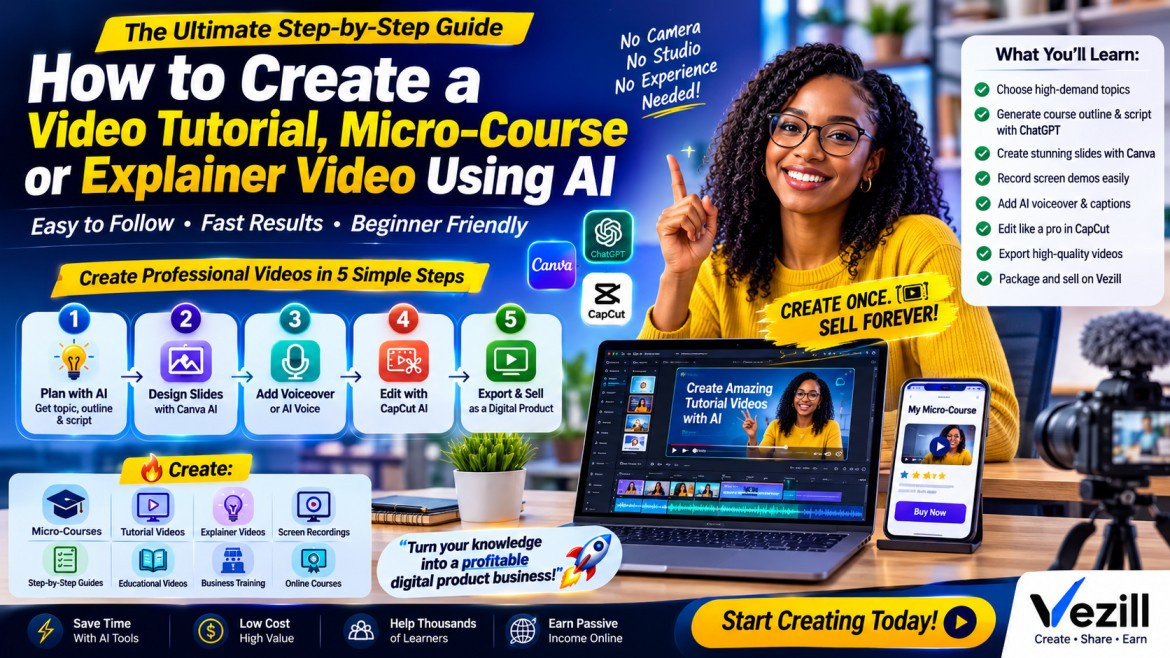
Learn How to Create a Video Tutorial, Micro-Course or Explainer Video Using AI
By Super Admin
Discover the best AI tools for small businesses that automate marketing, customer support, accounting, content creation, emails, scheduling, and administration.
By Super Admin
Get the updates, on newly released, popular & fast-moving MRR digital products
Up to Top
Comments All
Davine
@davine
I liked the mix of practical ideas and simple topics that can be turned into valuable microcourses or video tutorials. It definitely made coming up with content ideas feel a lot easier and more exciting.
September 08,2026 At 09:39 PM
Koech
@koech
I was looking for simple ideas for a short course, and this gave me quite a few options to think about. I like that the topics are focused on specific skills rather than trying to teach too much at once. Some of these could actually be turned into useful tutorials.
August 27,2026 At 11:52 PM
Alvin
@alvin
Some of these micro-course ideas are actually pretty practical. I like the focus on teaching specific skills instead of trying to create a huge course covering everything. It got me thinking about what small skill I could package into a short tutorial and sell.
August 27,2026 At 11:32 PM