
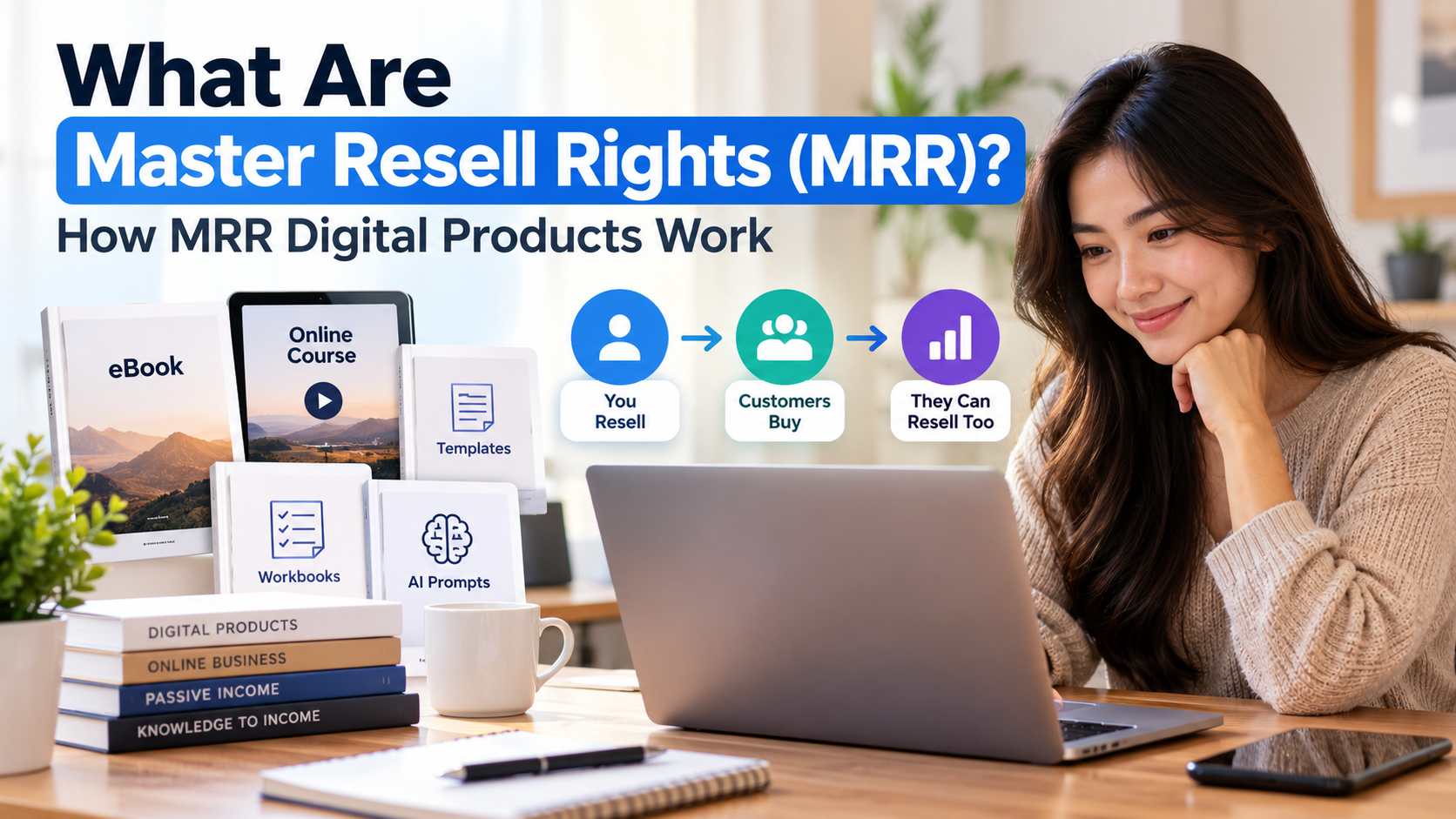
If you have been researching digital products, online business or ways to sell knowledge online, you may have come across the term Master Resell Rights, usually shortened to MRR.
But what exactly are Master Resell Rights? Can you legally resell an MRR product? Do you own the product after buying it? What is the difference between MRR, PLR and normal resell rights? And can you actually make money selling MRR digital products?
This guide explains Master Resell Rights in simple terms, including how the licensing model works, what you should check before buying an MRR product, the advantages and risks, and how MRR products work on Vezill.
Master Resell Rights (MRR) are licence permissions attached to certain digital products that allow a buyer to resell the product and, where the licence permits, pass reselling rights to subsequent buyers.
For example, suppose a creator produces a practical PDF guide and sells it with Master Resell Rights.
A buyer may be permitted to:
purchase the guide;
use or access it;
resell it to other customers; and
pass specified reselling rights to those customers.
The exact permissions depend on the licence attached to the product.
That last point is important.
Buying an MRR product does not automatically mean that you own its copyright, can edit it, claim authorship, use the creator's trademarks or do anything you want with the content.
MRR is a licence, not automatically a transfer of copyright ownership.

In digital-product licensing:
MRR = Master Resell Rights.
The term describes a licensing arrangement under which the copyright or rights holder gives another person permission to resell a digital product under specified conditions.
The distinguishing feature of Master Resell Rights is generally that the licence can permit the reseller to pass resale rights to customers as well.
This differs from ordinary resale rights, where you may be allowed to sell the product but your customer may not have permission to resell it again.
MRR should also not be confused with Monthly Recurring Revenue, another common meaning of the abbreviation MRR in SaaS and subscription businesses.
A typical MRR transaction works like this:
Creator → MRR buyer/reseller → Customer → Potential reseller
This could be:
an eBook;
PDF guide;
online course;
template;
workbook;
checklist;
prompt collection;
video training;
spreadsheet;
digital toolkit; or
another downloadable or online resource.
The creator decides which permissions buyers receive.
For example, the licence may specify whether a buyer can:
resell the product;
pass resale rights to another buyer;
change the selling price;
modify the content;
change the cover;
rebrand the product;
bundle it with other products; or
sell it on particular platforms.
The purchaser receives access to the product together with whatever rights are granted under its licence.
Instead of having to create an entirely new product from scratch, the reseller can concentrate on finding an appropriate audience and marketing the existing product.
The reseller earns revenue from the sale according to the applicable marketplace, payment and licensing terms.
If the licence allows Master Resell Rights to be transferred, the new buyer may also be able to resell the product.
Imagine a creator develops a practical guide called:
Home Wi-Fi Troubleshooting Guide
The creator decides to offer the guide with Master Resell Rights.
Mary buys the guide.
Instead of only reading it herself, its licence permits her to resell the guide.
Mary finds people who need help solving common Wi-Fi problems and sells the guide to some of them.
If the MRR licence permits transfer of the resale rights, eligible customers can subsequently resell the guide under the applicable terms.
That is the basic idea behind Master Resell Rights.
However, purchasing the guide does not necessarily make Mary its author or copyright owner.
She has acquired specified permissions under a licence.
These terms are frequently confused.
| Licence | Can You Use the Product? | Can You Resell It? | Can Your Buyer Resell It? | Can You Edit/Rebrand It? |
|---|---|---|---|---|
| Personal Use | Usually yes | No | No | Usually no |
| Resell Rights (RR) | Usually yes | Usually yes | Usually no | Depends on licence |
| Master Resell Rights (MRR) | Usually yes | Yes | Often yes | Depends on licence |
| Private Label Rights (PLR) | Usually yes | Often yes | Depends on licence | Often yes |
The important phrase throughout this table is:
Check the specific licence.
There is no universal MRR agreement covering every product sold online.
Two products described as “MRR products” can have different restrictions.
The major difference is usually the degree of control over the underlying content.
MRR primarily concerns reselling and transferring resale permissions.
Depending on the licence, you may have to sell the product substantially as supplied.
PLR commonly gives the purchaser broader modification rights.
Depending on the PLR licence, you may be able to:
edit the content;
change the title;
redesign it;
add your own material;
remove sections;
combine it with other content; or
publish a modified version under your brand.
But never assume that PLR gives unlimited rights either.
The written licence remains the authoritative source for what you can and cannot do.
Master Resell Rights are fundamentally a licensing arrangement.
Copyright owners generally have rights over reproduction, distribution and derivative uses of their work and can authorize other people to exercise certain rights.
Therefore, the critical issue is not simply whether a product carries an “MRR” label.
The important questions are:
Does the person granting the licence actually have the authority to grant those rights, and are you operating within the licence terms?
Before reselling an MRR product, verify that the product legitimately includes resale permission.
Do not download somebody else's book, course, video, software or other copyrighted work and start reselling it simply because you obtained a copy.
Owning or accessing a digital file is not the same thing as owning its copyright or having permission to redistribute it.
MRR can be applied to many types of digital knowledge products, depending on the rights held by the creator.
Examples include:
Examples:
business startup guides;
study guides;
job-search guides;
technology troubleshooting manuals;
farming guides; and
how-to playbooks.
Educational and informational books can be packaged with clearly defined resale rights.
Examples include:
business templates;
spreadsheets;
planners;
checklists;
worksheets; and
productivity resources.
Creators can license certain training materials for resale where they own the necessary rights.
These might include:
prompt collections;
workflow guides;
automation templates; and
practical AI playbooks.
Rights relating to AI-generated or AI-assisted content can be more complex, so creators should ensure that the underlying material and third-party assets can legally be distributed under the proposed licence.
MRR can provide creators with an alternative distribution model.
Instead of relying exclusively on the creator's own marketing, the creator can allow customers to become independent resellers.
This can potentially increase the number of people promoting the product.
For the creator, the model can provide:
wider product distribution;
additional marketing channels;
greater exposure;
reseller-driven discovery; and
depending on the platform model, continuing revenue from reseller activity.
But distribution does not replace product quality.
A weak product with an attractive resale licence is still a weak product.
The underlying product should solve a real problem or help a clearly defined audience achieve a useful result.
There are generally two possible reasons.
Someone may buy a guide, course or toolkit primarily because they want the knowledge or result it provides.
Someone may value the product and also want permission to market it to other people.
A strong MRR product should therefore ideally have standalone customer value even if the buyer never resells it.
This distinction is important.
The primary value should come from the usefulness of the product—not merely from the possibility of selling the same opportunity to another person.
It is possible to generate revenue by selling properly licensed digital products, including products with Master Resell Rights.
However, MRR does not guarantee sales, profit or passive income.
Your results can depend on factors such as:
product quality;
customer demand;
price;
competition;
marketing ability;
audience size;
trust;
positioning;
platform fees;
advertising costs;
taxes;
licence restrictions; and
the number of competing resellers.
A reseller who buys a product but never reaches potential customers may make no sales.
Another reseller with a relevant audience and effective marketing may perform differently.
For that reason, MRR is better understood as a digital-product licensing and distribution model, not a guaranteed-income system.
Not automatically.
Digital products have an important advantage: once the infrastructure is established, delivery can often be automated.
That means you do not necessarily need to package and ship something manually every time a customer buys.
But attracting customers generally still requires work.
A seller may need to:
create content;
explain the product;
answer customer questions;
build an audience;
improve sales pages;
share product links;
run advertising;
build an email list;
create demonstrations; or
develop partnerships.
MRR can reduce product-creation work, but it does not eliminate marketing and customer-acquisition work.
MRR can offer several practical advantages when used properly.
This can reduce the time required to enter digital-product selling.
Digital products do not require warehouses or traditional stock management.
Delivery can usually happen digitally.
Unlike a physical item that leaves your inventory after one sale, a properly licensed digital product can potentially be distributed repeatedly within its licence terms.
A marketplace can handle elements such as payments, hosting and delivery.
For creators, allowing resale can turn customers into additional distribution channels.
MRR is not automatically a good business merely because resale is allowed.
Consider these risks.
If many people sell exactly the same product to the same audience, competition can increase significantly.
Some MRR products are outdated, generic or provide little practical value.
Always evaluate the actual product—not merely the resale opportunity.
Reselling, editing, rebranding and claiming authorship are different permissions.
Violating a licence can create intellectual-property or contractual problems.
Be cautious of promotions suggesting that buying an MRR product guarantees large or effortless earnings.
Income depends on actual sales and costs.
If hundreds of sellers have identical products, simply posting the same sales message may not be enough.
A seller still needs positioning, credibility and access to an appropriate audience.
Before purchasing a product primarily for resale, evaluate it as if resale rights did not exist.
Ask:
Would somebody still want this product if they were not allowed to resell it?
If the answer is no, reconsider the product.
A useful MRR product should generally have:
The buyer should understand what problem it addresses.
The product should help someone accomplish something meaningful.
Useful instructions, examples, checklists, templates or action steps usually provide more value than vague motivational content.
Check dates, links, procedures, screenshots and other information that can become outdated.
Poor formatting and obvious errors can reduce trust.
You should know exactly what you are buying.
Be cautious when an MRR offer focuses almost entirely on how much money you can make rather than what the underlying product actually helps customers accomplish.
Other warning signs include:
no visible licence terms;
unclear product ownership;
copyrighted material from unrelated creators;
guaranteed-income claims;
pressure to buy immediately;
unrealistic earnings screenshots without context;
little explanation of the actual product;
outdated or low-quality content; or
claims that no marketing or work is required.
A legitimate digital product should be able to justify its value independently of exaggerated financial promises.
Before purchasing or selling an MRR product, check whether the licence addresses:
whether resale is permitted;
whether MRR can be transferred to subsequent buyers;
whether the content can be modified;
whether the product can be rebranded;
whether the title can be changed;
whether source files are included;
whether there is a minimum resale price;
which marketplaces or sales channels may be used;
whether the product can be given away;
whether it can be bundled;
whether trademarks or brand assets can be used; and
whether authorship can be claimed.
If something important is unclear, obtain clarification before selling.
Vezill is a digital-product marketplace where creators can sell knowledge products and qualifying products can be offered with Master Resell Rights.
Vezill's current product-upload guidance states that creators can decide whether to enable MRR for their products.
Under the platform's current model, an eligible reseller can receive 90% of the resale price, while the original creator receives 10% from the resale as a royalty.
These percentages describe Vezill's current platform model; they are not part of the universal definition of Master Resell Rights.
Platform fees, subscriptions, withdrawal rules and other conditions may also apply, so sellers should review the current Vezill terms and FAQ before making commercial decisions.
Suppose a creator publishes a practical digital guide on Vezill and enables Master Resell Rights.
A buyer purchases the guide and becomes eligible to resell it according to the applicable product licence and Vezill rules.
The reseller then promotes the product to an appropriate audience.
If a customer purchases through the reseller's product link, Vezill's current MRR model allocates the resale revenue according to the platform's applicable reseller/creator structure.
The customer may then receive the applicable resale rights where those rights form part of the product licence.
The important distinction is that the product generates revenue only when an actual customer purchases it.
Simply owning MRR does not itself generate income.
The general process is:
Register and review the current seller/reseller requirements.
Look for a product that solves a genuine problem for an audience you understand.
Don't promote something solely because it has MRR.
Understand what the customer will actually receive.
Confirm what resale and transfer rights are included.
Ask:
Who has the problem this product solves?
Instead of advertising only:
“Buy this product and resell it.”
Explain:
what the product teaches;
who needs it;
what problem it addresses;
what is included; and
what practical result it is designed to help achieve.
Depending on your audience, you might use:
WhatsApp;
TikTok;
Facebook;
Instagram;
YouTube;
email;
a blog; or
direct referrals.
Avoid guaranteed-income promises or misleading earnings claims.
You do not necessarily need to start as a reseller.
If you have useful knowledge, experience or a repeatable process, you can create an original digital product.
For example, you could package knowledge into:
a practical guide;
checklist;
template;
workbook;
mini-course;
troubleshooting manual;
procedure;
spreadsheet;
prompt pack; or
toolkit.
A simple framework is:
KNOW → PACKAGE → SELL → APPLY → GROW
Start with something useful that you know.
Package it into a format another person can easily understand and apply.
Then decide what licence you want to give buyers.
If you own the necessary rights and want buyers to be able to resell the product, you can consider offering it with Master Resell Rights.
For a detailed creation process, read Vezill's guide on how to create a digital product with AI.
MRR and affiliate marketing are also different.
With affiliate marketing, you generally promote somebody else's product and receive an agreed commission when your referral generates a qualifying transaction.
With MRR, you acquire specified resale rights and act as a reseller under the applicable licence.
Vezill explains these two distribution models further in its guide to affiliate marketing for digital products.
MRR itself is a licensing model, not a description of a compensation structure.
The key question is how a particular business using MRR operates.
A legitimate MRR product should have genuine standalone value for the end customer.
Consumers should therefore evaluate:
what the actual product contains;
whether it solves a real problem;
what the licence allows;
what fees are involved; and
whether marketing claims are realistic.
Be particularly cautious when an offer's main selling point is recruiting or selling the same income opportunity to others rather than delivering useful underlying customer value.
MRR can make sense for someone who wants to sell digital products without initially developing every product from scratch.
It may also be useful for creators who want other sellers to help distribute their knowledge.
But the licence itself does not create demand.
A successful digital-product business still depends on a fundamental principle:
Solve a real problem for a clearly defined customer.
If the product is useful, appropriately licensed, accurately marketed and matched with the right audience, MRR can provide an additional way to distribute and monetize digital knowledge.
In digital products, MRR stands for Master Resell Rights. It describes licence permissions that allow a product to be resold and may allow resale rights to be passed to subsequent buyers.
You own whatever rights the licence grants you. Buying a copy of a digital product does not automatically transfer its underlying copyright to you.
Only if the licence allows editing. Do not assume MRR automatically includes modification or rebranding rights.
Only where the licence expressly allows this. Some licences restrict changes to authorship, branding or copyright notices.
Many MRR licences permit repeated resale, but the specific licence determines the permitted scope.
This is generally the feature that distinguishes Master Resell Rights from ordinary resale rights, but you should still verify the specific product licence.
MRR primarily concerns resale and the ability to transfer resale rights. PLR commonly provides broader modification and rebranding permissions. Exact permissions vary by licence.
Yes, provided they understand the product, licence, platform rules and audience. Beginners still need to learn basic marketing and customer acquisition.
No. Buying resale rights does not guarantee customers, revenue or profit. Results depend on product demand, quality, marketing, pricing, competition, costs and other factors.
According to Vezill's current FAQ and reseller guidance, eligible resellers currently receive 90% of the resale price, while the original creator receives 10% from the resale. Other platform charges and conditions can apply, so users should check the current platform terms before selling.
No. A properly licensed MRR product can allow you to start with an existing product. Alternatively, you can create your own original digital product and decide whether to offer MRR to buyers.
Master Resell Rights are easiest to understand as a digital licensing and distribution system.
A creator makes a useful digital product.
The creator grants specified resale permissions.
A reseller can market and sell the product within those permissions.
And, where the licence permits, subsequent buyers can receive resale rights as well.
The opportunity comes from combining:
Useful knowledge + clear licensing + genuine customer demand + effective marketing.
MRR is not a guarantee of passive income or financial success. It is a mechanism that can make digital products easier to distribute and resell.
If you want to explore practical digital products that include resale opportunities, visit Vezill and check the licence attached to each product before purchasing or reselling.
Discover more articles you might be interested in
how to create your first knowledge product in one weekend
By Davie
how to build multiple digital products from one skill
By Davie

how to find problems people will pay you to solve
By Davie
How to turn a hobby into a digital product
By Davie
Get the updates, on newly released, popular & fast-moving MRR digital products
Up to Top
Comments All
Serah Wairimu
@serah_wairimu
I need to work at home
June 29,2026 At 10:04 AM