
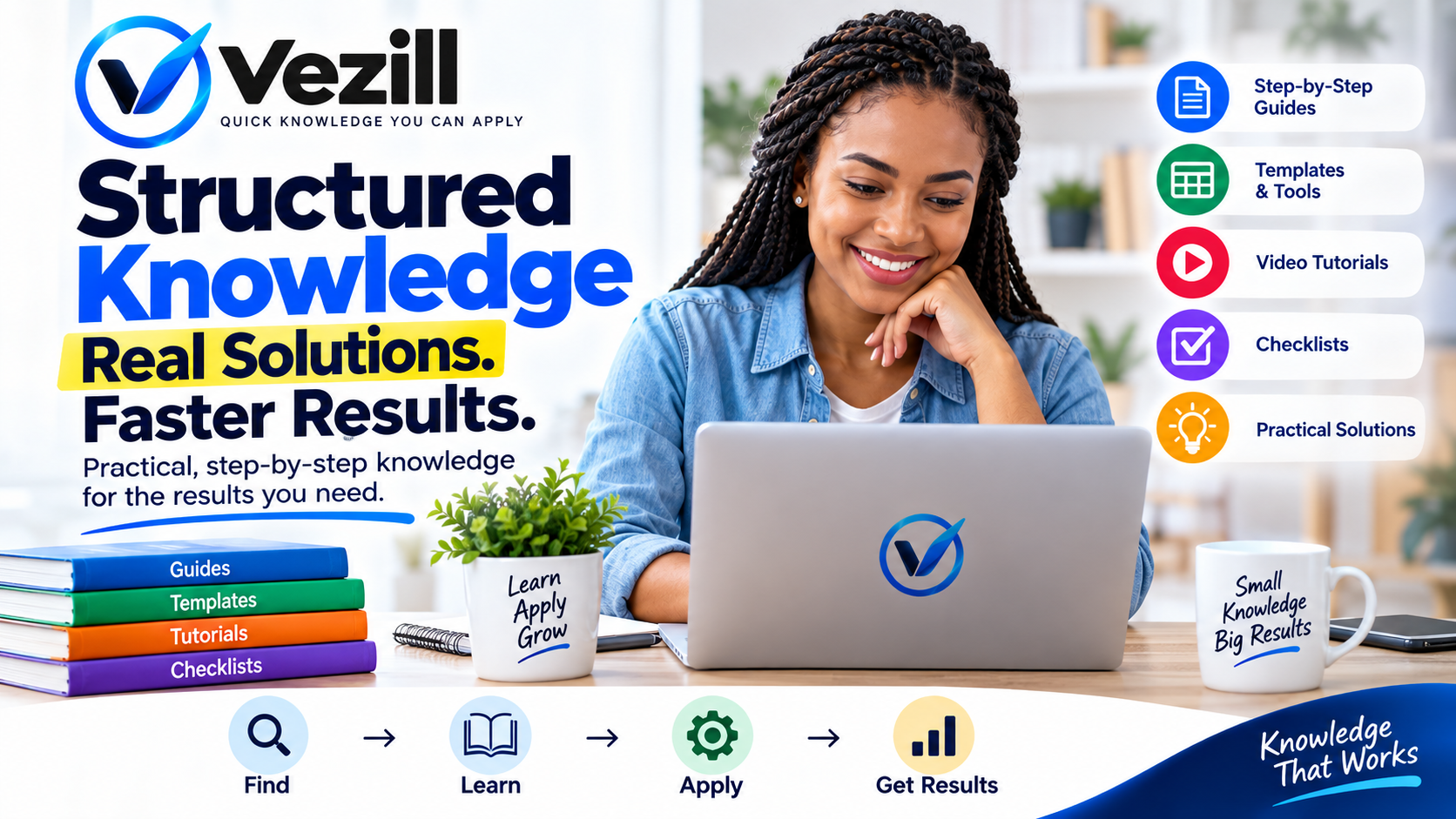
Looking for practical knowledge that helps you actually do something - not just read about it?
The internet has more information than at any other point in history. You can search Google, watch YouTube, ask an AI assistant, browse social media or read hundreds of articles.
Yet there is still a problem:
Finding information is easy. Turning information into a useful result can be difficult.
You might spend an hour opening websites and videos only to discover that the information you need is scattered across different sources.
One source tells you what to do.
Another explains why it works.
Another gives you the steps.
Another provides a template.
Another mentions an important mistake that everyone else forgot.
What you actually needed was all the relevant knowledge organized around the result you wanted to achieve.
That is Structured Knowledge.
And it is one of the ideas behind VEZILL - Quick Knowledge You Can Apply.
Structured knowledge is useful information that has been selected, organized and presented in a logical sequence to help someone understand something, complete a task, solve a problem or achieve a specific outcome.
Instead of giving you disconnected pieces of information, good structured knowledge may combine:
Goal → Requirements → Steps → Examples → Tools → Checks → Troubleshooting → Result
The emphasis is not simply on knowing more.
The emphasis is on knowing what you need, in the order you need it, so that you can act.
Google and AI assistants have made access to information dramatically easier.
If you ask an AI tool a question, you may receive an explanation within seconds.
But receiving an answer and completing a task are not always the same thing.
Imagine searching:
“How do I create a monthly budget for my small business?”
A simple answer might tell you:
Calculate your expected income, list your expenses and subtract expenses from income.
Correct.
But can you now create a useful business budget?
You may still need to know:
Which income categories should I include?
Which expenses are fixed and which are variable?
How should I organize the spreadsheet?
How do I account for irregular expenses?
What formulas should I use?
What does a completed example look like?
How do I know whether my business is overspending?
A structured knowledge package might therefore provide:
Explanation + Spreadsheet + Categories + Formulas + Worked Example + Instructions + Checklist
Now the knowledge is much easier to apply.
This is the difference between finding an answer and having a usable solution.
High-value knowledge isn't necessarily long, complicated or academic.
Sometimes the most valuable knowledge is surprisingly small.
Its value comes from its usefulness.
For example, suppose you have been struggling for several hours to calculate the correct selling price for products in your small business.
Someone gives you a spreadsheet where you enter:
Material Cost + Labour + Packaging + Transport + Overheads + Desired Margin
and the spreadsheet automatically calculates a suggested selling price.
That spreadsheet might contain less information than a 300-page business textbook.
But for your immediate problem, it could be more useful.
The value of practical knowledge should therefore not be measured only by how many pages, lessons or hours it contains.
A better question is:
Does this knowledge help me achieve the result I need?
VEZILL is built around a simple idea:
Someone has already learned something through:
experience, research, experimentation, professional practice, repeated work or solving a particular problem.
Instead of leaving that knowledge scattered inside their head, notebooks, computer files or conversations, they can organize it into something another person can use.
That might become:
a step-by-step guide
a practical ebook
a checklist
a template
a spreadsheet
a calculator
a formula
an SOP
an AI prompt system
a video tutorial
a micro-course
a troubleshooting guide
a digital toolkit
The digital product is the container.
The knowledge inside it is the real value.
Suppose someone wants to learn:
“How do I photograph products professionally using my smartphone?”
There are thousands of videos and articles about photography.
But the person doesn't necessarily want to become a professional photographer.
They have a much narrower goal:
I need better photos of the products I sell online.
A useful structured knowledge package could therefore contain:
Take clear, attractive product photographs using an ordinary smartphone.
Smartphone
Natural light or affordable lighting
Simple background
Basic editing app
Product to photograph
Where to position the product.
Where the light should come from.
How far the phone should be from the product.
Which settings matter and which ones can be ignored.
Prepare → Position → Light → Frame → Focus → Shoot → Select
Poor photograph vs improved photograph.
Crop → Brightness → Contrast → Colour correction → Export
Harsh shadows.
Distracting backgrounds.
Digital zoom.
Poor angles.
Over-editing.
Before publishing:
✓ Image is sharp
✓ Product colour is accurate
✓ Background is clean
✓ Important details are visible
✓ Correct dimensions are used
That is structured knowledge.
Instead of giving the learner everything about photography, it gives them the knowledge necessary for one useful outcome.
There is often a hidden gap between asking a question and getting a result.
Consider:
“How do I write a professional business proposal?”
A search engine or AI assistant can explain what a proposal contains.
But you may still be staring at a blank document.
Structured knowledge can fill that gap:
Question
↓
Explanation
↓
Requirements
↓
Step-by-Step Process
↓
Template
↓
Completed Example
↓
Checklist
↓
Your Finished Proposal
This is why structured practical knowledge can save more than research time.
It can reduce decision friction.
Instead of repeatedly asking:
“What comes next?”
the structure tells you.
When looking for practical knowledge online, don't judge a resource only by its title or length.
Look for these characteristics.
Weak:
Learn Social Media Marketing
More focused:
Create a 30-Day Social Media Content Calendar for Your Small Business
You should understand what you are expected to accomplish.
Useful knowledge should have a logical progression.
For example:
Prepare → Set Up → Do → Check → Improve
rather than random tips.
After learning something, you should know what action to take.
Examples bridge the gap between theory and execution.
Sometimes the fastest route to a result isn't another paragraph.
It is a:
template, checklist, calculator, spreadsheet, script, prompt or worksheet.
Experienced people often know something beginners don't:
what usually goes wrong.
Good practical knowledge captures those lessons.
How do you know you have completed the task correctly?
Useful structured knowledge should provide checkpoints, expected outcomes or verification methods where appropriate.
The concept becomes clearer when we compare broad information with outcome-focused knowledge.
|
What Someone Wants |
General Information |
Structured Knowledge |
|
Prepare for a job interview |
Articles about interviews |
Interview checklist + common questions + answer framework + practice worksheet |
|
Calculate business profit |
Definition of profit |
Spreadsheet + instructions + worked example |
|
Build a simple website |
Articles about web development |
Domain → hosting → setup → pages → testing → launch guide |
|
Create social media content |
Marketing tips |
30-day calendar + content framework + caption templates |
|
Use AI for work |
List of AI tools |
Task-specific prompts + workflow + examples + verification process |
|
Write a CV |
CV advice |
Step-by-step guide + editable template + completed example + checklist |
|
Manage household spending |
Budgeting articles |
Monthly budget spreadsheet + categories + instructions |
|
Create an online course |
Course-creation theory |
Topic → outline → lessons → recording → packaging → publishing workflow |
|
Price a service |
Pricing theory |
Cost calculator + pricing framework + worked examples |
|
Create a business proposal |
Explanation of proposals |
Template + instructions + sample + final checklist |
The distinction is important.
Information increases awareness.
Structured knowledge increases your ability to act.
This is an important question.
Much of the world's information is already available somewhere online.
But imagine needing one practical solution and having to:
Search Google.
Open 12 websites.
Watch five videos.
Ask AI several follow-up questions.
Download three different templates.
Compare conflicting recommendations.
Work out which information is outdated.
Then reorganize everything into a process you can actually follow.
You may eventually get the answer.
But you have paid with something else:
your time and attention.
A good structured knowledge creator may already have done much of this work:
Learned → Tested → Selected → Organized → Simplified → Packaged
What you are paying for is therefore not necessarily “secret information.”
You may be paying for:
clarity, structure, convenience, context, examples, tools, reduced research and fewer avoidable mistakes.
That is why well-structured knowledge can have value even when individual pieces of the information exist freely elsewhere.
Different platforms serve different knowledge needs.
Search engines are excellent for discovering information.
AI assistants are excellent for asking questions, generating explanations and exploring ideas.
YouTube can be excellent when you need to see something demonstrated.
Traditional online courses are useful when you need broader knowledge and sustained skill development.
VEZILL focuses on another part of the knowledge ecosystem: practical digital knowledge packaged around specific tasks, problems and outcomes.
VEZILL describes itself as a global digital knowledge marketplace connecting people who know how with people who need to know how.
Depending on available listings, knowledge can be packaged as guides, ebooks, templates, spreadsheets, calculators, AI prompts, tutorials, checklists, micro-courses and digital toolkits.
The objective is simple:
Suppose you want to become a professional data analyst.
A short guide isn't enough.
You need deeper learning, practice, projects and possibly recognized training.
But suppose you already use Excel and simply need to know:
“How do I create a PivotTable showing monthly sales by branch?”
You probably don't need a six-month data analytics course to solve that immediate problem.
You need the right knowledge for the size of the task.
A useful rule is:
Structured knowledge should reduce unnecessary learning, not necessary learning.
Before purchasing a guide, template, tutorial, micro-course or other knowledge product, ask:
1. What specific result does this resource help me achieve?
If the outcome is unclear, investigate further.
2. Who created it?
Look for relevant experience, expertise, evidence or context.
3. Is the knowledge current?
This is especially important for technology, AI, software, regulations and rapidly changing subjects.
4. Is it practical?
Does it explain what to actually do?
5. Does it provide examples?
A worked example can dramatically improve understanding.
6. Are there useful tools included?
Templates, checklists and calculators can increase practical value.
7. Does it explain limitations?
Trustworthy knowledge should not promise guaranteed outcomes where outcomes depend on individual circumstances.
8. Can I verify my result?
Look for checkpoints, expected outcomes or testing procedures.
VEZILL is designed around people who arrive online with a simple but powerful question:
Or:
How do I make this?
How do I create this?
How do I fix this?
How do I calculate this?
How do I start this?
How do I improve this?
What process should I follow?
Is there a template I can use?
Is there a formula that works?
Is there an AI prompt for this task?
Sometimes you don't need more information.
You need the right information, organized around what you are trying to accomplish.
That is the opportunity VEZILL is building around.
The internet solved one major problem:
access to information.
AI is solving another:
access to fast explanations and synthesis.
But another challenge remains:
People still need to turn what they know into what they can do.
That requires:
Relevant Knowledge + Structure + Context + Action + Verification
This is where high-value structured knowledge becomes especially useful.
A knowledgeable person has already discovered a method.
They structure it.
Another person discovers it.
They apply it.
They achieve or move closer to the desired outcome.
That is knowledge becoming useful.
The next time you need to learn something, don't start by asking:
“What subject should I study?”
First ask:
If the goal is broad, you may need comprehensive education.
If the goal is specific, you may need a focused piece of structured knowledge.
Look for a resource that gives you the:
steps, process, examples, tools and checks required to move from question to action.
That is what good practical knowledge should do.
And that is the type of knowledge VEZILL is designed to make easier to discover and share.
People Who Know How → People Who Need to Know How.
Don't just search for more information.
Find the knowledge you need. Apply it. Get the result.
Structured knowledge is information that has been selected, organized and presented logically around an objective. It can include explanations, steps, examples, templates, tools, checklists and verification methods that help someone apply what they learn.
Practical knowledge is knowledge that can be applied to a real task, decision, problem or outcome. It focuses on doing, not merely knowing.
Step-by-step knowledge is available through search engines, educational websites, video platforms, AI tools, online-course platforms and digital knowledge marketplaces such as VEZILL. The best source depends on the complexity and consequence of the task.
VEZILL uses Quick Knowledge to describe focused, practical knowledge designed around a specific task, problem or outcome without requiring someone to study an entire subject first.
Not necessarily. Quick Knowledge can be a guide, checklist, template, spreadsheet, formula, prompt system, tutorial, calculator, toolkit or micro-course. The defining characteristic is its focus on a useful outcome rather than its file format or length.
Its value can come from saving research time and providing curation, organization, context, sequence, examples, tools and troubleshooting. The buyer isn't necessarily paying for secret information; they may be paying for knowledge that has already been organized into a usable form.
For a specific task, it can reduce unnecessary searching and learning by focusing attention on the knowledge required for that outcome. However, complex skills and professional competencies still require deeper study and practice.
Depending on available creator listings, VEZILL can include how-to guides, practical ebooks, templates, checklists, spreadsheets, calculators, AI prompts, tutorials, micro-courses and other digital knowledge products designed to help people learn and apply useful knowledge.
Discover more articles you might be interested in
how to create your first knowledge product in one weekend
By Davie
how to build multiple digital products from one skill
By Davie
how to find problems people will pay you to solve
By Davie
How to turn a hobby into a digital product
By Davie
Get the updates, on newly released, popular & fast-moving MRR digital products
Up to Top