

A practical beginner’s guide to moving products from a Chinese supplier or warehouse to Kenya without being surprised by freight charges, customs requirements or avoidable shipping mistakes.
Updated: August 2026 | Reading time: Approximately 14 minutes
 Shipping decisions should begin with packed cargo details, not a headline price per kilogram.
For many beginners, one of the simplest ways to ship goods from China to Kenya is to use a freight forwarder with a warehouse in China. The supplier sends the cargo to that warehouse; the forwarder can receive, consolidate and ship it by air freight, sea freight, express courier or another agreed service.
CHINESE SUPPLIER → CHINA WAREHOUSE → CONSOLIDATION → AIR / SEA / COURIER → KENYA → CLEARANCE → DELIVERY
There is no single cheapest method. The right option depends on actual weight, volumetric weight, carton dimensions, CBM, product type, urgency, shipment size and what the quotation includes.
This article explains shipping and logistics. The full How to Import From China to Kenya — 2027 Edition guide goes further: product research, Alibaba and 1688, supplier verification, safe payment, samples, negotiation, landed-cost calculations, KRA and KEBS concepts, scam prevention, checklists and a seven-day first-import action plan.
Get the complete guide on Vezill →
Imagine you are in Nairobi and have ordered products from a supplier in Guangzhou. You can ask the supplier to arrange international shipping, or you can instruct the supplier to deliver the goods to your own freight forwarder’s Chinese warehouse.
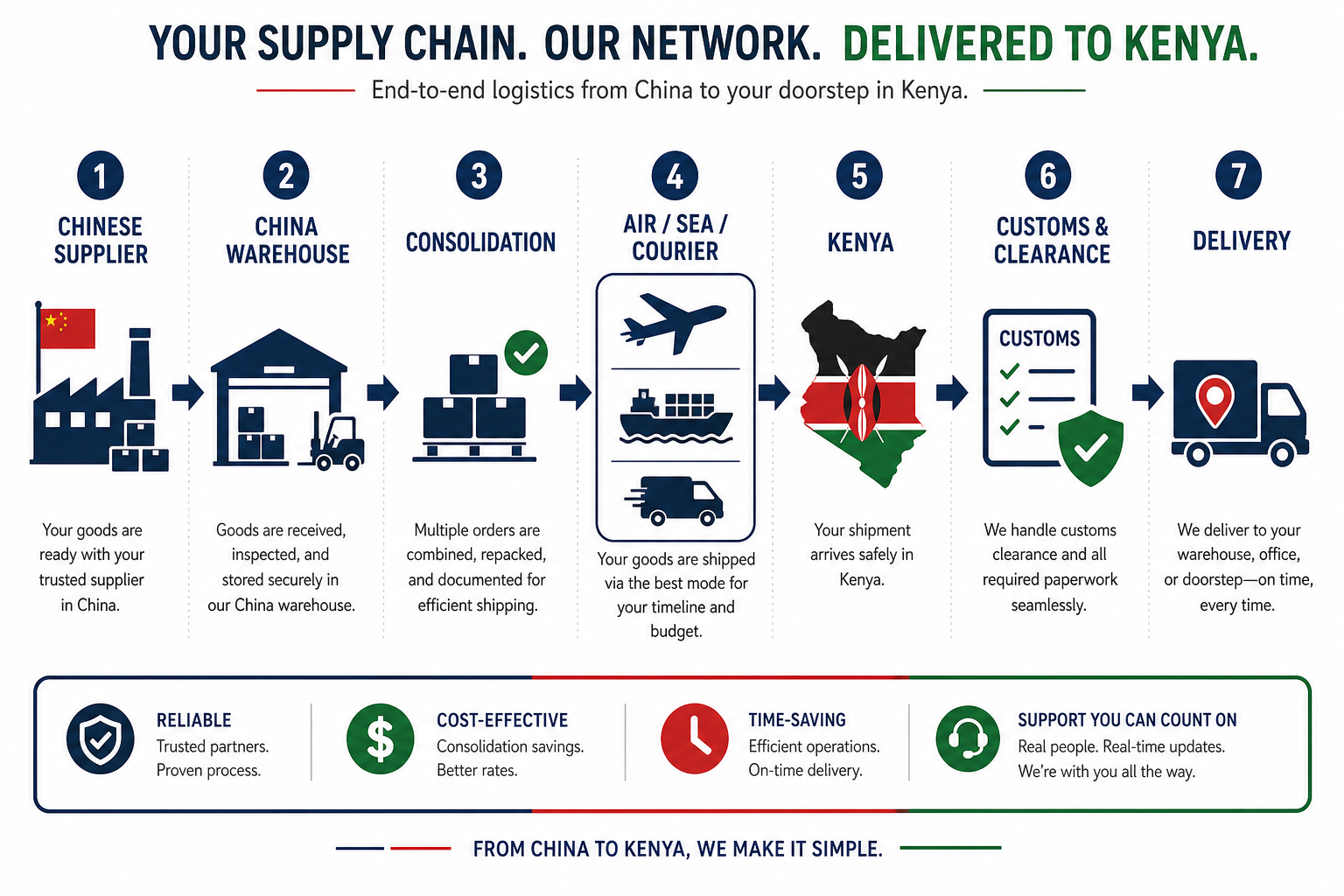 The basic China-to-Kenya shipping chain.
Supplier prepares the goods: confirm cartons, units per carton, gross weight, net weight, dimensions and quantity.
Goods move within China: domestic delivery to the warehouse may be a separate cost.
Forwarder receives the cargo: the warehouse identifies it using your name, code or customer number.
International transport: the shipment travels by the agreed air, sea, courier or consolidated service.
Arrival and clearance: customs, taxes, compliance and documentation are handled according to the shipment and arrangement.
Collection or delivery: after release, you collect the cargo or receive local delivery.
Shipping is only one part of importing. Product selection, supplier checks, safe payment, compliance and landed-cost analysis begin before the cargo reaches the warehouse. The full workflow is covered in the complete Vezill China-to-Kenya import guide.
|
Method |
Best suited to |
Main advantage |
Main trade-off |
|
Air freight |
Smaller, compact or urgent commercial cargo |
Faster |
Can be costly for heavy or bulky goods |
|
Sea freight |
Larger or bulky shipments |
Often worth comparing for volume |
Slower and may involve more destination processes |
|
Express courier |
Samples and small urgent parcels |
Convenient and fast |
Usually expensive for larger commercial orders |
|
Consolidated freight |
Small importers buying from one or several suppliers |
Forwarder combines shipments |
Inclusions differ by provider |
Do not choose air or sea based only on the purchase price. A cheap product in a large carton can have very different freight economics from an expensive compact product.
Air freight can suit test orders, compact products, higher-value goods and urgent inventory. The important calculation is not always the physical weight. Carriers may compare actual weight with volumetric or dimensional weight.
Using the DHL Express example of length × width × height in centimetres divided by 5,000, a carton measuring 60 × 50 × 40 cm has a dimensional weight of 24 kg, even if its physical weight is 12 kg:
60 × 50 × 40 ÷ 5,000 = 24 KG DIMENSIONAL WEIGHT
Different carriers and freight services can use different formulas. Ask the specific provider how chargeable weight will be calculated before you accept the quote. Packed dimensions matter as much as kilograms.
Kenya’s main maritime gateway is the Port of Mombasa. Sea freight becomes particularly relevant for larger volumes, but “sea” does not automatically mean cheap. Depending on the arrangement, costs may include origin handling, documentation, consolidation, ocean freight, destination handling, port processes, clearance, taxes, storage and local transportation.
LCL, or Less Than Container Load, means your cargo shares container space with other importers. FCL, or Full Container Load, means you use a full container. For a beginner with a smaller commercial order, LCL is often the more relevant term to understand.
 Air and sea are different cost systems; compare the complete shipment, not one isolated rate.
CBM means cubic metre. Calculate it by multiplying length × width × height in metres. A carton measuring 1 m × 0.5 m × 0.4 m occupies 0.20 CBM. Ten identical cartons occupy approximately 2 CBM.
Two products can have the same Chinese price but completely different freight economics because one arrives in a much larger package. Before placing a bulk order, ask for final export carton dimensions, gross weight, number of cartons and quantity per carton.
There is no universal rate. A quotation may depend on origin city, Kenyan destination, air or sea, actual or volumetric weight, CBM, product type, batteries or dangerous goods, shipment size, consolidation, pickup, fuel surcharges, clearance, taxes and local delivery.
Send several forwarders the same information:
Example quote request:
“Please quote shipping from Guangzhou, China to Nairobi, Kenya. Product: plastic storage organizers. Quantity: 100 units. Cartons: 5. Carton size: 60 × 45 × 40 cm each. Gross weight: 18 kg per carton. Please quote air and sea where available and state exactly what is included and excluded.”
A cheap-looking rate is not useful if it excludes charges another provider includes. Compare like-for-like quotations in writing.
Express courier is generally faster than ordinary air freight, and air is generally faster than sea. But transit time is not the same as total delivery time. Your timeline may include supplier preparation, China domestic delivery, warehouse receiving, consolidation, waiting for a flight or vessel, international transit, arrival, inspection, customs, clearance and Kenyan last-mile delivery.
Ask whether the quoted timeframe means transport-leg transit time or estimated time from the China warehouse until the cargo is ready for collection in Kenya.
If you buy 30 handbags from one supplier, 20 wallets from another and 50 accessories from a third, a Chinese warehouse may be able to receive and consolidate the packages. Possible services include receiving, package recording, consolidation, repacking, basic inspection, storage, international freight, collection and last-mile delivery.
Services differ significantly. Verify the provider, warehouse address, customer code, insurance terms and Kenyan operation before sending supplier instructions.
Never let the phrase “door-to-door” replace a written scope. Ask whether the quotation includes Chinese supplier pickup, domestic transport, warehouse charges, consolidation, repacking, international freight, insurance, customs clearance, taxes or duties, destination handling and delivery to your actual Kenyan address.
Do not ask only, “Is it door-to-door?” Ask: “Please give me a written list of everything included and excluded from this quotation.”
There are two common arrangements. The Alibaba supplier may arrange international shipping, or you may provide your forwarder’s Chinese warehouse address, recipient name, telephone number, customer ID and package-label instructions. In the second arrangement, the supplier handles Chinese domestic delivery and your forwarder handles the next stage.
Remember: Alibaba purchase price + Chinese delivery + international freight + Kenyan import costs is very different from the product price shown online. The full Vezill guide includes supplier questions and a landed-cost workflow.
1688 is primarily oriented toward China’s domestic wholesale market. A common overseas workflow is Kenyan buyer → 1688 supplier → buying or sourcing agent where needed → Chinese warehouse → freight forwarder → Kenya.
An agent may assist with domestic purchasing, supplier communication, Chinese payments, receiving or consolidation. A lower 1688 price does not automatically mean a lower landed cost after agent fees, domestic transport, warehouse charges, international freight and Kenyan import costs.
Depending on the goods and import procedure, you may encounter KRA for customs and tax administration, KEBS for standards and conformity requirements, a licensed clearing agent for customs processes, and your freight forwarder or carrier for transportation.
Possible documents include a commercial invoice, packing list, Bill of Lading or Air Waybill, Certificate of Origin, Certificate of Conformity where applicable, customs documentation and product-specific permits. Not every shipment requires every document. Requirements depend on the product, shipment, procedure and exemptions.
KEBS describes PVoC as conformity assessment in the country of supply or origin for covered goods. KRA’s Certificate of Origin requirements and cargo-document rules should be checked for the exact shipment. For applicable containerized cargo, KRA’s Advance Cargo Declaration process is a further reason not to rely on old importing videos.
Verify the current requirement for your exact product and shipment before paying for a bulk order. The complete import guide organizes the Kenya-side questions, documents and checklists in one place.
Ordering before confirming final carton dimensions.
Confusing actual weight with chargeable weight.
Choosing the cheapest headline rate automatically.
Failing to get inclusions and exclusions in writing.
Sending products to an unverified warehouse.
Assuming door-to-door includes taxes, clearance and every local charge.
Checking Kenyan compliance only after buying.
Forgetting Chinese domestic freight.
Ignoring Kenyan last-mile delivery costs.
Using old freight prices instead of a fresh quotation.
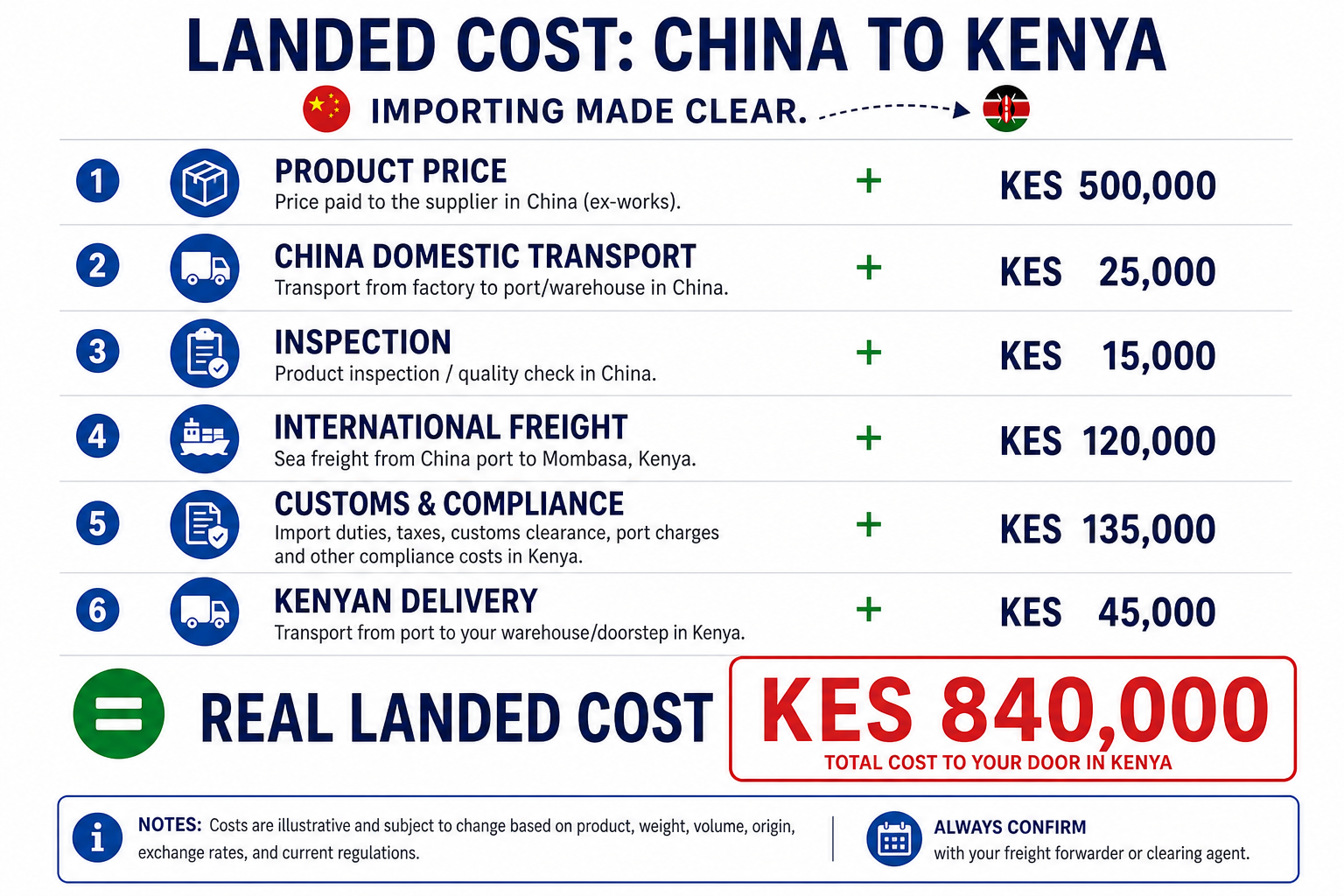 The number that matters is real landed cost, not the Chinese supplier price.
Air freight
Usually faster; useful for compact, urgent or test shipments; chargeable weight matters; can become expensive for bulky cargo.
Sea freight
Usually slower; worth comparing for larger or bulky shipments; CBM and destination charges matter; LCL and FCL apply.
There is no universal rule such as “anything above 100 kg must go by sea.” Ask the forwarder for both options and compare total landed cost, delivery timeline, risk and cash tied up in inventory.
Product confirmed.
Final quantity confirmed.
Final carton dimensions obtained.
Gross weight obtained.
Air and sea quotations compared.
Kenyan compliance checked.
Forwarder verified.
Written shipping inclusions received.
If you cannot confidently tick all eight, do not rush the bulk shipment.
Before products reach a freight forwarder, you still need to decide what to import, verify the supplier, order samples, pay safely, negotiate, calculate landed cost, understand Kenyan requirements and avoid scams.
The complete How to Import From China to Kenya — 2027 Edition guide is built for that full journey.
Read the complete Vezill import guide →
There is no universal rate. It depends on method, cargo weight, volumetric weight or CBM, origin, product type, destination and included services. Request a current written quote based on packed cargo.
For larger or bulky shipments, sea freight may be worth comparing. For smaller or urgent shipments, consolidated air freight can be practical. The actual cargo determines the answer.
Air is generally faster than sea, but total delivery also includes preparation, domestic transport, consolidation, departure schedules, customs, clearance and Kenyan delivery.
Ask the supplier to arrange an agreed method, or send the products to your verified Chinese warehouse for onward shipping through your forwarder.
A common workflow uses a sourcing agent where needed, followed by a Chinese warehouse and international freight forwarder.
CBM means cubic metre. Multiply length × width × height in metres to estimate cargo volume.
It estimates how much transport space a package occupies relative to its physical weight. Carriers may compare both when calculating chargeable weight.
Some providers offer door-to-door service, but the exact inclusions vary. Obtain a written breakdown of freight, clearance, taxes, handling and final delivery.
Commercial imports may require formal customs clearance, and the exact procedure depends on the shipment and applicable rules. Confirm the requirement for your goods.
Possible documents include a commercial invoice, packing list, Bill of Lading or Air Waybill, Certificate of Origin, customs documents, Certificate of Conformity where applicable and permits. Not every shipment requires every document.
A cheap product in China is not necessarily a cheap product in Kenya. Your calculation is closer to:
PRODUCT PRICE + PACKED SIZE & WEIGHT + CHINA LOGISTICS + INTERNATIONAL SHIPPING + CUSTOMS & COMPLIANCE + KENYAN DELIVERY = REAL LANDED COST
The importer who knows that number before ordering is in a stronger position than the importer who simply found the cheapest supplier or freight quote.
Use this article to understand shipping. Use the complete Vezill China-to-Kenya import guide when you are ready to understand the entire process from product research to receiving and scaling your goods.
Shipping rates, customs procedures, documentation requirements and compliance rules change. Verify current details for the exact product and shipment before importing.
Discover more articles you might be interested in

how to create your first knowledge product in one weekend
By Davie

how to build multiple digital products from one skill
By Davie

how to find problems people will pay you to solve
By Davie

How to turn a hobby into a digital product
By Davie
Get the updates, on newly released, popular & fast-moving MRR digital products
Up to Top
Comments All
Faith otieno
@faith_otieno
This was really helpful, especially for someone interested in importing from China to Kenya. I liked how it clearly explains the difference between air and sea freight and, most importantly, the extra costs people can easily overlook. The reminder to calculate the real landed cost before placing an order is definitely something I’ll keep in mind. Great and practical read! 👏
September 03,2026 At 10:00 PM