

How to Price Digital Products for Maximum Sales
Pricing is one of the biggest reasons digital products either succeed or fail.
Many creators spend weeks creating an amazing ebook, AI prompt pack, online course, template, or printable - only to make very few sales because they priced it incorrectly.
Some charge too much and scare away buyers.
Others charge too little and make customers think the product has little value.
The truth is that the best price isn't necessarily the cheapest price- it's the price that maximizes both conversions and profits.
In this guide, you'll learn exactly how successful digital entrepreneurs price their products, how psychology influences buying decisions, and how to find the sweet spot that increases both sales volume and revenue.
Whether you're selling your own products or reselling digital products through Vezill, these pricing principles will help you earn more from every visitor.
Why Pricing Matters More Than Most People Think
Pricing affects far more than revenue.
It influences:
A great product with poor pricing can fail.
An average product with smart pricing can become a bestseller.
Why Most Digital Products Are Priced Wrong
Common mistakes include:
Pricing Based on Effort
Many creators think:
"I spent 60 hours making this ebook."
Customers don't buy your time.
They buy the solution.
Copying Competitors
Competitor pricing provides useful context, but copying it exactly often ignores differences in:
Guessing
One of the biggest mistakes is simply choosing a number that "feels right."
Successful businesses test pricing continuously.
The Golden Rule of Digital Product Pricing
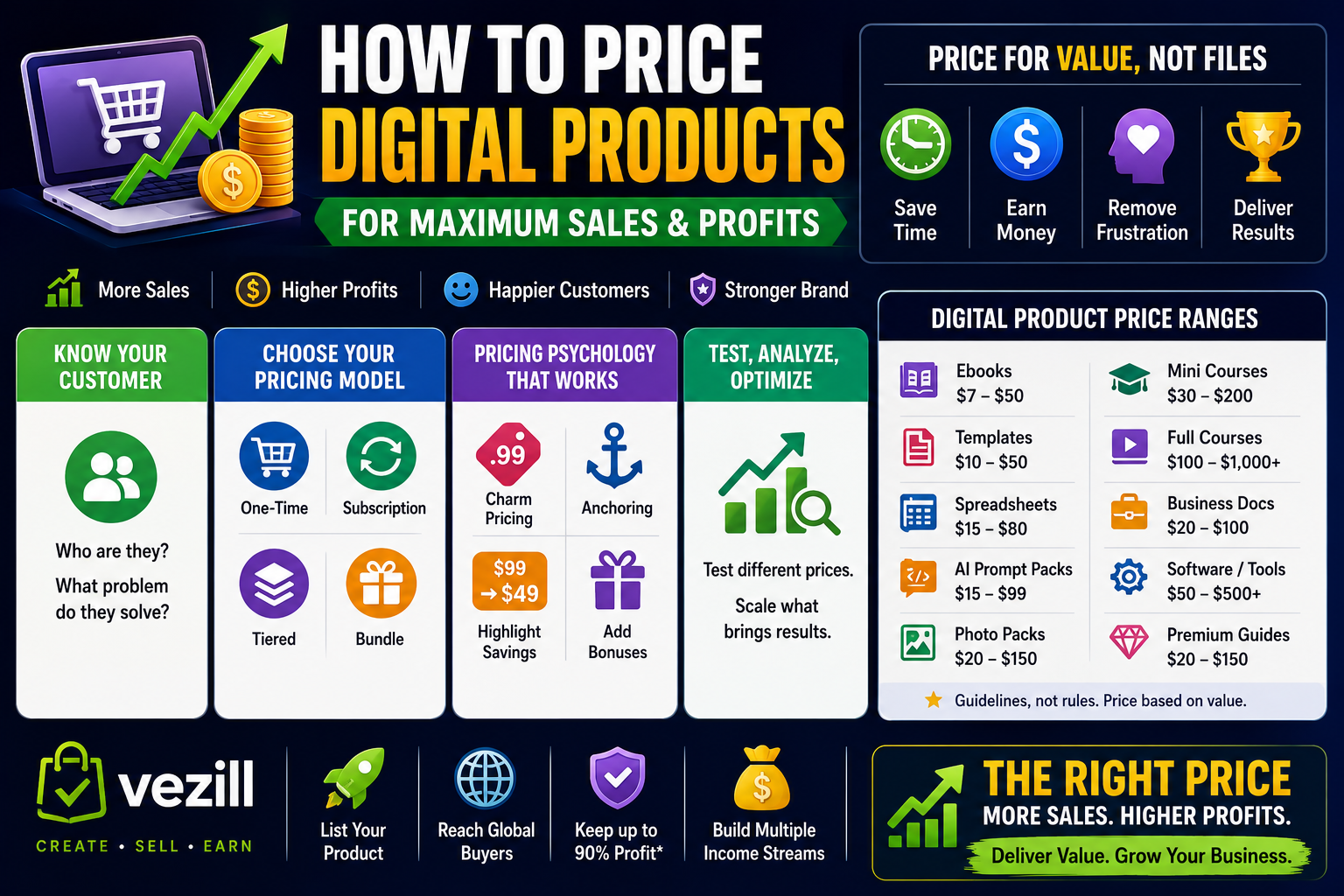
Price according to the value of the transformation -not the number of pages, videos, or files.
Ask yourself:
People buy results.
Not PDFs.
Understand Your Customer Before Setting a Price
Before pricing, answer these questions.
Who is buying?
Examples:
Each audience has different purchasing power.
What problem are they solving?
Someone buying:
is solving a different problem than someone buying coloring pages.
Higher-value problems justify higher prices.
Research the Market
Search for products similar to yours on marketplaces.
Compare:
You're not looking for the cheapest price.
You're identifying where customers already expect to pay.
Choose the Right Pricing Model
1. One-Time Purchase
Best for:
Simple and easy for beginners.
2. Subscription
Best for:
Creates recurring income.
3. Tiered Pricing
Offer multiple versions.
Example:
Starter – $9
Professional – $29
Business – $79
Customers can choose based on their needs.
4. Bundle Pricing
Instead of:
Bundle everything for:
$39
Bundles increase average order value while giving customers a better deal.
Use Value-Based Pricing
Instead of asking:
"How much is this worth to me?"
Ask:
"What is this worth to the customer?"
For example:
An ebook that helps someone earn $1,000 should not be priced at $3 simply because it's only 40 pages.
Value determines price.
Common Digital Product Price Ranges
|
Product |
Typical Price |
|
Printables |
$3–15 |
|
Coloring Books |
$5–20 |
|
Templates |
$10–50 |
|
AI Prompt Packs |
$15–99 |
|
Resume Templates |
$10–40 |
|
Spreadsheet Templates |
$15–80 |
|
Business Documents |
$20–100 |
|
Stock Photo Packs |
$20–150 |
|
Digital Planners |
$10–50 |
|
Online Mini Courses |
$30–200 |
|
Full Online Courses |
$100–1,000+ |
|
Ebooks |
$7–50 |
|
Premium Guides |
$20–150 |
|
Software |
$50–500+ |
These are guidelines, not fixed rules. Exceptional products that solve expensive problems can command much higher prices.
Pricing Psychology That Increases Sales
Use Charm Pricing
Instead of:
$20
Use:
$19.99
Instead of:
$100
Use:
$97
Customers perceive these prices as noticeably lower.
Use Anchoring
Offer:
Basic – $19
Pro – $49
Premium – $99
Most buyers choose the middle option because it appears to offer the best value.
Highlight Savings
Instead of:
Price: $49
Say:
Regular Price: $99
Today: $49
This creates a stronger perception of value when the discount is genuine.
Add Bonuses Instead of Cutting Price
Rather than reducing your price from $49 to $29, keep the price and include:
Customers often value added bonuses more than discounts.
Test Different Prices
Pricing is never permanent.
Try:
Track:
Sometimes increasing the price leads to higher profits because customers perceive the product as more valuable.
Don't Compete Only on Price
If your only advantage is being cheaper, someone else can always undercut you.
Instead, compete on:
This allows you to charge premium prices while building customer loyalty.
Increase Perceived Value
Customers are willing to pay more when they clearly understand the benefits.
Improve your product by adding:
Perceived value often has a greater impact on sales than lowering the price.
Should You Offer Discounts?
Yes, but strategically.
Good times include:
Avoid running continuous discounts, as they can reduce trust and train customers to wait for lower prices.
Pricing Products with Master Resell Rights (MRR)
If you're selling products with Master Resell Rights (MRR), pricing becomes even more important.
Consider:
Many successful sellers increase profits by creating value-added bundles that combine MRR products with their own checklists, templates, tutorials, or support, giving buyers a compelling reason to purchase from them.
Why Vezill Makes Pricing Easier
One challenge many creators face is figuring out where to sell digital products while maintaining profitable pricing.
Vezill simplifies this by giving creators and resellers a marketplace where they can:
This flexibility allows creators to test different pricing strategies, create bundles, and optimize their listings based on real customer demand.
Frequently Asked Questions
What is the best price for an ebook?
Most ebooks sell well between $7 and $50, while premium guides with practical resources, templates, or exclusive insights can justify higher prices.
Should I start with a low price?
A launch discount can help attract early customers, but don't undervalue a product that delivers meaningful results. Your long-term price should reflect the value it provides.
Can I increase my prices later?
Absolutely. As your reputation grows, you add new content, or demand increases, gradually raising prices is a common and effective strategy.
Are expensive digital products harder to sell?
Not necessarily. Products that solve valuable problems, save significant time, or help customers generate income often sell well at premium prices when the value is clearly communicated.
Should I bundle products?
Yes. Bundling complementary digital products often increases perceived value, boosts average order value, and improves overall profitability.
Final Thoughts
Pricing digital products is both a science and an ongoing optimization process. The goal isn't simply to choose a number- it's to align your price with the value your product delivers, the expectations of your audience, and your long-term business strategy.
Research your market, understand your customers, communicate the transformation your product provides, and test different price points using real sales data. Small pricing adjustments can have a significant impact on both conversion rates and total revenue.
Remember, successful digital businesses don't win by being the cheapest. They win by offering the best combination of value, trust, quality, and customer experience.
If you're creating or reselling digital products, apply these pricing principles consistently, measure the results, and refine your approach over time. The right pricing strategy can turn an ordinary product into a profitable digital asset that generates income for years.
Discover more articles you might be interested in

Digital Products Market 2026–2030: Is It Worth Investing In? Global Data, Trends & Opportunities

By Super Admin
Learn how to turn your YouTube videos into profitable digital products such as ebooks, courses, guides, templates, checklists and prompt packs using AI.
By Super Admin

Discover 100 high-demand digital product topics for ebooks, PDF guides, online courses, AI prompt packs, apps, audio products and video tutorials.
By Super Admin

Discover why Vezill is one of the best free platforms to host and sell digital products worldwide
By Super Admin
Get the updates, on newly released, popular & fast-moving MRR digital products
Up to Top
Comments All
Brenda
@brenda
Pricing digital products can be tricky, so I found the tips here really helpful. I like how it explains finding a price that works for both you and the customer.
September 10,2026 At 10:24 PM
Laurence
@laurence
Pricing digital products can be surprisingly difficult, so I like the focus on finding the balance between customer value and profit. Charging too little can be just as problematic as charging too much.
September 05,2026 At 02:16 PM
Gilbert
@gilbert
I like the point that pricing should be based on the value a product provides, not just how much time it took to create. That’s an easy mistake to make with digital products.
September 01,2026 At 03:14 PM