
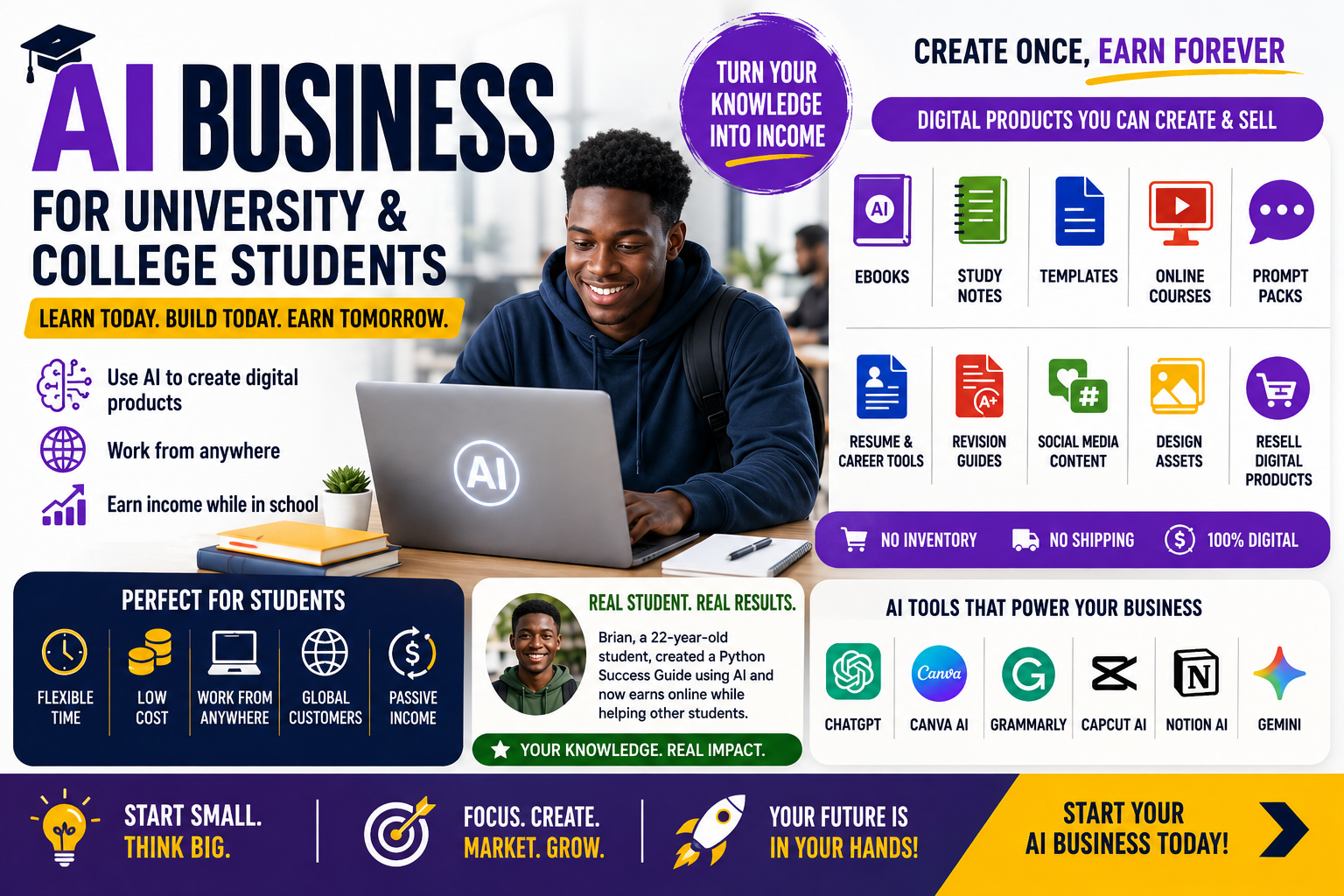
Artificial Intelligence (AI) has transformed entrepreneurship, making it easier than ever for university and college students to start businesses with minimal capital. Instead of waiting until graduation to find employment, students can now leverage AI tools to create digital products, offer online services, automate workflows, and generate income from anywhere.
One of the fastest-growing opportunities is creating and selling digital products. Unlike physical businesses, digital products require no inventory, can be sold repeatedly, and can generate passive income for years.
Whether you are studying Engineering, Business, ICT, Education, Agriculture, Medicine, or Arts, AI can help you turn your knowledge into valuable products that people are willing to buy.
Students have several advantages when starting an AI-powered business:
Flexible working hours
Low startup costs
Can operate from a laptop or smartphone
No need for office space
Easy to scale globally
Can generate passive income
AI significantly reduces the time required to create products
Instead of trading time for money, students can build digital assets that continue earning even during lectures, holidays, internships, or after graduation.
An AI business uses Artificial Intelligence tools to research, create, market, automate, or sell products and services.
Examples include:
AI-generated eBooks
AI-powered online courses
Prompt packs
Business templates
Resume templates
Social media content packs
Study notes
Revision guides
Printable planners
AI consulting services
AI tutoring
Digital design assets
Digital products have become one of the most profitable online business models because they can be created once and sold unlimited times.
Benefits include:
No manufacturing costs
No shipping
High profit margins
Global customers
Passive income
Easy updates
AI speeds up production dramatically
Many successful student entrepreneurs begin by selling a single digital product before expanding into a complete online business.
Use AI to organize class notes into premium revision materials.
Examples:
Nursing revision notes
Engineering formula sheets
CPA revision summaries
Computer programming cheat sheets
Students from other institutions often pay for well-organized notes that save them study time.
Create educational or practical eBooks using AI.
Popular topics include:
How to Pass KCSE
CV Writing
AI for Beginners
Personal Finance
Side Hustles
Farming
Healthy Living
Business Ideas
Programming
Graphic Design
Businesses and professionals increasingly search for ready-made AI prompts.
Examples:
ChatGPT prompts for teachers
Marketing prompts
Business prompts
Content creation prompts
Research prompts
Coding prompts
These require minimal maintenance after creation.
AI makes course creation significantly easier.
You can create courses on:
Excel
Graphic Design
Coding
AI Skills
Photography
Public Speaking
Personal Branding
Digital Marketing
Examples include:
Budget planners
Meal planners
Student planners
Assignment trackers
Timetables
Goal planners
These are popular because customers can download and print them instantly.
Students and graduates constantly need:
CV templates
Cover letters
Interview preparation guides
LinkedIn optimization guides
Portfolio templates
Create comprehensive revision materials for:
KCSE
TVET
University units
CPA
ACCA
Nursing
Engineering
ICT certifications
Use AI to:
Explain difficult concepts
Generate quizzes
Create assignments
Build revision schedules
Students can package these into tutoring services or learning resources.
Businesses purchase ready-made:
Instagram posts
Facebook content
TikTok scripts
YouTube titles
Content calendars
AI dramatically reduces production time.
Instead of creating products from scratch, students can legally resell digital products that include resale rights or Master Resell Rights (MRR), allowing them to focus on marketing and customer acquisition.
|
Tool |
Purpose |
|
ChatGPT |
Research, writing, brainstorming |
|
Canva AI |
Design eBooks, planners, social media graphics |
|
Grammarly |
Editing and proofreading |
|
CapCut AI |
Video editing |
|
Gamma |
Presentations |
|
Notion AI |
Productivity |
|
Claude |
Long-form writing |
|
Perplexity |
AI research |
|
Google Gemini |
Research and content generation |
Brian is a 22-year-old third-year Computer Science student at a university in Kenya.
Like many students, he struggled to cover expenses such as internet bundles, meals, transport, and printing assignments. Taking on a part-time job meant sacrificing valuable study time.
Instead, Brian decided to build an AI-powered digital product business.
He noticed that first-year Computer Science students frequently asked for help with:
Python programming
SQL databases
Data structures
Exam revision
Practical assignments
He realized many students wanted concise, practical study resources.
Brian used ChatGPT to draft explanations, practice questions, and coding exercises. He then refined the material with his own knowledge to ensure accuracy and aligned it with his university curriculum.
Next, he used Canva AI to design a polished PDF guide titled:
"Python Programming Success Guide for First-Year University Students."
The guide included:
Beginner-friendly explanations
Sample programs
Common errors and fixes
Practice exercises
Mock examination questions
Quick-reference cheat sheets
Brian uploaded the guide to a digital marketplace that supports downloadable products and also promoted it through:
Student WhatsApp groups
University clubs
TikTok
He also created short videos demonstrating Python tips, with links directing viewers to his guide.
Encouraged by positive feedback, Brian expanded his catalog to include:
SQL Revision Guide
Data Structures Workbook
Git & GitHub Quick Guide
Final-Year Project Proposal Template
Internship Interview Preparation Kit
Instead of relying on one product, he built a growing library of resources.
Within several months, Brian had earned enough to comfortably pay for internet, transport, software subscriptions, and some tuition-related expenses. More importantly, he developed practical skills in AI, content creation, digital marketing, and online entrepreneurship—experience that strengthened both his income and his career prospects.
This example illustrates how a student can transform subject knowledge into reusable digital assets. Individual results will vary depending on product quality, marketing effort, demand, and consistency.
Successful student AI entrepreneurs typically:
Solve real problems
Focus on one niche
Learn prompt engineering
Build a personal brand
Publish consistently
Collect customer reviews
Improve products continuously
Learn SEO and AI search optimization
Use social media for free marketing
Build an email list
Avoid these common pitfalls:
Copying AI output without reviewing it
Ignoring customer needs
Trying to sell too many unrelated products
Poor product design
Weak product descriptions
No marketing strategy
Giving up too early
Publishing inaccurate or outdated information
Yes. Many successful AI businesses rely on no-code tools for writing, design, video creation, and marketing.
Many students start with a laptop or smartphone, an internet connection, and free AI tools. As revenue grows, they often upgrade to paid tools that improve efficiency.
Popular categories include:
Study guides
eBooks
Templates
AI prompt packs
Online courses
Career resources
Business tools
Printable planners
Yes. Some student founders continue growing their digital product businesses after graduation, while others use the experience to secure jobs or freelance opportunities. Success depends on the value of the products, effective marketing, and ongoing improvement.
AI has dramatically lowered the barriers to entrepreneurship for university and college students. With the right tools, students can transform their academic knowledge, hobbies, or professional interests into digital products that serve customers around the world.
Creating and selling digital products is one of the most scalable AI business models because it combines low startup costs, global reach, and the potential for recurring income. By identifying real problems, using AI responsibly to accelerate creation, and consistently marketing high-quality solutions, students can build a business that supports them during their studies and provides valuable entrepreneurial experience for the future.
Discover more articles you might be interested in

Learn how to make your first £1,000 selling digital products online.

By Super Admin
Discover the best online businesses for teachers
By Super Admin

Passive Income in 2026: The Complete Beginner's Guide to Building Passive Income with AI and Digital Products
By Super Admin

Best platforms for digital products and make money online in Kenya and Globally
By Super Admin
Get the updates, on newly released, popular & fast-moving MRR digital products
Up to Top
Comments All
Keisy
@keisy
I like that it shows students can use AI to start small businesses while still in school. Some of the ideas are actually practical and gave me a few things to think about. Definitely a useful read for students looking to earn on the side. 😊
September 09,2026 At 10:26 PM
Faith
@faith
This is a good one for students who want to make some money without waiting until graduation. I liked the idea of using AI to offer simple services that businesses already need. It actually made me think about a few small things I could start doing alongside school.
August 28,2026 At 02:27 PM
Erick
@erick
I'm pleased to find you and hope to work together in this job
August 27,2026 At 11:13 PM